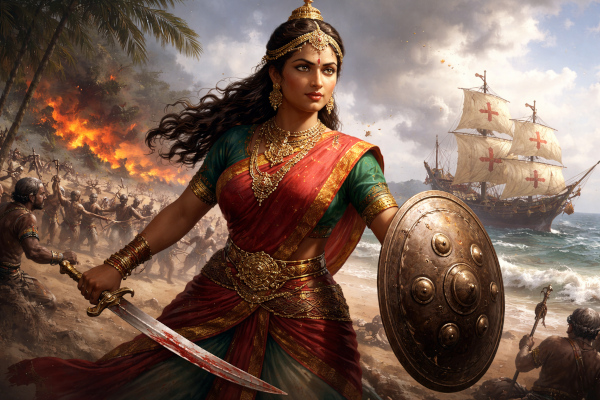
Rani Abbakka Chowta stands among the most remarkable women in Indian history: a 16th-century queen of coastal Karnataka who turned a small maritime kingdom into a stubborn center of resistance against Portuguese expansion on the west coast. She ruled Ullal in Tulu Nadu, near present-day Mangaluru, and belonged to the Chowta dynasty, a ruling house linked to the wider political world of coastal Karnataka and the Vijayanagara era. She is remembered in regional memory as Abhaya Rani, the fearless queen, because she repeatedly resisted Portuguese attacks at a time when European naval powers were trying to dominate Indian Ocean trade.
The first thing to say clearly is that some personal details about Abbakka are uncertain. Her life is historically real, but the surviving record is patchy, and later folklore has merged with documented history. Her exact birth year is not firmly established in the available sources. Many modern summaries place her life broadly in the 16th century and some give her reign as beginning around 1525, but this should be treated as an approximate historical frame rather than a fully secure birth-and-accession chronology. Her parentage is also not clearly documented in the way it is for some better-recorded medieval rulers. What appears more consistently in the available tradition is that she was born into the Chowta royal family and was closely associated with Tirumala Raya Chowta, who is described in some accounts as the ruler of Ullal and as the senior royal figure who trained and elevated her.
Her lineage is one of the most important keys to understanding her rise. The Chowtas were rulers in Tulu Nadu, the coastal belt of present-day Karnataka. Their political culture followed the Aliyasantana system, a matrilineal mode of inheritance that was well known in the region. This matters because Abbakka did not emerge as an exception in defiance of every local custom; she emerged from a political tradition that could accommodate female authority through matrilineal succession. She is also widely described as belonging to a Jain royal house, though she ruled over a socially mixed and commercially active coast with Hindu, Jain, Muslim, and maritime communities participating in the life of the kingdom.
Abbakka’s upbringing, as preserved in tradition, was that of a ruler being prepared for power. She is said to have been trained in warfare, military strategy, and administration from a young age. That preparation becomes easier to understand when one remembers where Ullal stood. This was not an isolated inland chiefdom. Ullal sat on a commercially valuable coastline connected to the Arabian Sea trade, close to Mangaluru, where control over ports, shipping, customs, and alliances could translate into real power. A queen ruling there had to understand not only land warfare but also coastal defense, commerce, and diplomacy.
Many accounts say she was married to Lakshmappa Arasa of the Banga line, another ruling house of the region. The match appears to have been intended as a strategic union, but later traditions describe relations becoming strained and, in some versions, her husband drifting toward the Portuguese side. The exact details of that marital-political rupture are harder to pin down with certainty, yet the broader point is clear: Abbakka ruled in a world where local dynasties, merchant interests, and foreign naval power were all entangled.
Abbakka’s notable contribution lies above all in her resistance to Portuguese control of the west coast. The Portuguese were not merely traders. They were building a coercive maritime empire, demanding tribute, trying to regulate shipping, and using naval force to subordinate local ports. Ullal’s refusal to submit made it a target. Abbakka did not accept Portuguese suzerainty, and she appears to have built alliances across communities and regions to sustain that defiance. Accounts consistently connect her with cooperation from Arab traders, support from local seafaring groups, and ties with the Zamorin of Calicut, another long-standing opponent of Portuguese dominance.
Her wars with the Portuguese are the reason she entered legend. Sources commonly describe major confrontations in the 1550s and 1560s, including a notable Portuguese attack under Dom Álvaro da Silveira and later assaults under the Estado da Índia. One of the most famous episodes comes from 1567, when Portuguese forces attacked Ullal and briefly occupied it. According to the account preserved by IGNCA, Abbakka escaped, took shelter, regrouped her supporters, and launched a sudden night counterattack. In that fighting, the Portuguese commander João Peixoto was killed, and the attackers suffered heavy losses. Whether every battlefield detail survives with perfect precision is difficult to establish, but there is broad agreement across the available material that she repeatedly beat back Portuguese offensives and turned Ullal into one of the most troublesome pockets of resistance on the coast.
What made her effective was not simply courage. It was military ingenuity suited to coastal warfare. Abbakka fought a stronger naval power by using local geography, speed, alliances, and community support. Tradition also associates her forces with the use of fire-arrows and sudden strikes. Her resistance seems to have drawn strength from the fishing and maritime communities of the coast, as well as from a broader anti-Portuguese political network. In other words, she did not fight like an isolated queen defending a palace. She fought like a ruler who understood that control of the littoral was political, commercial, and military all at once.
Her rule also appears to have had a wider administrative dimension. Modern summaries credit her with strengthening Ullal’s trading role and maintaining ties across religious and social lines. This is plausible in the context of the west coast, where commerce linked local rulers with merchants from Arabia and the wider Indian Ocean world. Even the memory of her has survived in a distinctly plural way: through folk songs, Yakshagana, local commemorations, and regional festivals, rather than through one single court chronicle. That itself says something about her legacy. She lived not only in royal history, but in popular memory.
The circumstances of her death are, again, not perfectly documented. The broad tradition says that after years of warfare and intrigue, Abbakka was eventually captured. Some accounts hold that she was betrayed; others emphasize only that she was taken prisoner after prolonged resistance. The recurring narrative is that even in captivity she remained defiant and died resisting rather than yielding. The exact sequence of her final days remains uncertain, but the historical tradition overwhelmingly remembers her as a queen who died in the course of resistance, not as one who accepted Portuguese dominance.
Rani Abbakka Chowta was not ruling a giant empire, yet she understood the stakes of foreign domination earlier than many larger powers did. She recognized that tribute could become subordination, that trade control could become political conquest, and that a coastal kingdom could fight back through intelligence, alliances, and audacity. Her memory survives because she represents something larger than regional pride. She stands as one of the earliest Indian rulers — and certainly one of the earliest women rulers — to wage sustained armed resistance against European colonial power on Indian soil.
Reference:
https://ignca.gov.in/abbakka-rani-the-unsung-warrior-queen/
https://ignca.gov.in/PDF_data/Abbakka_Rani.pdf
https://en.wikipedia.org/wiki/Abbakka_Chowta
You may also like
-
Sindhu: The Indus Kingdom of Jayadratha in the Mahabharata
-
Kuninda or Kulinda: The Himalayan Realm of the Mahabharata in Uttarakhand and Himachal Pradesh
-
Durga versus Mahishasura: Weapons, Battlefield Tactics and the Triumph of Shakti
-
Kuluta: The Kullu Valley Kingdom of the Mahabharata
-
Israel to Honour Indian Pilot Smit Machchhar with Highest Civilian Bravery Award for Saving Flydubai Flight
