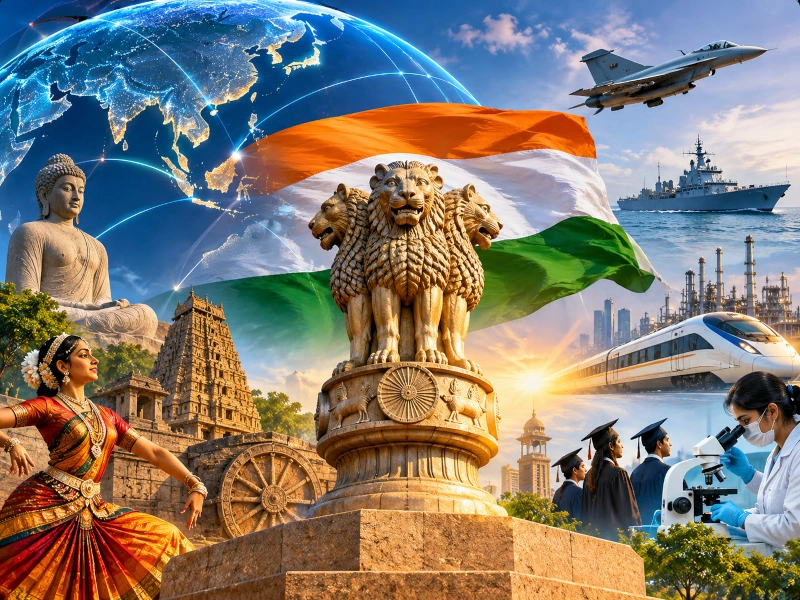
India has retained its position as the third-most powerful country in Asia in the 2026 edition of the Asia Power Index, published by the Australia-based Lowy Institute. India’s comprehensive power score increased by 0.5 points to 40.5 out of 100, consolidating its classification as a major power in the region. The findings, reported by DD India on 23 November 2026, highlight India’s expanding regional influence, strengthening defence relationships, cultural reach and long-term strategic potential.
India Consolidates Its Major Power Status
The Asia Power Index evaluates the capabilities and influence of 27 countries and territories across 131 indicators. Introduced in 2018, the annual assessment measures national power through eight broad categories: economic capability, military capability, resilience, future resources, economic relationships, defence networks, diplomatic influence and cultural influence.
India’s comprehensive score increased from 40.0 in 2025 to 40.5 in 2026, maintaining its position within the index’s major-power category. The improvement reflects gains across several dimensions of national capability and regional engagement, while the gap between India and China has narrowed to its lowest level since the index was introduced in 2018.
Expanding Defence Networks and Military Capabilities
India recorded a 2.1-point improvement in its defence networks score, supported by greater military engagement with regional partners and the expansion of defence exports. The Lowy Institute specifically identified BrahMos missile sales to Southeast Asia and increased regional defence cooperation as contributors to India’s growing strategic influence.
The country also registered a 0.5-point improvement in military capability. India’s expanding indigenous defence manufacturing ecosystem, international military engagements and growing participation in regional maritime security initiatives provide a broader context for these developments. Together, these capabilities offer India additional avenues for strengthening strategic partnerships across the Indo-Pacific.
Cultural Influence Records the Largest Improvement
Cultural influence emerged as India’s strongest area of improvement in the 2026 assessment, recording an increase of 2.3 points and reaching a score of 43.8. Cultural influence constitutes an important dimension of national power, reflecting a country’s ability to establish international connections and extend its influence beyond conventional economic and military instruments.
India’s civilisational heritage, global diaspora, cultural traditions, educational institutions and international cultural exchanges provide an extensive foundation for its soft power. These longstanding connections complement the country’s economic and diplomatic engagement, creating opportunities for sustained people-to-people cooperation across Asia and beyond.
Economic Relationships and Diplomatic Influence Remain Stable
The Lowy Institute noted that India maintained stable trade and investment relationships during a period in which the economic relationships of several other countries weakened. India also improved its relative position in the economic relationships category, advancing by two places despite its score remaining unchanged.
India’s diplomatic influence remained stable, with a score of 70.3. Although the country’s economic capability score declined by 0.7 points, its overall improvement demonstrates that regional influence is shaped by a combination of economic resources, international partnerships, military capabilities and cultural engagement rather than economic performance alone.
Future Resources Strengthen India’s Long-Term Strategic Potential
India recorded a 1.2-point improvement in the future resources category, which represents its strongest area of relative advantage in the index. This category assesses the resources and capabilities that countries can potentially draw upon to sustain and expand their influence over the coming decades.
India’s demographic resources, expanding industrial ecosystem, technological development and growing scientific capabilities provide an important foundation for its long-term national potential. Continued investment in infrastructure, education, research, advanced manufacturing and human capital can help translate these resources into greater economic and strategic capabilities.
India’s Expanding Role in the Indo-Pacific
The 2026 Asia Power Index highlights the increasingly multidimensional nature of India’s regional engagement. Its expanding defence partnerships, stable economic relationships, diplomatic presence and growing cultural influence provide complementary avenues for strengthening cooperation with countries across Asia.
India’s consolidated major-power status reflects the importance of developing domestic capabilities alongside sustained international engagement. Continued progress in indigenous manufacturing, technological innovation, economic development and regional partnerships offers India a strong foundation for contributing to a stable, prosperous and interconnected Indo-Pacific.
References
- Lowy Institute — Asia Power Index 2026: India Country Assessment.
https://power.lowyinstitute.org/countries/india/ - Lowy Institute — Asia Power Index 2026: Comprehensive Power Assessment.
https://power.lowyinstitute.org/power-index/ - DD India — India Retains Third Spot in Lowy’s Asia Power Index 2026, 23 November 2026.
https://ddindia.co.in/2026/11/india-retains-third-spot-in-lowys-asia-power-index-2026-pm-modi-ranked-most-effective-regional-leader/
You may also like
-
DRDO and Singapore Explore Quantum and Underwater Technology Cooperation
-
India and Nepal Sign Eight Cooperation Agreements
-
India and Netherlands Seek Deeper Defence and Technology Cooperation
-
Rāma’s Counsel to Bharata: Governance, Intelligence and the Responsibilities of Kingship
-
Arunachal Pradesh Gets New NDRF Battalion Campus to Strengthen Disaster Response
