Rajnath Singh called for stronger defence industrial collaboration between India and Germany during his address to German parliamentarians in Berlin on April 21, 2026. Emphasising the vision of Aatmanirbhar Bharat, he described it not just as a procurement initiative but as an open invitation for global partners to co-create, co-develop, and co-innovate to tackle emerging security challenges.
Speaking to the German Parliamentary Standing Committee on Defence and Security, Singh highlighted the increasingly complex global security landscape shaped by rapid technological advancements. He stressed that coordinated responses, trusted strategic partnerships, and adaptability are essential in addressing modern threats.
Referring to India’s defence transformation under Prime Minister Narendra Modi, Singh noted that deeper engagement with German industries could yield mutual benefits. He praised Germany’s strong industrial base and its “Mittelstand” ecosystem, while also pointing to India’s growing network of startups and private enterprises that are strengthening the country’s defence capabilities. He said the complementary strengths of both nations offer significant scope for expanded cooperation.
Singh also underlined the importance of strengthening strategic ties at both bilateral and broader levels, including the India–EU partnership. He mentioned that German Chancellor Friedrich Merz and Prime Minister Modi share a common vision to advance this relationship, which is gaining momentum within the European Union framework.
Describing India and Germany as key democratic voices on the global stage, Singh said both countries share common values and economic resilience. He expressed confidence that their partnership would continue to grow as a model of long-term, stable cooperation shaped by mutual trust rather than immediate crises.
Addressing global geopolitical tensions, Singh pointed out that current conflicts have far-reaching implications beyond regional boundaries, affecting energy supplies, food security, and economic stability. He specifically highlighted India’s dependence on West Asia for energy and warned that disruptions in the Strait of Hormuz pose direct challenges to the country’s security and economy.
He noted that India has adopted a proactive and coordinated approach to such challenges. A dedicated Group of Ministers is continuously monitoring developments in West Asia, focusing on ensuring energy security, maintaining essential supplies, controlling inflation, and safeguarding citizens and industries. This, he said, reflects India’s ability to respond to global crises with calmness, foresight, and effective institutional coordination.
During the visit, Singh was received by German parliamentarian Thomas Roewekamp. He also paid tribute to Rabindranath Tagore at Humboldt University of Berlin, highlighting the deep cultural ties between the two nations. Tagore’s engagement with Germany in the early 20th century played a significant role in promoting his work across Europe.
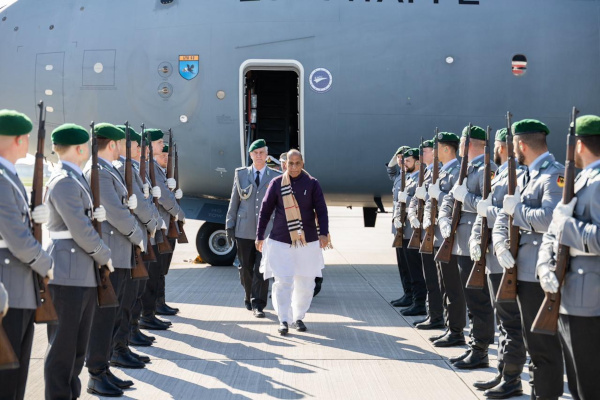
Singh was accorded a ceremonial welcome upon arrival in Berlin and travelled from Munich aboard a special German Air Force aircraft, escorted by fighter jets, marking the significance of his official visit.
Reference: PIB
You may also like
-
Indian Startup Decouvertes Unveils Vision Nano 250g Drone with 25-Minute Flight Endurance
-
India and UK Strengthen Cooperation in Space, Nuclear Energy and Emerging Technologies
-
India and UK Target Doubling Bilateral Trade by 2030 as CETA Opens New Opportunities
-
Exercise Tarang Shakti 2026 Concludes in Jodhpur, Showcasing India’s Air Power, Indigenous Defence Technology
-
US Double Standards in Foreign Policy: 16 Recent Cases Involving India, Russia, China and Global Trade
