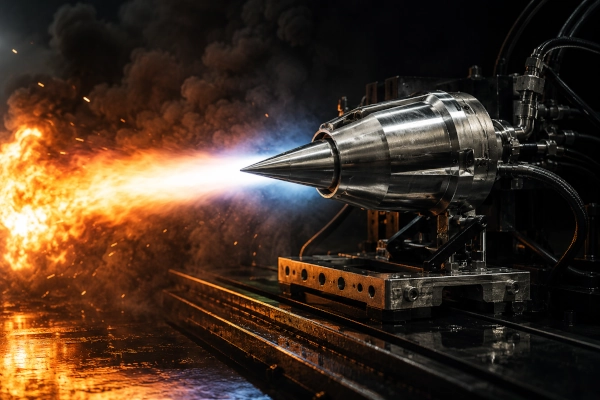
India’s private aerospace propulsion sector has recorded another notable technology milestone, with Bengaluru-based Prime Toolings announcing the successful development and testing of an indigenous Rotating Detonation Engine, or RDE. The company says the propulsion system has now achieved Technology Readiness Level 5, taking the project beyond an early laboratory proof-of-concept towards validation of integrated hardware under more representative test conditions.
Prime Toolings announced the achievement through its official social-media channels, including the company’s Instagram account, stating that its Rotating Detonation Engine had successfully completed development and testing and had reached TRL-5. The company has subsequently released additional glimpses of the engine’s internal configuration and indicated that further technical information from the development programme will be made public.
The milestone is significant because rotating detonation propulsion represents one of the most actively researched areas of advanced aerospace propulsion worldwide. Unlike conventional rocket or jet combustors, which normally burn their fuel through relatively slow subsonic combustion known as deflagration, an RDE sustains one or more supersonic detonation waves travelling continuously around an annular combustion chamber.
The rapid detonation process simultaneously compresses and burns the propellant mixture, creating what is known as pressure-gain combustion. The concept potentially allows an engine to extract greater useful energy from the same quantity of propellant while reducing the size and complexity of the combustion system.
The US Air Force Research Laboratory describes rotating detonation engines as potentially more compact and efficient propulsion systems capable of delivering high performance from relatively small combustion volumes. AFRL is investigating RDE technology for applications ranging from air-to-air and air-to-ground weapons to high-speed propulsion systems.
Prime Toolings Moves RDE Programme to TRL-5
Prime Toolings says its latest testing has taken the indigenous RDE programme to TRL-5. Under the widely used Technology Readiness Level framework, Level 5 generally corresponds to the validation of components or breadboard-level hardware in a relevant environment, representing a substantial progression from basic laboratory demonstration. It does not, however, mean that an engine is ready for operational deployment or flight qualification. Those stages correspond to considerably higher readiness levels.
The company’s TRL-5 announcement should therefore be viewed as an important intermediate development milestone rather than the completion of the propulsion programme.
Prime Toolings has also clarified that the hardware recently shown publicly included a pre-detonator test and fully assembled feasibility configuration. The company says the project is entirely self-funded and is ultimately aiming at a 5-kN-class thrust level.
Significantly, Prime Toolings has also stated that the presently demonstrated configuration is not an air-breathing engine. This distinction is important because rotating-detonation technology can be incorporated into several very different propulsion architectures, including rocket engines, ramjet-type systems and turbine engines.
The company’s own website lists rotating detonation propulsion alongside solid, liquid, hybrid, chemical, air-breathing and supersonic combustion systems among the aerospace propulsion technologies on which it is working.
Is It a 3 kN Engine?
Reports accompanying Prime Toolings’ announcement have described the current engine as producing approximately 2.8 to 3.0 kN of thrust, or roughly 300 kgf. The same reported specifications list a chamber pressure of around 33 bar, an engine mass of approximately 7.8 kg, kerosene and oxygen as propellants, and a specific impulse in the region of 280 to 293 seconds.
These figures are technically interesting, but they require an important qualification. Prime Toolings has not yet publicly released a detailed certified test report containing the full thrust-time curve, chamber-pressure history, detonation-wave measurements or independently validated performance results.
The company itself has indicated that official performance data will be released subsequently and has stated that it is aiming for a 5-kN-class configuration. Consequently, the confirmed milestone at present is that Prime Toolings has developed and tested an RDE and claims TRL-5 maturity. The reported 2.8–3.0 kN thrust figure should continue to be described as company-attributed or reported performance until detailed test data become available.
That distinction does not diminish the importance of the test. Establishing stable rotating detonation is itself technically demanding because engineers must control fuel and oxidiser injection while maintaining a continuously propagating detonation wave inside a compact combustion chamber.
How a Rotating Detonation Engine Works
A conventional rocket combustion chamber injects fuel and oxidiser and burns them through deflagration. Pressure produced by this combustion drives hot gases through a nozzle, creating thrust.
An RDE approaches combustion differently. Fuel and oxidiser enter an annular chamber, where one or more detonation waves travel continuously around the circumference at supersonic velocities. Fresh propellant enters behind the passing wave, after which another travelling detonation consumes it.
According to AFRL, rotating detonation can provide intense heat release in a very compact volume while increasing pressure and potentially improving thermodynamic-cycle efficiency without requiring mechanically complicated rotating machinery inside the combustor.
Rotating detonation rocket engines are particularly attractive because conventional chemical rocket propulsion has traditionally relied on constant-pressure combustion. Detonation-driven combustion provides a fundamentally different thermodynamic process in which the shock wave and reaction zone are closely coupled.
AFRL notes that rotating detonation waves in rocket propellants can travel at more than two kilometres per second, while the compact reaction zone can reduce combustor length and mass.
NASA research has similarly examined the potential for RDE propulsion to increase specific impulse. One NASA-sponsored investigation estimated that suitable rotating detonation configurations could potentially provide 10–15 per cent higher specific impulse than conventional rocket-engine architectures, although actual gains depend heavily on engine design, propellant choice, injection losses and nozzle configuration.
Why RDE Technology Is Difficult
The apparent mechanical simplicity of an RDE can be misleading. Sustaining a controlled detonation wave over meaningful operating periods creates demanding thermal, structural and combustion-engineering problems.
Fuel and oxidiser must mix rapidly and uniformly enough to sustain the detonation. Injection systems must continue feeding propellant despite violent pressure oscillations inside the chamber. Engineers must also prevent combustion products from flowing backwards into the feed system.
Thermal management is another major obstacle. The detonation front produces extremely high transient temperatures and pressures, exposing the combustion chamber to severe cyclic thermal and mechanical loads.
NASA research has identified propellant mixing, pressure losses, backflow prevention and chamber durability among the important technical challenges facing rotating detonation propulsion.
Prime Toolings’ progress therefore involves considerably more than simply producing a visible flame from an experimental combustor. Progression towards a useful RDE requires repeatable ignition, sustained detonation propagation, controlled pressure behaviour, adequate cooling, structural durability and predictable thrust.
Engineering activity connected with Prime Toolings’ programme has also included work on thermal gradients, material limits, cooling arrangements and combustion instability, according to publicly available descriptions from personnel associated with the project.
Aerospike Integration Could Be Particularly Interesting
One of the more interesting aspects of the reported Prime Toolings configuration is its association with aerospike and truncated-aerospike nozzle concepts.
Aerospikes differ significantly from conventional bell-shaped rocket nozzles. Instead of expanding exhaust gases inside a fixed outer bell, an aerospike directs exhaust around a central surface, allowing the surrounding atmospheric pressure to influence expansion.
The concept can potentially provide improved performance across a wider range of altitudes because the exhaust plume can adapt more naturally to changing external pressure.
RDEs are particularly interesting candidates for aerospike integration because their annular combustion geometry can naturally complement certain aerospike configurations. AFRL specifically identifies annular RDE chamber designs as offering opportunities for aerospike integration, while NASA has separately investigated aerospike nozzles for rotating detonation propulsion.
If Prime Toolings continues developing this combination, the programme could eventually provide useful experimental data on the interaction between pressure-gain combustion and altitude-compensating nozzle architectures.
Potential Defence Applications
Rotating detonation propulsion has attracted substantial military interest because relatively compact engines could potentially provide greater range or payload within the same weapon dimensions.
For a missile constrained by an aircraft’s internal weapons bay or external hardpoint, propulsion volume is extremely valuable. If a more compact combustor can provide comparable or better performance, designers can potentially allocate additional internal volume to fuel, payload, sensors or other systems.
AFRL explicitly identifies air-to-air missiles, air-to-ground weapons and other high-speed systems among potential military applications of rotating detonation technology. It has also highlighted the possibility of achieving longer range within an existing weapon form factor.
This explains the wider interest in RDE development within India. A mature indigenous pressure-gain combustion capability could eventually contribute to future missile propulsion, high-speed strike systems, space propulsion and other applications where compactness and high propulsive efficiency are valuable.
It is nevertheless premature to associate the Prime Toolings engine with a specific operational missile or to conclude that the current demonstrator is already capable of powering a Mach 4 or Mach 5 weapon. Such applications would require substantial additional development, integration and flight testing beyond TRL-5.
India Joins a Global Race in Detonation Propulsion
Prime Toolings’ programme also needs to be viewed against rapidly expanding international work on rotating detonation engines.
The United States has invested extensively in the technology through AFRL, NASA, universities and private companies. NASA’s current Integrated Rotating Detonation Engine System, or InRoDES, programme is developing a liquid-oxygen/liquid-methane RDRE in the 5,000–10,000 pound-force thrust class.
NASA reported that one full-scale rotating-detonation combustor test produced more than 5,800 pounds of thrust for 251 seconds, while development is continuing towards a complete propulsion system for possible planetary-lander applications.
These international efforts demonstrate both the enormous potential of rotating-detonation propulsion and the distance between experimental ground testing and mature operational engines.
For India, the emergence of privately funded RDE programmes is therefore notable. It indicates that sophisticated propulsion research is gradually expanding beyond India’s traditional government laboratories and major aerospace organisations into specialised private engineering companies.
A Significant Step, With More Testing Ahead
Prime Toolings’ achievement should ultimately be assessed for what it represents today: an Indian private company says it has successfully built and tested an indigenous rotating detonation engine and advanced the technology to TRL-5 using a self-funded development programme.
That is a meaningful propulsion-development milestone.
At the same time, considerable work remains before such an engine could be considered flight-ready. Longer-duration firings, repeatability testing, thermal validation, thrust characterisation, vibration studies, feed-system optimisation, altitude testing and eventually integration with a representative vehicle would all contribute to progressively raising the technology’s readiness.
The next important development will therefore be the release of Prime Toolings’ promised official performance data. That information should provide a clearer picture of sustained thrust, specific impulse, chamber pressure, detonation stability and the configuration used during the TRL-5 test.
For now, however, the achievement demonstrates something broader about India’s changing aerospace industrial landscape. Advanced propulsion technologies such as aerospikes, rotating detonation engines and high-speed combustors, once confined largely to major government research establishments and a handful of global aerospace corporations, are increasingly being pursued by India’s emerging private propulsion ecosystem.
Prime Toolings’ successful RDE test adds another Indian programme to that increasingly important field and provides a foundation from which a larger, higher-thrust and eventually flight-capable rotating detonation propulsion system could emerge.
You may also like
-
Tata Advanced Systems Reportedly Considering LAMV 4×4 Production in Morocco
-
Indian Navy Initiates Communication Systems Upgrade for Kamorta-Class Anti-Submarine Warfare Corvettes
-
TDB Backs Panacea Medical Technologies to Develop Indigenous 32-Slice CT Scanner in Karnataka
-
India Reportedly Offers Mine-Protected Vehicles to Kenya to Strengthen Defence Cooperation
-
Sigma Advanced Systems and Munitions India Sign MoU for Indigenous 155mm Course-Correction Fuzes
