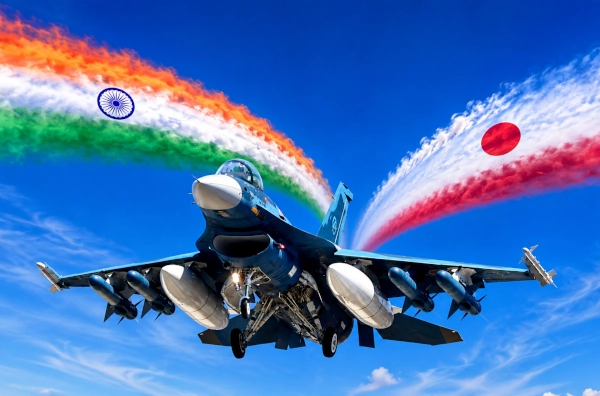
Japan is sending combat aircraft to India for the first time in the history of defence relations between the two countries, with three Mitsubishi F-2A fighters preparing to deploy to Rajasthan for the second edition of the bilateral Exercise Veer Guardian. The deployment represents a significant new stage in India-Japan air-power cooperation and will place Japanese fighter aircraft on Indian soil for an extended bilateral combat-training exercise for the first time.
The Japan Air Self-Defense Force officially announced on August 25, 2026 that Exercise Veer Guardian 26 will be conducted with the Indian Air Force from September 9 to September 21 at Air Force Station Jodhpur and the surrounding airspace in Rajasthan. Japan will deploy three F-2A fighters from its 8th Air Wing at Tsuiki Air Base, accompanied by approximately 110 personnel. The wider deployment and redeployment phase will run from September 1 to September 30.
According to the official Japanese announcement, the principal flying activity during Veer Guardian 26 will involve air combat manoeuvring. The stated objectives are to improve the tactical proficiency of participating units and deepen mutual understanding between the Japanese and Indian air forces.
The deployment has an importance extending well beyond the three aircraft involved. Japan has participated in military exercises in India before, but its fighter aircraft have never previously deployed to the country. During their August defence talks, Indian Defence Minister Rajnath Singh and Japanese Defence Minister Shinjiro Koizumi specifically welcomed the forthcoming visit of Japanese fighters as a milestone in bilateral defence cooperation. The two sides also agreed to progressively increase the complexity of their exercises, including through the integration of unmanned systems and more responsive joint training.
India Hosted Japan Only After an Earlier Indian Deployment to Japan
Veer Guardian was created as a dedicated fighter exercise between the two air forces, with its inaugural edition taking place in Japan in January 2023. On that occasion, India undertook the difficult long-range deployment.
The Indian Air Force sent four Su-30MKI fighters to Japan, supported by two C-17 Globemaster III strategic transports and an IL-78 aerial-refuelling aircraft. Japan fielded four F-2s and four F-15s. Over the course of the exercise, the two air forces conducted air-combat manoeuvring, interception and air-defence missions encompassing both visual-range and beyond-visual-range scenarios.
Veer Guardian 26 effectively reverses the direction of that deployment. Instead of Indian fighters travelling thousands of kilometres to Japan, Japanese combat aircraft will now operate from an Indian air base.
This reciprocal deployment is important because overseas fighter operations require considerably more than simply flying aircraft from one country to another. Fighters require maintenance crews, spare parts, mission-planning equipment, communications infrastructure, ground support and logistics. Demonstrating that an air force can sustain a combat-aircraft detachment thousands of kilometres from its home bases is therefore itself a useful measure of expeditionary capability.
Reports citing the Japanese air force indicate that the F-2As are expected to travel from Japan through Okinawa and Thailand before reaching India, with the United States providing support that includes aerial refuelling. The overall journey is roughly 5,600 kilometres, making the deployment a valuable opportunity for Japan to practise moving fighter aircraft and their supporting infrastructure across the Indo-Pacific.
The F-2A Is Far More Than a Japanese F-16
The aircraft coming to India will also be of considerable professional interest to the Indian Air Force. Although the Mitsubishi F-2 is often described simply as a Japanese version of the American F-16, the aircraft incorporates substantial structural, aerodynamic and electronic differences.
Japan and the United States jointly developed the F-2 to meet Japanese operational requirements, using the F-16 as the starting point. According to the Japanese air force, modifications included a larger wing area, increased use of advanced materials and structures, a higher-thrust engine configuration and advanced electronic systems.
The single-seat F-2A and two-seat F-2B have a wingspan of approximately 11.1 metres, a length of 15.5 metres and are powered by a single General Electric F110-GE-129 turbofan. Japan lists the aircraft’s maximum speed at approximately Mach 2. Its weapons repertoire includes a 20-mm cannon as well as radar-guided air-to-air missiles, infrared-guided air-to-air weapons and air-to-ship missiles.
The F-2 was designed with Japan’s particular geography in mind. As an island country surrounded by large maritime approaches, Japan has historically placed considerable emphasis on long-range maritime strike, air defence and the ability to engage hostile aircraft and naval targets before they approach Japanese territory.
These characteristics make the F-2 a particularly interesting platform for exercises with the Indian Air Force, which operates its own mix of heavy fighters, multirole combat aircraft and increasingly sophisticated airborne sensors and weapons.
Air Combat Training Offers Both Sides a Different Opponent
One of the principal benefits of bilateral fighter exercises is exposure to aircraft, tactics and operating philosophies that pilots do not routinely encounter within their own air forces.
For Japanese pilots, exercising against Indian combat aircraft offers experience against platforms and tactical methods outside the predominantly American-influenced ecosystem familiar to the Japanese force. India, in turn, gains exposure to Japanese tactics, mission planning and operational procedures developed around an air force that has spent decades preparing for high-intensity air defence operations in Northeast Asia.
The first Veer Guardian demonstrated the potential value of that interaction. During the 2023 exercise, Indian and Japanese crews progressed through complex simulated operational situations incorporating interception, air combat and air-defence missions.
The second edition at Jodhpur provides an opportunity to build on that foundation rather than starting again with basic familiarisation. The official Japanese description of air combat manoeuvring suggests that fighter-versus-fighter tactical training will remain at the centre of the programme.
The exact Indian aircraft participating in Veer Guardian 26 had not been identified in the Japanese August 25 announcement. It is therefore preferable not to assume the final Indian fighter composition until the Indian Air Force or Ministry of Defence releases its own exercise details.
Jodhpur Provides a Major Fighter-Training Environment
The choice of Air Force Station Jodhpur is also noteworthy. Rajasthan provides extensive airspace suitable for complex fighter training, while Jodhpur is an important Indian Air Force operating location with access to the large training areas of western India.
For Japanese pilots accustomed to operating primarily around the Japanese archipelago, flying missions over the very different terrain, climatic conditions and airspace of Rajasthan will provide useful exposure to an unfamiliar operating environment.
The deployment will also give maintenance and ground personnel experience sustaining F-2 operations in Indian conditions over an exercise lasting nearly two weeks. Such interaction at the technical and logistics level can be just as valuable as the airborne training because it builds familiarity between personnel who would have to work together during future multinational deployments.
Part of a Much Broader India-Japan Defence Expansion
Veer Guardian 26 is taking place as India and Japan expand defence cooperation across virtually every military domain.
During the August 2026 India-Japan defence ministerial meeting, the two sides highlighted established exercises including the Army’s Dharma Guardian and the naval JAIMEX series, while giving particular prominence to the forthcoming first visit of Japanese fighter aircraft to India.
India and Japan have also agreed to make future exercises more sophisticated rather than simply increasing their frequency. Their August joint statement specifically referred to enhanced complexity, the integration of unmanned systems and the possibility of conducting exercises at shorter notice when opportunities arise.
This reflects a defence relationship increasingly centred on operational interoperability rather than ceremonial exchanges.
Japan’s strategic outlook has changed significantly in response to the increasingly demanding security environment around the East China Sea and western Pacific. India, meanwhile, is expanding defence relationships throughout the Indo-Pacific while retaining strategic autonomy and strengthening its indigenous military capabilities.
For both countries, exercises such as Veer Guardian provide a practical mechanism for translating their growing strategic convergence into operational familiarity between their armed forces.
A Historic Deployment With Practical Military Value
The arrival of three F-2As may appear modest compared with the scale of major multinational exercises involving dozens of aircraft, but the historical importance of the deployment lies elsewhere.
For the first time, a Japanese fighter unit will travel thousands of kilometres from its home base and operate from India alongside the Indian Air Force. Three years earlier, Indian Su-30MKIs made the corresponding journey to Japan. The bilateral fighter relationship has therefore evolved from India demonstrating its long-range reach into Northeast Asia to both countries being capable of hosting and supporting each other’s combat-aircraft deployments.
That reciprocity is an important indicator of a maturing defence partnership.
Veer Guardian 26 will consequently serve several purposes simultaneously. At the tactical level, Indian and Japanese pilots will practise air combat against a foreign force employing different aircraft and operating methods. At the logistical level, Japan will demonstrate its capacity to deploy and sustain F-2As deep into the Indo-Pacific. At the strategic level, the exercise will provide another visible indication that defence relations between India and Japan are moving towards deeper and increasingly operational cooperation.
When the three F-2A fighters of Japan’s 8th Air Wing arrive at Jodhpur, their appearance on an Indian flight line will mark something that has never happened before in the history of the two countries’ military relationship. Veer Guardian 26 will therefore be remembered not merely as the second edition of another bilateral exercise, but as the occasion on which Japanese combat aircraft deployed to India for the first time.
You may also like
-
India Reportedly Offers Mine-Protected Vehicles to Kenya to Strengthen Defence Cooperation
-
Sigma Advanced Systems and Munitions India Sign MoU for Indigenous 155mm Course-Correction Fuzes
-
India and Russia Hold Seventh Strategic Security Dialogue on Pakistan and Afghanistan
-
Rolls-Royce and Reliance Advance Indigenous 120 kN AMCA Engine Plans with Focus on Indian Design and Manufacturing
-
Indian Coast Guard and Korea Coast Guard Strengthen Maritime Cooperation at 14th High-Level Meeting in Incheon
