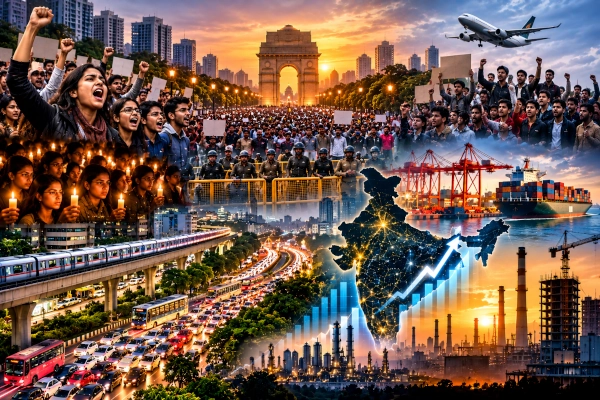
India’s emergence as one of the world’s fastest-growing major economies has increased the importance of political stability, reliable infrastructure and uninterrupted commercial activity. As the country expands its manufacturing capabilities, strengthens international trade relationships and attracts investment into strategic industries, prolonged political agitations, transport blockades, violent demonstrations and enforced shutdowns can impose substantial economic costs that extend far beyond the immediate locations of unrest.
India has experienced several such disruptions over the past two decades. The Telangana statehood agitation in 2011, Haryana’s Jat reservation protests in 2016, the Darjeeling shutdown in 2017, the unrest associated with the Citizenship (Amendment) Act in 2019, and successive farmers’ agitations have affected industrial production, transport networks, agricultural trade, tourism and commercial establishments. Industry associations have reported losses ranging from hundreds to thousands of crores of rupees during particularly disruptive episodes.
The consequences are not confined to the domestic economy. International buyers depend on Indian manufacturers to deliver products according to contractual schedules, foreign tourists make travel decisions based partly on perceptions of safety, and investors evaluate the reliability of local infrastructure before committing capital. When political confrontations repeatedly interrupt economic activity, the resulting uncertainty can influence India’s competitiveness in international markets.
The central economic question is not whether citizens have the right to protest, but how India can prevent political disagreements from developing into prolonged disruptions that damage employment, commercial activity, exports and investor confidence.
India’s Constitution protects peaceful assembly and political expression. These freedoms remain essential to democratic accountability. However, the economic consequences of violent unrest, coercive shutdowns and sustained blockades deserve careful examination, particularly when ordinary workers, small businesses and industries unrelated to the underlying political dispute bear substantial financial costs.
The Economic Cost of Political Agitations in India
Industry associations, government agencies and business organisations have periodically attempted to calculate the financial consequences of major protest movements. Their findings indicate that large-scale disruption can affect entire regional economies, particularly when demonstrations interrupt highways, railway networks, industrial clusters or commercial centres.
These figures require careful interpretation because they do not all measure the same economic activity. Some estimates include damage to public and private property, while others calculate interrupted production, reduced business turnover or potential losses arising from transportation restrictions. Daily projections also cannot be treated as audited losses throughout the duration of an agitation.
The following historical examples demonstrate the scale of economic disruption reported during major episodes of unrest in India.
Political Protests in India: Economic Losses, Export Disruptions and the Impact on Investor Confidence
Revised List: Major Political Protests That Disrupted New Delhi and Other Indian Economic Centres
The list should include the December 2012 Nirbhaya protests, the 2011 anti-corruption movement, the 2019–2020 anti-CAA demonstrations, the Shaheen Bagh sit-in, the farmers’ agitations and other movements that brought large gatherings to India’s capital.
However, their economic consequences differ considerably. Some resulted in extensive property destruction and industrial losses, while others principally affected traffic, public transport, security expenditure and local businesses. Several major demonstrations, including the Nirbhaya movement, had important social and institutional consequences without a reliably established monetary estimate of economic losses.
The revised chronology therefore distinguishes between documented financial estimates, reported commercial disruption and events for which no reliable loss figure is available.
Major Protests That Shook New Delhi and Other Parts of India: Revised Historical List
The revised list now includes the 2012 Nirbhaya protests, the 2011 Anna Hazare anti-corruption movement, the 2019–2020 Shaheen Bagh agitation, student and employment protests, and other demonstrations that significantly affected the national capital.
It also retains the major regional agitations from the original article, allowing readers to compare disruptions in Delhi with economic losses in India’s industrial, agricultural and tourism centres.
A. Major Protests That Affected India’s National Capital
| Year | Protest or agitation | Principal demands or grievances | Impact on Delhi and the economy | Reported financial losses |
|---|---|---|---|---|
| 2006 | Anti-reservation protests | Opposition to proposed expansion of OBC reservations in central educational institutions | Medical students and junior doctors participated in strikes and demonstrations. Hospital services and normal activity at some institutions were affected. | No reliable consolidated estimate |
| 2011 | Anna Hazare’s India Against Corruption movement | Stronger anti-corruption legislation and establishment of a Lokpal | Large gatherings at Jantar Mantar and Ramlila Maidan created traffic restrictions and additional public-order requirements. | No reliable consolidated estimate |
| December 2012 | Nirbhaya protests | Justice following the Delhi gang rape and stronger laws protecting women | Thousands gathered near India Gate and Raisina Hill. Police restrictions, road closures and Metro station shutdowns affected central Delhi. | No reliable consolidated estimate |
| 2015 | One Rank One Pension agitation | Implementation of OROP for military veterans | Prolonged demonstrations at Jantar Mantar attracted national attention and required security arrangements. | No reliable consolidated estimate |
| 2016 | JNU student protests | Disputes over sedition allegations, student rights and university administration | Demonstrations, marches and heightened security affected university activity and parts of Delhi. | No reliable consolidated estimate |
| 2018 | Kisan Kranti Yatra | Agricultural loan waivers, remunerative prices and other farmers’ demands | Thousands of farmers approached Delhi, creating a confrontation at the Delhi–Uttar Pradesh border and disrupting road traffic. | No reliable consolidated estimate |
| 2019 | Jamia Millia Islamia and anti-CAA protests | Opposition to the Citizenship (Amendment) Act and concerns about police action | Demonstrations, violence in some locations, transport restrictions and temporary Metro closures affected Delhi. | No reliable Delhi-wide estimate |
| 2019–2020 | Shaheen Bagh sit-in | Opposition to the CAA and proposed citizenship-verification measures | The prolonged occupation of Road 13A disrupted Delhi–Noida connectivity and local businesses. Traders claimed losses exceeding ₹100 crore. | ₹100 crore-plus claimed by some traders; not independently audited |
| February 2020 | Northeast Delhi riots | Communal violence following escalating political and social tensions | Destruction of shops, warehouses, vehicles and commercial establishments caused substantial damage. | Delhi Chamber of Commerce estimate: approximately ₹25,000 crore |
| 2020–2021 | Farmers’ protest at Delhi borders | Repeal of three agricultural laws | Prolonged disruptions around Singhu, Tikri and Ghazipur affected transportation, manufacturing and supply chains. | ASSOCHAM estimated ₹3,000–3,500 crore per day in affected regional activity in December 2020 |
| 2022 | Agnipath recruitment protests | Opposition to the new short-term military recruitment system | Demonstrations occurred in Delhi and other states. Railway property damage and widespread cancellations were concentrated elsewhere. | National railway losses were reported above ₹1,000 crore; not Delhi-specific |
| 2023 | Wrestlers’ protest at Jantar Mantar | Investigation of sexual harassment allegations and accountability in sports administration | Prolonged demonstrations, a march towards India Gate and confrontations near the new Parliament building required security deployment. | No reliable consolidated estimate |
| February 2024 | Farmers’ Delhi Chalo agitation | Minimum support price guarantees and other agricultural demands | Security restrictions and disruptions along major approaches to Delhi affected commercial traffic. | PHDCCI warned of potential regional losses exceeding ₹500 crore per day |
| June 2024 | NEET-UG and UGC-NET protests | Alleged examination irregularities and demands for accountability | Demonstrations at Jantar Mantar and National Testing Agency offices affected local activity and required police deployment. | No reliable consolidated estimate |
| July 2024 | UPSC aspirants’ protests | Accountability after the deaths of three students in a flooded coaching-centre basement | Demonstrations in Old Rajinder Nagar and surrounding areas drew attention to building safety and civic administration. | No reliable consolidated estimate |
| 2026 | Protests over examination leaks and education administration | Demands for accountability over examinations and education governance | Demonstrations in central Delhi led to Metro and internet restrictions, affecting commuters and businesses dependent on digital payments. | No citywide figure; individual traders reported substantial daily income declines |
| October 2026 | SIR electoral-roll protests | Objections to electoral-roll revisions and demands for accountability from the Election Commission | Demonstrations and extensive security measures affected central Delhi. Metro restrictions, train disruptions and market closures interrupted commercial activity. | No reliable consolidated estimate as of 11 October 2026 |
The Nirbhaya movement deserves particular distinction. Although the protests caused transport disruption and security-related expenditure, they also contributed to major reforms in India’s laws concerning sexual offences. Their social consequences cannot be evaluated solely through the financial cost of managing demonstrations.
B. Major Regional Protests and Their Economic Impact
| Year | Protest or agitation | Region | Reported economic impact | Sectors affected |
|---|---|---|---|---|
| 2011 | Telangana statehood agitation | Undivided Andhra Pradesh | ASSOCHAM estimated losses exceeding ₹10,000 crore during the first 15 days of the general strike. | Power, manufacturing, transportation and public services |
| 2016 | Jat reservation agitation | Haryana and northern India | ASSOCHAM estimated ₹18,000–20,000 crore in Haryana; PHDCCI projected regional disruption approaching ₹34,000 crore. | Manufacturing, automobiles, retail, logistics and public infrastructure |
| 2017 | Gorkhaland agitation | Darjeeling | Approximately ₹590 crore in reported losses to tea and tourism during the 104-day shutdown. | Tea exports, tourism, hotels and local trade |
| 2018 | SC/ST Act-related Bharat Bandh | Several states | Rail and road disruptions, violence and property damage were reported. | Transport, retail and public infrastructure; no reliable national total |
| 2019 | Anti-CAA agitation | Assam and Northeast India | Assam tourism authorities estimated around ₹1,000 crore in losses, while Northeast Frontier Railway reported more than ₹100 crore. | Tourism, railways, hospitality and regional commerce |
| 2020–2021 | Farmers’ agitation | Punjab, Haryana and Delhi-border regions | ASSOCHAM’s December 2020 estimate indicated ₹3,000–3,500 crore per day in regional economic disruption. | Manufacturing, agriculture, exports and logistics |
| 2022 | Agnipath protests | Bihar, Uttar Pradesh and other states | Railway-related damage and refunds reportedly exceeded ₹1,000 crore nationally. | Railways, public property and transportation |
| 2023–2026 | Manipur ethnic conflict, shutdowns and blockades | Manipur | Extensive economic disruption without a reliable consolidated total for the full period. | Trade, agriculture, transport, tourism and public finances |
| 2024 | Farmers’ agitation | Punjab, Haryana and neighbouring regions | PHDCCI projected potential losses exceeding ₹500 crore per day during prolonged disruption. | MSMEs, industrial supply chains, logistics and trade |
These estimates cannot be added together to establish a cumulative national economic loss. They cover different periods, geographic areas and accounting methods, and some measure projected rather than realised losses. Nevertheless, they provide evidence that prolonged political disruption can impose substantial costs on regional economies.
Telangana’s 2011 Agitation Demonstrated the Cost of Prolonged Economic Shutdowns
The movement demanding a separate Telangana state produced one of the most extensive periods of organised economic disruption in undivided Andhra Pradesh. During September and October 2011, the Sakala Janula Samme, or general strike, brought together employees, transport workers, educational institutions and other organisations supporting the demand for statehood.
The agitation significantly affected coal production, electricity generation, public transport, industrial operations and administrative services. Interruptions to fuel and electricity supplies increased production costs for businesses that depended on reliable power, while transport restrictions complicated the movement of raw materials and finished goods.
In October 2011, ASSOCHAM estimated that tangible losses in goods and services had exceeded ₹10,000 crore during the first fifteen days of the strike. The Federation of Andhra Pradesh Chambers of Commerce and Industry separately reported substantial daily industrial losses, reflecting the difficulties faced by manufacturers operating in affected regions.
The impact extended beyond immediate production interruptions because businesses faced uncertainty about future operating conditions and the availability of essential services. Industry representatives warned that prolonged disruption could affect Andhra Pradesh’s reputation as an investment destination, particularly among companies evaluating major industrial projects.
Telangana eventually became India’s 29th state in June 2014, demonstrating that the underlying political demand had enduring constitutional and public significance. The economic experience of 2011 nevertheless illustrated how prolonged disruption to power generation and transportation can affect industries and households beyond the direct participants in a political movement.
Haryana’s 2016 Jat Agitation Caused Extensive Industrial and Commercial Damage
The February 2016 Jat reservation agitation provides one of the clearest examples of the economic consequences of violent unrest in an industrially important state. The protests affected several districts of Haryana, with incidents of arson, vandalism, road blockades and damage to public and private infrastructure.
Haryana occupies an important position in northern India’s manufacturing and logistics network. Its industrial centres support automobile production, engineering, textiles, consumer goods and businesses supplying the National Capital Region. Important highways and railway corridors also pass through the state, connecting Delhi with neighbouring regions.
As unrest spread, manufacturing activity slowed, commercial establishments closed and transportation services experienced serious disruption. Damage to vehicles, warehouses, retail facilities and public infrastructure created immediate financial losses, while interruptions to industrial supply chains affected businesses outside Haryana.
On 21 February 2016, ASSOCHAM estimated economic losses of approximately ₹18,000–20,000 crore in Haryana, including damage to property and interruptions to business activity. The following day, PHD Chamber of Commerce and Industry warned that losses across northern India could approach ₹34,000 crore when the wider effects of transport disruption and commercial inactivity were considered.
The difference between these figures reflects their geographic scope and estimation methods. The higher number was a regional projection rather than a final audited assessment of Haryana’s losses.
The agitation also generated concerns about industrial investment. Businesses considering new manufacturing facilities require confidence that employees, suppliers and goods can move safely. Extensive disruption to established industrial corridors can cause investors to examine additional security arrangements and operational risks before committing substantial capital.
Darjeeling’s 104-Day Shutdown Damaged Tea Exports and Tourism
The 2017 Gorkhaland agitation severely disrupted economic activity in the Darjeeling hills, where tea production and tourism provide important sources of income. The movement included a prolonged shutdown that affected transportation, commercial establishments, plantations and hospitality businesses.
Darjeeling tea occupies a distinctive position in international markets because of its geographical identity, established reputation and demand among premium buyers. Production depends on seasonal harvesting, skilled labour and efficient processing. Disruptions during important harvesting periods can therefore produce losses that cannot be fully recovered after normal operations resume.
The agitation interrupted plantation activity and affected supplies to domestic and international markets. Tea producers faced reduced output, while buyers encountered uncertainty regarding product availability and delivery schedules.
Tourism suffered simultaneously because visitors cancelled bookings and operators struggled to maintain services during the shutdown. Hotels, transport providers, restaurants and small traders experienced reduced income, particularly as the disruption continued through important travel periods.
When the shutdown ended in September 2017 after 104 days, industry estimates placed combined losses affecting tea and tourism at approximately ₹590 crore. Business reporting indicated that the tourism sector alone had lost around ₹140 crore.
The consequences extended beyond the period of the agitation because tourism businesses needed to restore visitor confidence, while tea producers had to rebuild commercial relationships affected by missed production and delivery schedules.
Assam’s 2019 Anti-CAA Unrest Affected Tourism and Railway Revenue
The protests against the Citizenship (Amendment) Act in December 2019 created substantial disruption in Assam and other parts of Northeast India. Some demonstrations were peaceful, while incidents of violence, vandalism and damage to transport infrastructure affected normal commercial activity.
Tourism experienced a particularly severe impact because the unrest coincided with an important travel season. Foreign travel advisories, cancelled bookings and concerns about transportation reduced visitor arrivals across affected destinations.
On 31 December 2019, the Assam Tourism Development Corporation estimated that the sector could experience losses of approximately ₹1,000 crore across December and January. The assessment reflected reported cancellations and expectations of reduced tourist activity, rather than a final audited calculation of completed losses.
Northeast Frontier Railway provided a more detailed account of transport-related financial damage. By 30 December 2019, the railway reported losses exceeding ₹100 crore, including reduced passenger and freight earnings, cancelled services and damage to railway infrastructure.
The railway’s reported figures included approximately ₹30.13 crore in passenger revenue losses, ₹63.42 crore in freight revenue losses and ₹5.05 crore in parcel earnings losses. Property damage formed an additional component of the disruption.
The economic consequences were especially significant because Northeast India relies on a relatively limited number of important transport corridors. Interruptions to railway services can affect the movement of essential commodities and industrial goods across several states.
The 2020 Delhi Riots Destroyed Businesses and Commercial Assets
The communal violence in Northeast Delhi during February 2020 resulted in significant loss of life, destruction of property and disruption to local commercial activity. The violence occurred against the backdrop of intense political disagreements concerning the Citizenship (Amendment) Act, although responsibility for individual incidents and the wider causes of the riots require separate examination.
Commercial establishments were among the major casualties. Shops, warehouses, workshops, vehicles and inventories were destroyed or damaged, leaving business owners facing immediate losses and uncertainty about reopening their establishments.
Several affected areas contained small manufacturing units and wholesale businesses that supported employment and local supply chains. The destruction of stock and machinery imposed costs extending beyond the value of damaged buildings because businesses also lost future income during reconstruction.
The Delhi Chamber of Commerce estimated economic damage and disruption at approximately ₹25,000 crore. This was a chamber assessment rather than an audited government valuation, and the figure should not be interpreted as verified physical property damage alone.
The economic burden was particularly difficult for small traders and workers who lacked sufficient savings or insurance coverage. Many affected enterprises faced the challenge of replacing inventories, repairing premises and rebuilding customer relationships.
The episode demonstrated how quickly violent unrest can destroy productive assets accumulated over many years, while recovery may require sustained financial and administrative support.
The 2020–2021 Farmers’ Agitation Disrupted Northern India’s Supply Chains
The farmers’ agitation against three agricultural laws became one of India’s longest major protest movements in recent years. Beginning in 2020, demonstrations concentrated around important entry points to Delhi and involved participants from several northern states.
The movement occurred during a period when the Indian economy was recovering from the severe disruption caused by the COVID-19 pandemic. Transport restrictions and blockades therefore created additional difficulties for manufacturers and distributors attempting to restore normal business operations.
On 15 December 2020, ASSOCHAM estimated that disruption to transportation and regional value chains was causing economic losses of approximately ₹3,000–3,500 crore per day across affected northern economies. The assessment focused on Punjab, Haryana, Himachal Pradesh and Jammu and Kashmir, where manufacturing and agricultural activities depend on interconnected transport networks.
Industry representatives identified textiles, automobile components, bicycles, sporting goods and food processing among the sectors facing difficulties. These industries serve both domestic and international markets, making reliable transportation essential to meeting customer commitments.
The Confederation of Indian Industry separately warned that road diversions could increase journey distances and logistics expenses, placing additional pressure on businesses operating with limited margins.
The agitation continued into 2021 and ended after the Union government announced the repeal of the three agricultural laws. However, the December 2020 daily estimate should not be multiplied by the entire duration of the protests because the scale and geographic extent of disruption changed over time.
The experience demonstrated that prolonged blockades of economically important routes can affect businesses whose owners and workers have no direct involvement in the underlying political dispute.
The 2024 Farmers’ Agitation Raised Fresh Concerns About MSME Losses
The renewed farmers’ agitation in February 2024 generated concerns about another period of disruption affecting northern India’s industrial and commercial activity.
The movement involved efforts by farmers to travel towards Delhi to press demands concerning agricultural policy and income security. Restrictions on access routes, police barricades and interruptions to normal transportation affected movement through important commercial corridors.
On 16 February 2024, PHD Chamber of Commerce and Industry warned that a prolonged agitation could impose economic costs exceeding ₹500 crore per day.
The chamber identified micro, small and medium enterprises in Punjab, Haryana, Delhi and parts of Uttar Pradesh and Rajasthan as particularly vulnerable because their manufacturing operations depended on raw materials transported from other states.
According to PHDCCI, approximately 34 lakh MSMEs operated across Punjab, Haryana and Delhi, employing around 70 lakh workers. The figures illustrated the scale of industrial activity potentially exposed to extended disruption.
The chamber’s estimate was forward-looking and represented the potential cost of continued interruption rather than a verified daily loss sustained throughout the protest.
The warning nevertheless demonstrated the sensitivity of smaller manufacturers to transport uncertainty. Unlike large companies with substantial inventories and diversified suppliers, many MSMEs depend on relatively frequent deliveries and predictable cash flow.
Manipur’s Prolonged Unrest Has Affected Regional Trade and Economic Activity
The ethnic conflict that began in Manipur in May 2023 created extensive humanitarian, administrative and economic challenges. Violence, displacement, transport disruption and repeated shutdowns affected commercial activity across several districts.
Manipur depends on road connections for the movement of essential goods, agricultural products and industrial supplies. Interruptions to these routes can raise transportation costs and complicate the availability of commodities for businesses and households.
Retail establishments, transport operators and small enterprises have faced difficulties operating during periods of heightened insecurity. Tourism has also suffered because travellers are particularly sensitive to uncertainty concerning personal safety and transportation.
The conflict cannot accurately be characterised as a conventional political protest alone. Its consequences include violence between communities, displacement and prolonged security operations, requiring a broader assessment than that used for ordinary demonstrations.
Reliable estimates of the total economic cost remain difficult to establish because the crisis has continued over several years and affected multiple sectors differently.
The experience nevertheless demonstrates that sustained instability can weaken a region’s productive capacity, reduce commercial activity and increase public expenditure on security and relief.
How Political Disruptions Affect Indian Exporters
India’s growing participation in international manufacturing has increased the importance of predictable industrial operations. Exporters must meet delivery schedules, maintain product quality and coordinate transportation between factories, warehouses, ports and overseas customers.
When demonstrations or blockades disrupt these connections, manufacturers may be forced to reroute shipments, pay additional freight charges or seek extensions from customers. Companies producing time-sensitive goods can face particular difficulties because missed delivery windows may affect subsequent orders.
Industries such as garments, automobile components, pharmaceuticals, engineering products and agricultural exports operate in competitive international markets. Overseas buyers frequently have alternative suppliers and may reconsider sourcing arrangements when repeated delays affect business continuity.
The Darjeeling tea disruption of 2017 demonstrated the vulnerability of export-oriented agricultural products to prolonged local shutdowns. Similarly, industry warnings during the 2020 farmers’ agitation identified potential difficulties for manufacturers fulfilling international orders.
These developments do not establish a measurable nationwide reduction in exports attributable exclusively to political protests. Their significance lies in demonstrating how local transport or production disruptions can create risks for businesses participating in global supply chains.
Maintaining reliable export performance consequently requires effective transport infrastructure, efficient administrative responses and mechanisms for resolving disputes before they produce prolonged commercial interruption.
Tourism Suffers When Political Unrest Creates Perceptions of Instability
Tourism is particularly sensitive to perceptions of safety because travellers can postpone visits or select alternative destinations when they expect disruptions.
The economic effects extend across hotels, restaurants, travel agencies, transport operators, guides, handicraft sellers and local businesses. International tourism also generates foreign-exchange earnings, meaning prolonged regional instability can affect India’s services exports.
The Darjeeling shutdown and Assam’s 2019 unrest provide examples of how cancellations can rapidly reduce tourism income. Both regions depend on seasonal visitor activity, making disruptions during peak travel periods especially costly.
Even after normal conditions return, tourism businesses may need additional promotional efforts to reassure travellers and restore booking volumes. Airlines, tour operators and travel platforms can take time to rebuild commercial confidence in affected destinations.
The economic consequences are therefore not limited to the days when demonstrations take place. Lost seasonal bookings may be difficult to recover, particularly for smaller establishments that depend on a limited number of high-demand months to generate annual income.
Investor Confidence Depends on Predictable Business Conditions
Foreign and domestic investors evaluate a wide range of factors before committing capital to manufacturing plants, research facilities, logistics infrastructure and commercial projects. Market demand, workforce availability, taxation, electricity supply and regulatory procedures are important considerations, but operational stability also influences investment decisions.
Large industrial investments involve substantial fixed costs and long planning periods. A factory cannot easily relocate once production equipment, specialised buildings and supplier networks have been established.
Investors therefore examine whether transport corridors remain dependable, whether employees can reach workplaces safely and whether local institutions can respond effectively to emergencies.
Violent unrest and prolonged shutdowns can create uncertainty in these calculations. Companies may increase insurance coverage, maintain additional inventories or allocate resources towards contingency planning, raising the overall cost of doing business.
In February 2016, ASSOCHAM specifically warned that the Jat agitation could affect Haryana’s reputation among investors considering industrial projects. The concern reflected the disruption experienced along important manufacturing and transportation routes.
However, India does not have a reliable consolidated measure of foreign direct investment lost solely because of domestic political protests. Investment decisions depend on numerous economic variables, and it would be inaccurate to attribute a decline in investment automatically to a particular agitation.
The more defensible conclusion is that repeated operational disruption creates business risks that investors must consider, even when the financial consequences cannot be measured precisely.
Small Businesses and Daily-Wage Workers Bear a Disproportionate Burden
The financial consequences of prolonged unrest are not distributed equally across society. Large companies may maintain substantial inventories, operate facilities in multiple locations or possess financial resources sufficient to withstand temporary disruption.
Small traders, daily-wage workers, transport operators and informal businesses often lack similar protection. A closed market can immediately reduce a shopkeeper’s income, while restrictions on transportation may prevent workers from reaching employment locations.
Many small enterprises depend on daily sales to meet rent, wages, utility expenses and repayments. Even a relatively short interruption can create financial difficulties when businesses have limited cash reserves.
Manufacturers may face additional pressure when raw materials cannot reach production facilities or finished goods remain stranded during transport restrictions. Such interruptions can affect workers who have no connection with the political disagreement responsible for the disruption.
The Darjeeling shutdown, Haryana agitation and Delhi riots demonstrated the vulnerability of local livelihoods to extended commercial inactivity or physical destruction.
Protecting ordinary citizens from these consequences requires public-order arrangements that preserve access to essential services and allow lawful economic activity to continue wherever possible.
Public Property Damage Creates Additional Costs for Taxpayers
Violent protests can impose costs on government finances through damage to roads, railway stations, buses, public buildings and communication infrastructure.
Repairing damaged assets requires public expenditure that could otherwise support infrastructure expansion, maintenance or essential services.
The Northeast Frontier Railway’s reported losses during December 2019 demonstrate how public infrastructure damage can combine with reduced operating revenue. The railway faced expenses relating to damaged facilities while simultaneously losing passenger and freight earnings because of cancelled services.
The economic impact may also extend to additional security deployment, emergency operations and administrative expenditure.
However, government actions can contribute to disruption costs as well. Curfews, prolonged internet restrictions, road closures and transport suspensions may reduce economic activity even where demonstrators themselves have not damaged property.
Accurate economic assessments should therefore distinguish physical destruction, interrupted services and losses associated with public-order measures.
The objective of effective administration is to protect both constitutional freedoms and public assets while preventing unnecessary interruption to essential economic activity.
Political Communication Must Not Create Unnecessary Economic Uncertainty
Political competition is an essential feature of India’s democratic system, but public debate becomes less constructive when complex administrative issues are presented through inaccurate or incomplete information.
The controversy surrounding the Special Intensive Revision of electoral rolls provides a contemporary example of the importance of clear communication. Electoral verification has historical precedents, and the Election Commission has the responsibility to identify duplicate or invalid entries while protecting the registration rights of eligible voters.
Political parties may legitimately disagree over verification procedures, documentation requirements and the possibility of wrongful exclusions. Such disagreements deserve examination through electoral institutions, courts and public debate.
However, presenting established electoral verification procedures as inherently unlawful would be misleading, just as dismissing every concern about wrongful deletion would prevent meaningful scrutiny.
Political organisations have a responsibility to distinguish factual administrative disagreements from unsupported allegations. Public mobilisation based on misinformation can deepen institutional distrust and create unnecessary confrontation, although the existence of a protest alone does not establish that its organisers intended to mislead citizens.
Where political disagreements produce sustained transport blockades or commercial shutdowns, the economic burden may fall on citizens and businesses that have no role in the dispute.
Responsible political participation should allow grievances to be expressed without turning public uncertainty into avoidable disruption of livelihoods and economic activity.
India’s Manufacturing Ambitions Require Reliable Industrial Corridors
India is seeking to expand its role in global manufacturing, particularly in electronics, automobiles, pharmaceuticals, aerospace, engineering and advanced technology.
These sectors depend on the reliable movement of materials, components, finished products and skilled employees. Industrial competitiveness is influenced not only by production costs but also by the ability to deliver goods consistently.
The growth of expressways, freight corridors, logistics parks and modern ports is intended to reduce transportation delays and improve manufacturing efficiency.
However, infrastructure investments deliver their greatest economic benefits when transport routes remain operational. Repeated closures of important highways or disruptions to industrial clusters can undermine some of the efficiency gains created through public investment.
International manufacturers evaluating India alongside other production locations consider these operational risks as part of their broader investment assessment.
India’s economic strategy therefore requires effective coordination between industrial policy, infrastructure development and local governance.
Disputes affecting important manufacturing regions should be addressed through timely dialogue and lawful administrative action, limiting the risk that political disagreements interrupt production across wider supply chains.
The Economic Consequences of Unrest Extend Beyond Immediate Financial Losses
Some effects of political unrest are difficult to capture through monetary estimates. Interrupted educational services may affect students, healthcare disruptions can create additional burdens for patients, and prolonged transport closures may complicate the movement of essential goods.
Businesses also make decisions about future operations based on their experience of local conditions. Repeated disruptions can encourage companies to maintain larger inventories or develop alternative supply arrangements, increasing operating expenses even after normal conditions return.
Public confidence matters because households and businesses are more willing to make long-term commitments when institutions function predictably. Political disagreement does not inherently weaken this confidence, but prolonged violence and uncertainty can undermine it.
The capacity to resolve disputes through dialogue, legal procedures and representative institutions therefore carries economic value.
A stable democratic environment enables citizens to express grievances while allowing enterprises to continue producing goods, employing workers and providing services.
Protecting Investor Confidence While Preserving Democratic Rights
India’s constitutional framework recognises freedom of speech and peaceful assembly, subject to lawful restrictions. These rights provide citizens with opportunities to question government decisions and demand accountability.
At the same time, workers, traders and businesses have legitimate interests in safe access to workplaces, transport networks and commercial facilities.
The challenge for public authorities is to protect both sets of interests through proportionate and lawful measures.
Effective crowd management, designated arrangements for demonstrations where appropriate, timely public communication and mechanisms for resolving grievances can reduce the likelihood of prolonged confrontation.
Political parties and protest organisers also bear responsibility for discouraging violence, avoiding deliberate misinformation and ensuring that demonstrations do not unnecessarily endanger public safety.
Economic stability should not become a justification for preventing legitimate dissent. Equally, constitutional protest rights do not provide immunity for violence, vandalism or unlawful coercion.
A framework that protects peaceful political participation while maintaining essential public services can strengthen India’s reputation as a dependable location for investment and commerce.
India’s Economic Growth Requires Stability Beyond Political Divisions
India’s continued economic expansion has increased the importance of maintaining confidence among domestic entrepreneurs, international investors and trading partners.
The country’s industrial ambitions depend on reliable infrastructure, skilled workers, technological capabilities and predictable business conditions. Prolonged disruptions affecting these foundations can impose costs that undermine productivity and employment.
Historical examples from Telangana, Haryana, Darjeeling, Assam and Delhi demonstrate that the economic consequences of political confrontation can be substantial. Industry estimates have repeatedly highlighted losses affecting production, transport, tourism and local commerce, while businesses have expressed concerns about investment confidence.
However, these experiences also demonstrate the importance of addressing the causes of disagreement through functioning democratic institutions. Political grievances cannot be evaluated solely according to the economic costs of the protests associated with them.
India’s long-term economic strength will depend on its ability to maintain public order, protect constitutional rights and resolve disagreements without allowing violence or prolonged shutdowns to damage livelihoods.
A confident and economically resilient India must provide space for democratic disagreement while protecting the factories, farms, transport networks, businesses and public infrastructure upon which millions of citizens depend. By combining responsible political participation with effective governance and commercial continuity, the country can strengthen investor confidence, protect employment and sustain its growing role in international trade.
References
- Business Standard — 12 October 2011. Telangana in Turmoil. Reports the economic consequences of the statehood agitation and ASSOCHAM’s estimate of losses exceeding ₹10,000 crore during the first fifteen days.www.business-standard.com/article/economy-policy/telangana-in-turmoil-111101200033_1.html
- ASSOCHAM / The Tribune — 22 February 2016. ₹20,000 Crore Loss Due to Jat Stir: ASSOCHAM. Industry assessment of commercial disruption and property damage in Haryana.www.tribuneindia.com/news/archive/business/rs-20-000-crore-loss-due-to-jat-stir-assocham-199388/
- The Economic Times — 22 February 2016. Jat Stir: North India May Face ₹34,000 Crore Loss, Price Rise. PHDCCI estimate of broader regional economic disruption.economictimes.indiatimes.com/news/politics-and-nation/jat-stir-north-india-may-face-rs-34000-crore-loss-price-rise/articleshow/51094083.cms
- Business Standard — 22 February 2016. Jat Stir Takes Economic Toll. Includes industry concerns about Haryana’s reputation as an investment destination.www.business-standard.com/amp/article/current-affairs/jat-stir-takes-economic-toll-116022200056_1.html
- Business Standard — 27 September 2017. Darjeeling Shutdown Called Off; Economy in Tatters After 104-Day Protest. Reports an estimated ₹590 crore impact on tea and tourism.www.business-standard.com/amp/article/current-affairs/darjeeling-shutdown-called-off-economy-in-tatters-after-104-day-protest-117092700661_1.html
- The Indian Express — 15 July 2017. Unrest in Hills Hits Tea Industry. Examines the consequences of the agitation for Darjeeling tea production.indianexpress.com/article/india/unrest-in-hills-hits-tea-industry-4751231/
- Press Trust of India — 31 December 2019. Tourism in Assam Suffers ₹1,000 Crore Loss Due to CAA Protests. Reports estimates from the Assam Tourism Development Corporation.timesofindia.indiatimes.com/india/tourism-in-assam-suffers-rs-1000-crore-loss-due-to-caa/articleshow/73048089.cms
- The New Indian Express — 1 January 2020. Northeast Frontier Railway Has Incurred ₹100 Crore Loss Due to CAA Agitation. Includes railway figures on lost passenger and freight earnings and damaged infrastructure.www.newindianexpress.com/india/2020/Jan/01/northeast-frontier-railway-has-incurred-rs-100-crore-loss-due-to-caa-agitation-2083339.html
- Business Standard — March 2020. Delhi Violence: As City Slowly Recovers, Citizens Count the Economic Costs. Reports the Delhi Chamber of Commerce’s assessment of property damage and business losses.www.business-standard.com/article/current-affairs/delhi-violence-as-city-slowly-recovers-citizens-count-the-economic-costs-120022900890_1.html
- ASSOCHAM / Press Trust of India — 15 December 2020. Farmers’ Protest Resulting in Daily Loss of ₹3,500 Crore: ASSOCHAM. Reports estimates of regional supply-chain disruption.www.business-standard.com/article/pti-stories/farmers-protest-resulting-in-daily-loss-of-rs-3-500-cr-assocham-120121500711_1.html
- India Today — 15 December 2020. Disruptions Due to Farm Stir Causing ₹3,500 Crore Daily Loss, Say Industry Bodies. Examines transportation costs and industrial supply-chain difficulties.www.indiatoday.in/india/story/disruptions-due-to-farm-stir-causing-rs-3500-crore-daily-loss-say-industry-bodies-1749743-2020-12-15
- PHD Chamber of Commerce and Industry — 16 February 2024. Farmers’ Agitation Will Impact Industry and Employment, May Cost More Than ₹500 Crore Every Day. Official industry statement concerning potential disruption to northern India’s MSMEs.www.phdcci.in/2024/02/19/farmers-agitation-will-impact-industry-and-employment-may-cost-more-than-rs-500-crore-everyday-phdcci/
- The Economic Times — 16 February 2024. Farmers’ Agitation to Cause ₹500 Crore Economic Loss Daily to Northern States: PHDCCI. Reports the chamber’s assessment of industrial and employment risks.economictimes.indiatimes.com/news/economy/finance/farmers-agitation-to-cause-rs-500-cr-economic-loss-daily-to-northern-states-phdcci/articleshow/107761839.cms
- Ministry of Commerce and Industry, Government of India. Department for Promotion of Industry and Internal Trade. Official statistics and policy information concerning industrial development and foreign direct investment.dpiit.gov.in
- Ministry of Statistics and Programme Implementation, Government of India. Official national and state economic statistics.mospi.gov.in
You may also like
-
PM Dhan-Dhaanya Krishi Yojana Completes One Year: Gaya, Nagaur and Umaria Emerge as Best-Performing Districts
-
Jeeraphool Rice of Chhattisgarh — Surguja’s Fragrant Cumin-Shaped Heritage Grain
-
India’s E-Commerce Platforms Record ₹24,000 Crore Festive Sales in Two Days as Meesho Reports 75% Surge in Orders
-
India’s Economic Warfare Challenge: Strategic Autonomy, Energy Security and the Rise of a Global Power
-
India-US Trade Deal Stalemate: Why Washington’s Tariff Pressure Has Failed to Secure an Agreement
