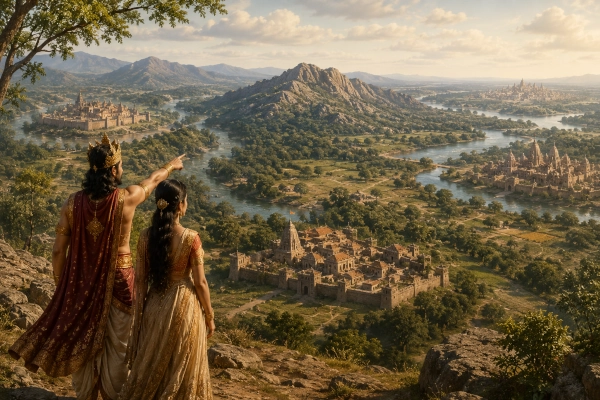
The Mahabharata introduces Nishadha primarily through the Nalopakhyana, the story of Nala and Damayanti in the Vana Parva. Sage Brihadashva narrates the story to Yudhishthira during the Pandavas’ exile to show him that another righteous king had also lost his kingdom through gambling, suffered in the wilderness and eventually recovered everything through perseverance and wisdom. The epic identifies Virasena as a celebrated ruler of the Nishadhas and his son Nala as the king who succeeded him.
Unlike Vidarbha, whose ancient geographical identity survives clearly in eastern Maharashtra, the borders and capital of Nishadha remain uncertain. Ancient travel descriptions nevertheless provide enough evidence to place Nala’s kingdom broadly in central India, probably somewhere within or adjoining the Vindhyan-central Indian corridor north or northwest of Vidarbha. Any modern boundary shown for Nishadha should therefore be presented as an approximation rather than a definite historical frontier.
Nishadha at a Glance
| Feature | Description |
|---|---|
| Ancient Name | Nishadha / Niṣadha |
| Famous Ruler | King Nala |
| Earlier Ruler | Virasena, father of Nala |
| Royal Consort | Damayanti of Vidarbha |
| Mahabharata Source | Vana Parva, Nalopakhyana |
| Political System | Monarchy |
| Capital | Not securely identified in the Mahabharata |
| Geographical Zone | Central Indian and Vindhyan region |
| Important Neighbouring Regions | Avanti, Vidarbha and Kosala routes |
| Major Geographic Clue | Vindhya Mountains and routes toward Vidarbha |
| Modern Identification | Parts of central India; exact location uncertain |
| Country Today | India |
The Kingdom of Nala
Nishadha enters the Mahabharata through one of the epic’s most celebrated secondary narratives. When Yudhishthira laments the loss of Indraprastha and his exile after the disastrous dice game with the Kauravas, the sage Brihadashva tells him about another king who suffered an even more severe reversal of fortune.
The sage begins by speaking of Virasena, a celebrated king among the Nishadhas, whose son was Nala. The epic describes Nala as handsome, powerful, truthful, knowledgeable in dharma and the Vedas, accomplished with horses, skilled with the bow and commander of a considerable army. He is portrayed not as a minor tribal chief but as a recognised monarch whose reputation extended beyond his own kingdom.
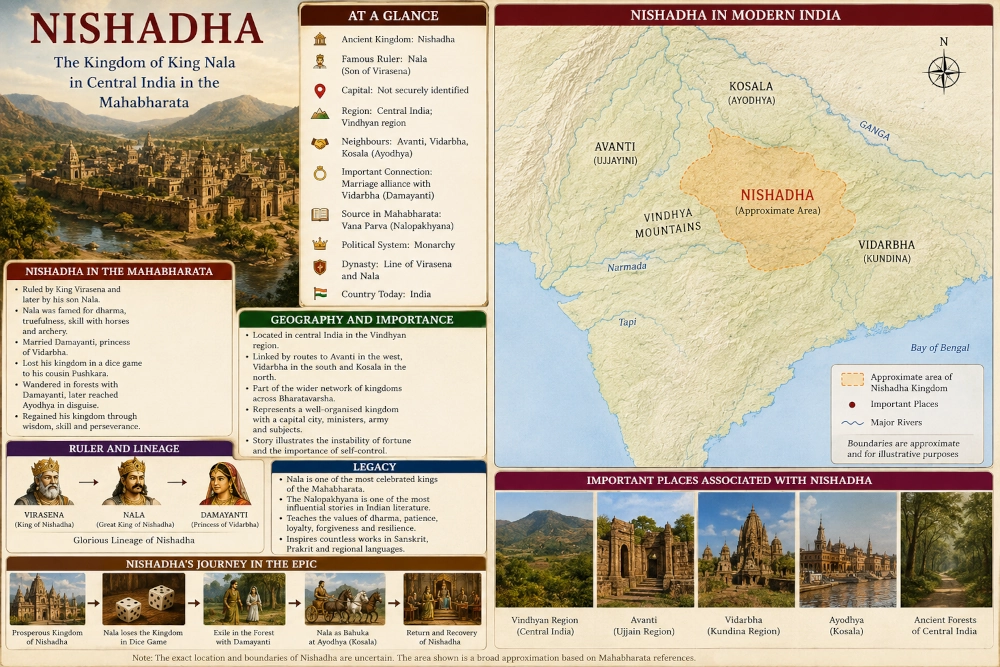
Nishadha was therefore imagined within the epic as an organised kingdom possessing a royal court, councillors, citizens, armed forces, chariots and established political institutions. When Nala later begins losing his kingdom through gambling, the Mahabharata describes both citizens and councillors gathering in an attempt to persuade their ruler to stop.
This is an important detail when reconstructing Nishadha geographically. The kingdom was not merely a forest territory mentioned in passing. It had an urban political centre, although the Mahabharata does not provide us with a securely identifiable name for Nala’s capital.
Nala, Son of Virasena
The political history of Nishadha preserved in the epic begins with King Virasena. Nala succeeds him and becomes the ruler most closely associated with the kingdom.
The Mahabharata presents Nala as an ideal king before his downfall. He protects his subjects, possesses wealth, commands military strength and understands both religious and royal duties. His particular mastery of horses becomes crucial later in the story, when he lives in disguise as the charioteer Bahuka at the court of Rituparna of Kosala.
His reputation also reached Vidarbha. Messengers and travellers carried accounts of Nala’s qualities to Princess Damayanti, while stories of Damayanti’s beauty and virtues reached Nala in Nishadha. Their attraction therefore begins before they meet, illustrating the communication that existed between the two royal courts.
Nishadha and Vidarbha
The most important political relationship of Nishadha in the Mahabharata was with Vidarbha, ruled at that time by King Bhima.
Damayanti was the daughter of Bhima of Vidarbha. After hearing repeatedly of Nala’s virtues, she chose him as her husband at her swayamvara despite the presence of gods and other powerful kings. Nala and Damayanti were subsequently married at Bhima’s court, after which Nala returned with his bride to Nishadha.
This marriage created a direct dynastic relationship between Nishadha and Vidarbha.
The connection is also highly important for determining Nishadha’s probable location. The story repeatedly describes movement between Nala’s territory, the wilderness, Vidarbha and later Kosala. These journeys place Nishadha within a central Indian network connecting the northern kingdoms with the Deccan.
The Great Geographical Clue in the Nala-Damayanti Story
The strongest geographical evidence appears after Nala has lost his kingdom.
Nala and Damayanti leave Nishadha and wander into the forest. At one point, Nala explains the surrounding routes to Damayanti. He describes roads leading toward the southern country, passing Avanti and the Rikshavat Mountains, points out the Vindhya, refers to the river Payasvini and distinguishes roads leading toward Vidarbha and Kosala.
This is an unusually valuable passage because the Mahabharata is effectively describing a road network across central India.
The landscape contains several major geographical anchors:
Avanti corresponds broadly to western Madhya Pradesh and the Malwa region.
The Vindhyas dominate the central Indian geographical corridor.
Vidarbha lay farther south and southeast in what is now eastern Maharashtra.
Kosala lay toward the north and northeast, centred principally upon the middle Gangetic region.
Taken together, these references strongly suggest that the narrative is unfolding somewhere within the central Indian-Vindhyan transition zone.
However, the passage does not provide coordinates for Nishadha itself. Nala and Damayanti had already left their kingdom and entered the wilderness when these roads were described. It would therefore be incorrect to assume that the place where Nala pointed out these routes was necessarily his capital.
The safest conclusion is that Nishadha belonged to the larger central Indian geographical world from which Avanti, Vidarbha, the Vindhyas and the route toward Kosala were accessible.
Why Nishadha’s Exact Location Remains Uncertain
Several modern reconstructions attempt to assign Nishadha to particular parts of Madhya Pradesh or adjoining central India. Some traditions have placed it farther north, while others position it closer to the Vindhyan belt. The Mahabharata itself does not give sufficient information to choose one precise modern district with confidence.
There is no clearly identifiable river described as flowing through Nala’s capital, no securely preserved archaeological city that can be conclusively equated with the Nishadha capital, and no sequence of distances comparable to a modern itinerary.
For our Mahabharata geography series, Nishadha should therefore be mapped differently from kingdoms whose locations are much more secure.
Rather than drawing a rigid territorial border, the map should show a broad approximate central Indian zone, accompanied by a clear statement that the boundaries are uncertain.
The surrounding landmarks can then provide geographical context:
Avanti — to the west
Vidarbha — toward the south
Vindhya Mountains — through the central Indian corridor
Kosala route — toward the northeast
This represents the evidence more faithfully than assigning Nishadha to a single modern district.
The Loss of Nishadha
The story of Nishadha changes dramatically after Nala’s marriage.
Kali, angered because Damayanti had chosen Nala, waits for an opportunity to bring about the king’s ruin. He eventually influences Nala, while Pushkara challenges him to a game of dice. The game continues for months, despite the attempts of Nala’s friends, councillors and subjects to intervene.
Nala gradually loses his wealth, treasures, chariots and finally his kingdom.
The description of this disaster contains valuable information about Nishadha’s political organisation. Citizens gather before the palace. Ministers and councillors attempt to approach their king. Damayanti summons Nala’s charioteer Varshneya and arranges for their children to be taken to her father’s kingdom of Vidarbha.
Eventually Pushkara gains control of Nishadha.
Nala and Damayanti leave the city wearing little more than a single garment each and remain for several nights outside its boundaries before travelling deeper into the wilderness.
The king who had ruled one of central India’s prosperous realms had become an exile.
Nishadha and the Mahabharata’s Central Theme of Gambling
Nishadha is particularly important within the Mahabharata because Nala’s story deliberately mirrors the experience of Yudhishthira.
Both were righteous kings.
Both possessed prosperous kingdoms.
Both lost those kingdoms through dice.
Both entered the forest with their wives.
Both endured separation, hardship and humiliation.
And both ultimately regained royal authority.
This parallel explains why the Nishadha story appears during the Pandavas’ exile. Yudhishthira asks whether any king has ever experienced suffering comparable to his own, and Brihadashva responds with the story of Nala.
The geography of Nishadha is therefore tied directly to one of the Mahabharata’s central moral themes: the instability of royal fortune and the dangers of gambling, attachment and loss of self-control.
Nala and Damayanti in the Forest
After leaving Nishadha, the royal couple enters a dramatically different world.
They no longer possess servants, armies, chariots or palace protection. The Mahabharata repeatedly places them among forests, rivers, mountains and wilderness routes. Nala eventually abandons Damayanti while she sleeps, believing that she may have a better chance of returning safely to Vidarbha without sharing his misfortune.
Damayanti then wanders alone through the wilderness searching for him. Later, when describing herself, she recalls travelling among woods, mountains, lakes and rivers in search of the lost king of Nishadha.
The episode gives the Nishadha narrative a strongly geographical character. Courtly life, highways between kingdoms and dangerous forest regions all appear within the same story.
Karkotaka and Nala’s Journey Toward Kosala
Nala’s wanderings eventually bring him into contact with the serpent king Karkotaka.
After this encounter, Nala’s outward appearance changes and he assumes the identity of Bahuka. Karkotaka advises him to travel to Ayodhya and enter the service of King Rituparna. There, Nala’s exceptional knowledge of horses will prove valuable, while Rituparna’s knowledge of numbers and dice will eventually help Nala overcome the weakness that caused his downfall.
Nala consequently enters the court of Kosala, linking Nishadha with another major kingdom of northern India.
The movement between Nishadha’s central Indian environment, Vidarbha in the south and Ayodhya in the north demonstrates how the Nala narrative stretches across a broad north-central Indian corridor.
Nala’s Extraordinary Knowledge of Horses
Among Nala’s greatest accomplishments was his mastery of ashvavidya, the science and management of horses.
This skill becomes one of the principal means through which he rebuilds his life. Disguised as Bahuka, he becomes Rituparna’s charioteer. When Rituparna must travel rapidly toward Vidarbha, Nala selects and controls extraordinary horses capable of covering vast distances at astonishing speed. His former charioteer Varshneya recognises that Bahuka possesses a skill comparable to that of Nala himself.
The episode also contains another geographical link between Kosala and Vidarbha. Rituparna travels from Ayodhya toward the Vidarbha court, with Nala driving the chariot.
These movements reinforce the picture of central India as a major connecting zone between the northern Gangetic kingdoms and the regions farther south.
The Recovery of Nishadha
The story eventually turns toward restoration.
Nala exchanges his knowledge of horses for Rituparna’s understanding of numbers and dice. Freed from Kali’s influence and reunited with Damayanti, he prepares to recover the kingdom that Pushkara had taken from him.
Nala returns and challenges Pushkara once again, offering either a renewed game of dice or battle.
This time Nala wins.
The Mahabharata describes him recovering his wealth, treasures and kingdom in a single decisive contest. Rather than killing Pushkara, however, Nala forgives him and allows him to depart with property and followers. Pushkara acknowledges Nala’s generosity before leaving.
Nala then resumes his position as ruler of Nishadha.
The story that began with a prosperous king, passed through exile and degradation, therefore ends with the restoration of both family and kingdom.
Nishadha as a Kingdom with an Urban Centre
Although the Mahabharata does not securely preserve the name of Nala’s capital, the narrative clearly implies the existence of an important city.
When the gambling crisis intensifies, citizens and state officials assemble at the royal residence. When Nala finally loses his kingdom, he and Damayanti leave the city and spend several nights beyond it. When Nala later returns to power, Nishadha again functions as the seat of his restored monarchy.
For an illustrated reconstruction, Nishadha can therefore reasonably be represented with a fortified or organised ancient city surrounded by forests, agricultural settlements and central Indian hills.
What should not be done is label a specific modern city as Nala’s capital without clearly marking that identification as speculative.
Nishadha, Avanti and the Vindhyan World
Geographically, Nishadha appears to fit naturally into the complex political landscape surrounding the Vindhyas.
To the west lay Avanti, one of ancient India’s major kingdoms and later a powerful centre around Ujjayini.
To the south and southeast lay Vidarbha, the kingdom of Damayanti’s father.
Across the Vindhyan and central Indian corridors ran roads toward the northern plains and Kosala.
The Mahabharata’s description of Nala pointing toward Avanti, the Vindhyas, Vidarbha and Kosala provides the clearest basis for viewing Nishadha as part of this interconnected central Indian landscape.
This placement also explains why the kingdom could participate in long-distance royal marriage networks and why its rulers possessed knowledge of the political courts both north and south of the Vindhyas.
Nishadha and the Wider Political Network
The marriage between Nala and Damayanti demonstrates that Nishadha belonged to the same aristocratic political world as Vidarbha and other great kingdoms.
Damayanti’s swayamvara attracted numerous rulers as well as the gods themselves. Nala’s participation indicates that the king of Nishadha ranked among the significant monarchs of the region. The Mahabharata explicitly portrays him as standing at the head of kings and commanding a powerful army.
Nishadha therefore should not be imagined as geographically remote from the larger political system of ancient Bharat.
Its uncertain location reflects the limitations of surviving geographical evidence rather than an absence of political importance.
Nishadha and Nishada: A Necessary Distinction
The name Nishadha or Niṣadha, associated with King Nala, can easily become confused with Nishada or Niṣāda, a name used in ancient literature for several forest, hunting and fishing communities.
The two terms are treated as distinct in scholarly discussions of ancient Indian peoples, even though English spellings frequently blur the difference. The Nishadas associated with figures such as Ekalavya or Guha should therefore not automatically be identified with Nala’s kingdom of Nishadha.
For this geographical series, Nishadha means the kingdom ruled by Virasena and Nala in the Nalopakhyana.
This distinction is important when locating the kingdom on a map.
Nishadha on the Modern Map
The most responsible modern identification is:
Nishadha → central Indian-Vindhyan region → exact boundaries uncertain → India
The map should therefore avoid presenting a precise outline as established fact.
A useful reconstruction would place an approximate shaded zone within central India, while showing the major geographical reference points mentioned in Nala’s journey:
| Ancient Geography | Modern Approximation |
|---|---|
| Nishadha | Central India; exact location uncertain |
| Vindhya | Vindhya Range of central India |
| Avanti | Malwa and western Madhya Pradesh |
| Vidarbha | Eastern Maharashtra |
| Kosala | Region centred toward modern Uttar Pradesh |
| Ayodhya | Ayodhya, Uttar Pradesh |
| Kundina / Vidarbha Court | Vidarbha region of Maharashtra |
| Country Today | India |
The map should use a dashed or translucent boundary labelled “Approximate Location of Nishadha” rather than claiming a fixed ancient frontier.
Vidarbha should appear to the south or southeast, Avanti toward the west, the Vindhyan zone across central India and the route toward Kosala and Ayodhya to the north or northeast.
A Kingdom Defined More Clearly by Story Than Archaeology
Nishadha illustrates an important challenge in reconstructing the geography of the Mahabharata.
Some ancient kingdoms survive through cities whose archaeological locations are widely accepted. Hastinapura, Mathura, Ujjain and Rajgir provide relatively strong geographical anchors for their respective regions.
Nishadha is different.
Its literary identity is exceptionally strong, but its physical geography remains uncertain.
The Mahabharata tells us who ruled it. It describes its citizens and ministers. It records the loss and recovery of its throne. It connects Nishadha dynastically with Vidarbha and geographically with the central Indian routes between Avanti, the Vindhyas, Vidarbha and Kosala. Yet it does not provide enough information to fix its capital or borders conclusively.
The uncertainty should therefore be preserved rather than concealed.
Nishadha’s Place in the Mahabharata
Nishadha may not dominate the Kurukshetra narrative, but few secondary kingdoms contribute a story of comparable importance to the Mahabharata’s moral and philosophical structure.
Through Nala, Nishadha becomes a mirror of Yudhishthira’s own kingdom.
A prosperous ruler loses everything through dice. A queen follows her husband into exile. The king wanders without wealth or identity. Knowledge acquired during suffering eventually becomes the means of recovery. Husband and wife reunite, the lost kingdom is restored and the ruler emerges transformed by experience.
Sahapedia notes that the Nalopakhyana became one of the most influential stories within the Indian literary tradition, inspiring numerous Sanskrit works, plays, poems and regional adaptations over subsequent centuries.
At the geographical centre of this extraordinary story stood Nishadha — the kingdom of Nala.
Its precise modern boundaries may be lost, but the Mahabharata preserves enough clues to place it within the broad landscape of central India and the Vindhyan world, connected with Avanti, Vidarbha and the northern road toward Kosala.
For our reconstruction of ancient Bharat, Nishadha should therefore be represented as an important but geographically uncertain central Indian kingdom — remembered above all through Nala, Damayanti and one of the Mahabharata’s greatest stories of loss, endurance and restoration.
Sources
Mahabharata — Vana Parva, Nalopakhyana
Brihadashva introduces Virasena and Nala as rulers of the Nishadhas and narrates Nala’s rise, marriage, loss of the kingdom, exile and eventual restoration.
Mahabharata — geographical passage during Nala and Damayanti’s exile
Nala identifies routes associated with Avanti, the Rikshavat Mountains, the Vindhya, Vidarbha and Kosala, providing the principal clues for locating the story within central India.
Mahabharata — Nala at the court of Rituparna
The narrative records Nala’s journey to Ayodhya, his service under the Kosala king and his celebrated mastery of horses.
Sahapedia — The Nala-Damayanti Narrative
Provides an overview of the Nalopakhyana and the enormous influence of the Nala-Damayanti story on later Sanskrit and regional literature.
Geographical Identification
Nishadha — Parts of central India; exact boundaries uncertain — India
You may also like
-
Durga versus Mahishasura: Weapons, Battlefield Tactics and the Triumph of Shakti
-
Kuluta: The Kullu Valley Kingdom of the Mahabharata
-
Trigarta: The Kangra–Jalandhar Kingdom of the Mahabharata
-
Kasmira: The Kashmir Valley and the Northwestern Himalayan World of the Mahabharata
-
Nepala: The Kathmandu Valley and the Central Himalayan World of the Mahabharata
