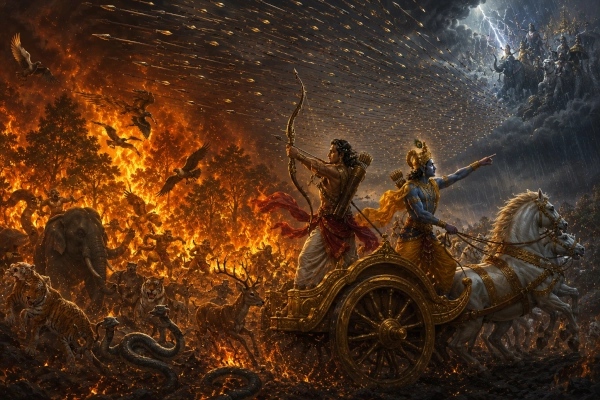
Long before the armies of the Pandavas and Kauravas gathered at Kurukshetra, another terrible conflict had left behind a survivor whose anger would wait for years before returning to the battlefield. His name was Ashvasena, a young Naga and the son of Takshaka, the powerful serpent king associated with the Khandava forest. When Agni consumed Khandava with the assistance of Krishna and Arjuna, Ashvasena saw his home destroyed and his mother killed while attempting to save him. He escaped the flames, but the memory of that day remained with him until he found an opportunity to strike at Arjuna during the great war.
The story of Ashvasena is comparatively brief within the enormous Mahabharata, yet it connects two widely separated moments of the epic. The first occurs during the rise of the Pandavas, when Arjuna and Krishna assist Agni in burning Khandava. The second takes place many years later during the climactic duel between Karna and Arjuna. What happened in the burning forest had not disappeared with the flames. One survivor carried its memory all the way to Kurukshetra.
The Forest of Khandava
Khandava was no ordinary woodland. It was an immense forest inhabited by animals, birds, Nagas, Rakshasas, Asuras and many other beings. Among its most important inhabitants was Takshaka, the Naga chief who enjoyed the friendship and protection of Indra. When Agni sought to consume the forest, Indra repeatedly frustrated him by sending rain to extinguish the flames.
Agni eventually approached Krishna and Arjuna and sought their assistance. Once they agreed, Arjuna used his extraordinary archery to prevent creatures from escaping and to stop Indra’s rain from reaching the forest. The sky above Khandava became covered by his arrows, while Krishna guarded other routes of escape. The burning of the forest became one of the most violent and morally unsettling episodes of the Adi Parva.
Takshaka himself was not present when the catastrophe began. The Mahabharata states that the Naga chief had gone to Kurukshetra. His son Ashvasena, however, remained inside the forest with his mother. As fire spread across Khandava and Arjuna’s arrows closed the routes of escape, the young serpent suddenly found himself trapped between two forces from which there seemed to be no way out.
Ashvasena Trapped by Fire and Arrows
Ashvasena tried desperately to escape. The flames were consuming the forest behind him, while Arjuna’s arrows formed a deadly barrier around it. The young Naga could not simply rise into the sky or flee through an opening, because Arjuna was striking down creatures that attempted to escape from the burning woodland.
The destruction around Ashvasena must have been terrifying. The forest that had been his home was disappearing in fire, animals were fleeing in panic, and the heavens themselves had become part of the battle between Arjuna and Indra. Ashvasena possessed the power of a Naga, but he was still unable to break through the barrier created by one of the greatest archers in the world.
Seeing that her son could not escape, Ashvasena’s mother made a desperate decision. She would attempt to carry him out herself, even if doing so placed her directly in the path of Arjuna’s arrows.
A Mother Tries to Save Her Son
Ashvasena’s mother began swallowing her son so that she could conceal and protect him within her own body. The Mahabharata describes her first swallowing his head and then beginning to swallow his tail. Her intention was to carry Ashvasena with her while attempting to escape from the burning forest.
It was an extraordinary act of maternal desperation. The she-serpent could see that the young Naga had no path through Arjuna’s arrows. She therefore made her own body his refuge and attempted to rise from the forest while still drawing the remaining part of her son’s body inside herself.
Arjuna saw her escaping.
He did not know that the serpent before him was a mother desperately attempting to preserve her son. His purpose was to prevent the inhabitants of Khandava from escaping so that Agni could consume the forest completely. Arjuna therefore released a sharp arrow at the fleeing serpent.
The arrow struck with devastating accuracy.
Ashvasena’s mother was beheaded.
Indra Gives Ashvasena a Moment to Escape
Ashvasena had now lost the very being who was trying to save him. Yet the young serpent’s life did not end beside his mother’s body.
Indra had been watching the destruction of Khandava. Takshaka was his friend, and Ashvasena was Takshaka’s son. Seeing what had happened, Indra intervened. According to the Mahabharata, he raised a violent wind that momentarily deprived Arjuna of his ability to continue the attack. During those few precious moments, Ashvasena escaped.
The opportunity lasted only briefly, but it was enough.
The young Naga fled from the burning forest while Arjuna was unable to stop him. Khandava continued to burn behind him, and his mother remained among its dead. Ashvasena had survived one of the most destructive events of the Mahabharata, but survival came at a terrible cost.
Arjuna soon realised that the serpent had escaped and became furious at having been deceived. The epic records that Arjuna, Krishna and Agni cursed the escaping Naga. Yet Ashvasena had already disappeared from their reach.
The Memory of His Mother’s Death
For Ashvasena, the destruction of Khandava could never become merely an event of the distant past. His mother had died directly before him while attempting to preserve his life, and the arrow that killed her had been released by Arjuna.
Years would pass. The Pandavas would rise in power, lose their kingdom, endure exile and eventually return to demand justice from the Kauravas. Kings would choose sides, armies would assemble, and the field of Kurukshetra would become the centre of a war involving nearly every great warrior of Bharata.
Ashvasena waited through all of it.
The Mahabharata does not describe him participating in the political quarrels between the Pandavas and Kauravas. His grievance was older and deeply personal. He did not seek Arjuna because of Duryodhana’s cause or because he believed Karna should rule. He sought the man whose arrow had killed his mother.
When the opportunity finally came, it appeared in one of the greatest duels of the war.
Karna and Arjuna Face Each Other
On the seventeenth day of Kurukshetra, Karna and Arjuna finally confronted one another in the battle both had anticipated for years. The two warriors possessed extraordinary weapons, immense skill and deeply personal reasons for seeking victory.
Karna knew that defeating Arjuna was essential to Duryodhana’s hopes. Arjuna knew that Karna had been one of the central enemies of the Pandavas and had participated in the events that culminated in the death of Abhimanyu. Around them, warriors and celestial beings watched a confrontation that seemed capable of deciding the war itself.
It was during this duel that Ashvasena recognised his opportunity.
Karna possessed a particularly terrible serpent-shaped arrow that he had preserved for the destruction of Arjuna. Ashvasena used his own power to enter that weapon without Karna’s knowledge. The Karna Parva specifically states that Karna did not know the Naga had entered his arrow.
The revenge born in the flames of Khandava was now hidden inside the weapon of Arjuna’s greatest battlefield rival.
The Serpent Within Karna’s Arrow
Karna placed the terrible shaft upon his bow. Even Shalya, who was driving Karna’s chariot, recognised the extraordinary importance of the weapon and warned that its aim might not properly sever Arjuna’s head. Karna refused to adjust the shot merely because Shalya questioned it. He declared that he would not behave as a crooked warrior by repeatedly altering his aim.
Karna then released the weapon toward Arjuna.
The arrow carried not only Karna’s tremendous force but also the will of Ashvasena. For the Naga, this was the moment for which he had waited since the destruction of his home. The son of Takshaka was travelling directly toward the warrior who had killed his mother.
Krishna saw the danger.
As Arjuna’s charioteer, Krishna understood that the approaching weapon could kill him. At the crucial instant, Krishna forced the chariot downward, causing it to sink sufficiently for the arrow to miss Arjuna’s neck and head. Instead of killing him, the serpent weapon struck Arjuna’s magnificent crown and tore it away.
Ashvasena had come extraordinarily close to completing his revenge.
But Arjuna was still alive.
Krishna Saves Arjuna
The moment illustrates once again how essential Krishna’s presence was to Arjuna throughout Kurukshetra. Arjuna’s skill could counter countless warriors and celestial weapons, but the serpent hidden within Karna’s shaft represented a danger he did not fully perceive.
Krishna did.
By forcing the chariot downward at exactly the right moment, Krishna changed the path of the missile by only the distance needed to preserve Arjuna’s life. The crown was destroyed, but the warrior beneath it survived.
For Ashvasena, however, the result was unbearable. He had carried his hatred across years, found the perfect weapon, entered it unseen and reached his enemy during a moment when Arjuna was already engaged with Karna. Yet after all that preparation, the arrow had only removed a crown.
The Naga was not willing to abandon his revenge.
Ashvasena Approaches Karna
After the first attack failed, Ashvasena revealed himself and sought Karna’s cooperation. He explained the reason for his hatred of Arjuna and offered to help Karna kill their common enemy.
For Karna, the offer created an extraordinary opportunity. He was already engaged in a battle that could determine his own fate and the fate of Duryodhana’s cause. Ashvasena had nearly killed Arjuna once. If Karna launched him again with full knowledge of the Naga’s presence, the second attempt might succeed.
Yet Karna refused to depend upon Ashvasena’s hidden assistance.
The Mahabharata’s account emphasises that Karna did not originally know the Naga had entered the first arrow. When Ashvasena revealed himself and sought another opportunity, Karna would not allow the same weapon to become the means of a second concealed attack. Later retellings remember the moment as a demonstration of Karna’s insistence that he would fight Arjuna through his own martial ability.
Ashvasena therefore found himself without Karna’s help.
His hatred, however, remained unchanged.
Ashvasena Attacks on His Own
Having failed to persuade Karna to launch him again, Ashvasena decided to attack Arjuna directly. The opportunity for carefully hidden revenge had passed. He would now have to confront the Pandava himself.
Arjuna learned who the serpent was and why he sought his death. The connection between the battlefield and the burning of Khandava was finally made explicit. The enemy before him was the surviving son of the serpent whose mother he had killed years earlier.
The old destruction had returned to stand before him.
This time Krishna warned Arjuna of the danger, and Arjuna was prepared. Ashvasena’s attempt failed, and the Naga was struck down before he could complete his revenge. Traditional summaries of the Karna Parva record that after Karna rejected further assistance, Ashvasena attacked independently and was killed by Arjuna.
Thus ended the life that had been preserved in the flames of Khandava.
A Survivor Who Could Not Leave the Fire Behind
Ashvasena’s story is tragic because his physical escape from Khandava did not free him from what happened there. His body survived, but his life remained tied to the moment of his mother’s death.
This gives the episode a very different character from many Mahabharata stories about vengeance. Ashvasena was not seeking territory, royal power or fame. His anger came from the most personal of losses. He had survived because his mother sacrificed herself, and the man responsible for her death continued to live as one of the most celebrated warriors of the age.
From Ashvasena’s perspective, revenge may have appeared inseparable from loyalty to his mother.
Yet the years he spent carrying that purpose ultimately brought him back to Arjuna only to die before him.
The fire had claimed him after all, though not on the day Khandava burned.
The Mahabharata and the Long Memory of Violence
The story also demonstrates one of the Mahabharata’s recurring truths: violence rarely ends where the victor believes it ends.
Arjuna and Krishna succeeded in helping Agni consume Khandava. For them, the episode concluded with Agni satisfied, celestial weapons acquired and Maya surviving to become associated with the magnificent hall later built for the Pandavas. Yet for Ashvasena, the same event was not a heroic victory. It was the destruction of his home and the death of his mother.
Both memories existed at the same time.
The epic frequently allows such different perspectives to coexist. A triumph for one family may become a wound carried by another. A battle completed in one generation can create an enemy who appears years later. The person who survives violence may become the carrier through whom that violence enters the future.
Ashvasena embodies that continuity.
Arjuna’s Arrow Creates a Future Enemy
When Arjuna killed Ashvasena’s mother, he was focused entirely on the immediate purpose of preventing creatures from escaping Khandava. He could not know that the serpent she was trying to save would survive and someday enter an arrow directed at his own head.
The moment illustrates the unpredictability of consequences.
A warrior may control the arrow he releases, but he cannot control every consequence created by that arrow. The death of one opponent may produce another. The destruction of one refuge may create a survivor who remembers. Victory may contain within itself the seeds of a future danger.
Years later, when Ashvasena approached Arjuna through Karna’s weapon, the past suddenly became present.
The arrow from Khandava had returned in another form.
The Mother at the Centre of the Story
Although the episode bears Ashvasena’s name, its emotional centre is his mother.
Without her decision, Ashvasena would almost certainly have died inside Khandava. She knew that Arjuna’s arrows prevented escape, yet she attempted to carry her son through the deadly barrier anyway. Her actions cost her life but created the brief opportunity through which Ashvasena eventually survived.
Her sacrifice gives Ashvasena’s later vengeance its emotional force. He is not merely a serpent seeking revenge because his clan suffered. He personally survived through his mother’s final effort.
The Mahabharata offers no long speech from her and does not even make her a major character. Yet within a few verses, it presents an unforgettable image of maternal courage. Surrounded by fire and arrows, she turns her own body into a shelter for her child.
She cannot save herself.
But she succeeds in giving him a chance.
Indra, Takshaka and the Survival of Ashvasena
Ashvasena’s escape was also connected to the larger relationship between the Nagas and the gods. Takshaka enjoyed Indra’s friendship, and Indra was already attempting to prevent Agni from consuming Khandava. When Takshaka’s son was placed in immediate danger, Indra’s intervention created the opening through which the young Naga escaped.
This detail reminds us that Ashvasena was not simply a random serpent living in the forest. He belonged to the family of an important Naga ruler whose relationships extended into the celestial world.
The Mahabharata would later return repeatedly to Takshaka and the Kuru dynasty. Long after Kurukshetra, Takshaka would become central to the death of King Parikshit, and Parikshit’s son Janamejaya would respond with the great serpent sacrifice. The hostility between humans and Nagas therefore stretches across generations within the epic tradition.
Ashvasena’s story belongs to that wider chain of action, injury and retaliation.
Karna’s Unexpected Role
Karna’s role in Ashvasena’s revenge is particularly interesting because he does not knowingly participate at first.
Ashvasena secretly enters the serpent-shaped shaft. Karna believes that he is releasing his own treasured weapon against Arjuna. The Naga is using Karna’s strength without revealing his presence.
Once Karna discovers what has happened, he is presented with the possibility of consciously joining Ashvasena’s personal revenge. Yet he refuses to rely upon that concealed advantage for another attempt.
This moment adds another layer to the duel between Karna and Arjuna. Two separate conflicts briefly occupy the same arrow. Karna seeks to defeat Arjuna as his battlefield rival, while Ashvasena seeks to kill him for the death of his mother.
Their purposes overlap, but they are not the same.
Karna’s battle belongs to Kurukshetra.
Ashvasena’s battle began in Khandava.
When Two Stories Meet on One Battlefield
The Mahabharata frequently brings apparently separate stories together many years after they first appear.
Ashvasena’s survival in the Adi Parva may initially seem like a minor detail amid the enormous destruction of Khandava. The reader could easily assume that the young serpent simply escapes and disappears from the epic.
Instead, he returns in the Karna Parva at precisely the moment when Arjuna’s life is already in extraordinary danger.
The connection gives the epic a remarkable sense of continuity. Actions are remembered. Survivors return. Consequences travel across books, kingdoms and generations.
Kurukshetra is therefore not merely the result of the immediate dispute between the Pandavas and Kauravas. By the time the armies meet there, the battlefield has accumulated older enmities as well.
Ashvasena carries one of them.
Revenge Does Not Restore What Was Lost
Ashvasena’s anger is understandable, but his story also demonstrates the limits of revenge.
Even if he had succeeded in killing Arjuna, his mother would not have returned. Khandava would not have grown again exactly as it had been. The years of grief between the fire and Kurukshetra would not have disappeared.
Revenge offered Ashvasena a target for his pain, but it could not undo its cause.
Instead, the desire to kill Arjuna eventually brought him directly into another battlefield where he lost the life his mother had sacrificed herself to preserve.
The Mahabharata rarely offers simple moral judgements about such grief. It understands the human and even non-human impulse toward retaliation while repeatedly showing how retaliation creates another link in a chain that can continue far beyond its beginning.
Ashvasena survives one act of violence only to return voluntarily to another.
The Fire That Reached Kurukshetra
The most powerful way to understand Ashvasena’s story may be to see the Khandava fire as something that never completely went out.
Its physical flames ended long before the Kurukshetra war.
Yet one flame remained alive within the young serpent who escaped.
For years it took the form of memory.
At Kurukshetra it became an arrow.
Ashvasena entered Karna’s weapon carrying the grief of his mother’s death directly toward Arjuna. For a moment, the distant forest fire and the great battlefield became part of the same event.
Krishna’s intervention prevented that old violence from claiming Arjuna.
Ashvasena then attempted to complete the revenge himself and died.
The fire finally ended with the survivor who had carried it.
Ashvasena and the Web of Karma
The Mahabharata does not portray Karma as a simple system in which every action produces an immediate and easily identifiable reward or punishment. Its consequences can travel through unexpected people, across decades and into entirely different circumstances.
Arjuna’s actions in Khandava did not lead to Ashvasena’s revenge the following day.
Years passed.
Arjuna probably had countless battles and difficulties in which Ashvasena played no role. Yet the consequence remained alive beyond his awareness.
Then, at one of the most dangerous moments of Arjuna’s life, the survivor suddenly appeared inside Karna’s weapon.
This is the Mahabharata’s world of consequence. An action may end in the eyes of the person who performs it while continuing in the memory of someone else.
Ashvasena became the living memory of Khandava.
The Survivor and the Warrior
There is also a striking contrast between Ashvasena and Arjuna.
Arjuna experiences the burning of Khandava as a warrior performing an immense task alongside Krishna. The episode demonstrates his astonishing archery, his ability to oppose Indra and the acquisition of powers that contribute to his future greatness.
Ashvasena experiences precisely the same event as a child trying to survive the destruction of his home.
Neither perspective erases the other.
This is one reason the Mahabharata remains so powerful. It allows heroic actions to possess terrible consequences and refuses to make every event morally comfortable. A celebrated warrior can become the object of another being’s entirely understandable hatred.
Ashvasena’s presence prevents the reader from seeing Khandava only through the eyes of its victors.
A survivor is still there to remember.
A Mother’s Sacrifice and a Son’s Choice
Ashvasena’s mother gave her life so that her son might live.
What he eventually chose to do with that life was seek vengeance.
This creates the deepest tragedy in the episode. Her sacrifice succeeded physically, but the trauma of the event shaped the purpose Ashvasena gave to his survival. He did not forget her, and he could not separate remembrance from retaliation.
The Mahabharata leaves us to consider whether preserving life and knowing how to live after loss are different challenges.
Ashvasena mastered the first because his mother and Indra helped him escape.
He never fully mastered the second.
His body left Khandava, but his mind remained there.
The Serpent Who Waited for Arjuna
Ashvasena’s story begins with a young serpent surrounded by fire and ends with that same serpent rushing toward one of the greatest archers of the age.
Between those moments lies an entire generation of the Mahabharata.
Kingdoms rise and fall. The dice game occurs. The Pandavas go into exile. Krishna attempts peace. Kurukshetra begins, and countless warriors perish.
Through all those enormous events, Ashvasena’s purpose remains astonishingly simple.
He remembers his mother.
When Karna finally faces Arjuna, the Naga sees his opportunity and enters the weapon that appears capable of fulfilling the vow he has carried silently for years. The attempt nearly succeeds, but Krishna changes the arrow’s path, and Arjuna survives.
Ashvasena then chooses direct confrontation and dies before the man he had hoped to kill.
His mother’s sacrifice had once allowed him to escape death.
His desire for revenge eventually brought him back to it.
The Enduring Meaning of Ashvasena’s Story
The tale of Ashvasena escaping the Khandava fire is therefore much more than a small episode about a serpent who survives a burning forest.
It is a story about memory.
It is about the hidden survivors left behind by great victories and the consequences that warriors cannot always see when they release their arrows.
It is about a mother who accepts death to create a path for her child and a son who carries the memory of that sacrifice for the rest of his life.
Most importantly, it shows how violence can remain alive long after the battlefield has changed.
Arjuna believed the struggle at Khandava had ended when the forest burned. Ashvasena knew otherwise.
Years later, amid the thunder of the greatest war in Bharata, an arrow flew toward Arjuna carrying within it a serpent and an old grief. For one extraordinary moment, the flames of Khandava reached all the way to Kurukshetra.
The Mahabharata thus reminds us that the past is rarely as dead as it appears. Every conflict leaves memories behind, and sometimes those memories survive long enough to become actors in another conflict.
Ashvasena escaped the fire.
But he carried its flame with him.
You may also like
-
Durga versus Mahishasura: Weapons, Battlefield Tactics and the Triumph of Shakti
-
National Institute of Naturopathy Opens Admissions for BNYS Programme at Pune for 2026–27
-
Yudhishthira’s Counter-Diplomacy With Shalya: Working With an Ally Who Has Joined the Other Side
-
Gnani AI Launches Nationwide Challenge Offering Up to 100 Paid AI Internships
-
NMMSS Scholarship Application Deadline Extended to October 31, 2026
