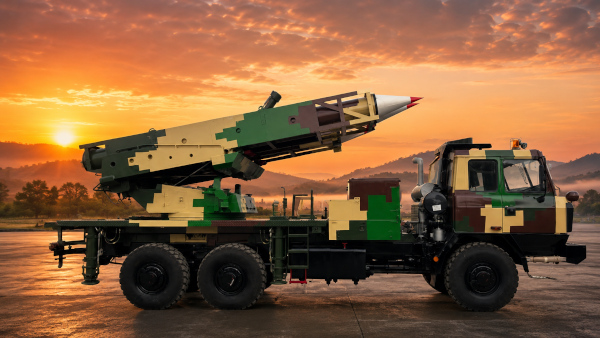
India’s private defence manufacturing ecosystem has taken another visible step forward with NIBE Limited announcing the successful test firing of its SURYASTRA Universal Rocket Launcher System at the Integrated Test Range in Chandipur, Odisha. The trials, conducted on 18 and 19 May 2026, validated the launcher’s ability to fire rockets in the 150 km and 300 km range categories, giving the Indian Army a potentially important addition to its long-range precision-fire options.
The development is significant because it is linked to an actual procurement pathway. According to NIBE’s regulatory filing, the company had received a purchase order in January 2026 under the Emergency Procurement route of the Indian Army for the supply of the SURYASTRA launcher and associated rockets. This means the test was not merely a company demonstration or exhibition claim; it was connected to a contracted military requirement.
The most eye-catching part of the announcement is the claimed accuracy. NIBE stated that the rockets achieved a Circular Error Probable of 1.5 metres at 150 km and 2 metres at 300 km. In simple terms, CEP is a standard measure used to describe weapon accuracy: the smaller the figure, the tighter the expected impact grouping around the target point. If these figures are sustained across operational conditions, they would place SURYASTRA in the category of precision rocket artillery rather than traditional area-saturation rocket fire.
This distinction matters. Conventional rocket artillery is usually associated with volume fire — saturating an area to suppress or destroy enemy formations, artillery positions or logistical nodes. Precision rocket artillery, however, gives commanders the ability to strike high-value targets at long distance with fewer rounds. That can include ammunition dumps, radar sites, command posts, air-defence nodes, bridges, staging areas and other battlefield assets that need to be hit quickly and accurately without using larger ballistic missiles.
For the Indian Army, such a capability fits into a broader shift towards deeper, faster and more precise land warfare. Modern battlefields are increasingly shaped by surveillance drones, counter-battery radars, electronic warfare, mobile air defences and dispersed logistics. In such an environment, the side that can detect, decide and strike faster often gains the advantage. A long-range rocket system with precision capability can help bridge the gap between tube artillery, tactical missiles and air-delivered strike options.
SURYASTRA also highlights a growing role for Indian private industry in defence production. NIBE describes itself as a defence technology company involved in the development, manufacturing and integration of defence systems, and its own corporate profile says it works on areas including advanced artillery systems, smart electronics, small arms and aerospace systems.
The industrial background is also important. In July 2025, NIBE was reported to have signed a technology collaboration agreement with Israel’s Elbit Systems for advanced universal rocket launcher manufacturing in India. That earlier report described the system as capable of precision engagement up to 300 km and framed it as a step towards domestic manufacturing for both Indian and export markets.
This means the SURYASTRA story should be understood carefully. It is a major Indian private-sector manufacturing and integration development, and NIBE’s filing calls it a milestone in indigenous rocket artillery development. At the same time, available public reporting also points to an earlier technology-collaboration background. So the most accurate description would be: an Indian private-sector manufactured and integrated long-range rocket artillery system, developed within India’s expanding defence industrial ecosystem, with reported international technology collaboration in the background.
The tactical value of such a system lies in flexibility. A universal launcher can potentially support different rocket types and ranges, allowing an army to select munitions according to mission need. Shorter-range precision rockets can be used for battlefield targets closer to the forward edge, while 300 km-class rockets can threaten deeper operational targets. This gives ground forces a larger strike envelope without always depending on aircraft or higher-end missile systems.
SURYASTRA’s emergence also complements India’s wider artillery modernisation. India already has strong indigenous rocket-artillery experience through systems such as Pinaka, but the battlefield requirement is expanding beyond range alone. Accuracy, guidance, survivability, rapid deployment, network integration and shoot-and-scoot capability are becoming equally important. A precision rocket system in the 150–300 km bracket can add a new layer to India’s conventional deterrence posture.
The Chandipur test also strengthens the argument that India’s defence private sector is moving beyond component manufacturing into complete systems. For decades, Indian private firms mostly supported defence through sub-assemblies, fabrication, machining and electronics. The new phase is different. Companies are now trying to build launchers, drones, loitering munitions, armoured platforms, electronic warfare equipment and guided-weapon subsystems. SURYASTRA fits into this larger transformation.
From an Army perspective, emergency procurement usually indicates a fast-track requirement driven by operational urgency. Such procurements are meant to close capability gaps quickly, especially when the armed forces need equipment within compressed timelines. If SURYASTRA proceeds smoothly from test validation to delivery, it could become an example of how Indian private industry can respond faster to urgent military requirements while supporting the Atmanirbhar Bharat defence agenda.
The system’s future will depend on more than one successful test. Operational acceptance will require reliability across multiple firings, integration with command-and-control networks, crew training, maintenance support, supply of ammunition, survivability of launcher vehicles, and performance under field conditions. Publicly available information confirms the successful test firing and stated accuracy figures, but details such as final induction numbers, delivery timelines, total system configuration and follow-on orders are still not fully available in the open domain.
Even with that caution, the development is clearly positive. The successful test firing of SURYASTRA shows that Indian private-sector defence firms are increasingly entering complex domains once dominated only by state-owned enterprises or foreign suppliers. If sustained, this could give India a deeper domestic base for rocket artillery, reduce dependence on imports, improve responsiveness to Army requirements and open export possibilities in the future.
SURYASTRA may not replace India’s existing artillery ecosystem, but it can add a valuable precision-strike layer to it. For a country facing complex land borders and fast-changing battlefield technologies, the ability to field accurate, long-range, road-mobile rocket artillery is strategically important. NIBE’s successful test firing at Chandipur therefore deserves attention not merely as a company milestone, but as part of a larger shift in India’s defence industrial capability.
You may also like
-
India Advances Project-75(I) and Submarine Modernisation Plans to Strengthen Underwater Warfare Capability
-
Kokasa Launches to Build Indigenous Mission-Critical Systems for Su-30MKI, MiG-29 and T-72
-
Flying Wedge Defence Partners With Portugal’s Keydef to Manufacture Kaal Bhairava and YAMA Drones in Europe
-
ASEAN Diplomats Visit BrahMos Facility as India Showcases Defence Engineering Capabilities
-
India and UAE Agree to Expand Army Cooperation and Desert Cyclone Participation
