
A new Indian-led study has offered an important scientific clue to one of solar physics’ longest-running puzzles: why the Sun’s outer atmosphere, known as the corona, is far hotter than its visible surface. The research, carried out by the Aryabhatta Research Institute of Observational Sciences (ARIES), Nainital and IIT Delhi, suggests that hidden turbulence generated by transverse magnetic waves in the corona may leave measurable signatures in solar spectral lines.
The Sun’s corona is a strange and extreme region. Although it lies above the visible surface, it reaches very high temperatures and remains one of the most difficult parts of the Sun to understand. NASA also notes that the corona is extremely hot but very dim because it is far less dense than the Sun’s surface. This basic contradiction — a hotter outer atmosphere above a comparatively cooler surface — is known as the coronal heating problem, and scientists have studied it for decades.
The latest study focuses on propagating transverse magnetohydrodynamic waves, often described as Alfvénic or kink waves. These waves travel along magnetic structures in the corona and make them sway sideways. Until now, such transverse waves were usually associated with Doppler shifts — alternating red and blue signatures that show plasma moving towards or away from the observer. But whether these waves could also distort the shape of coronal spectral lines in a measurable way had not been clearly established through observation.
This question is important because earlier observations of the corona and transition region had often shown blueward asymmetries in spectral lines. These were generally explained as evidence of upward plasma flows, jets or mass movements along magnetic-field lines. Transverse waves, by contrast, were often treated as nearly incompressible and therefore less likely to produce strong line-profile asymmetries. The new study challenges that assumption by showing that such waves can indeed create systematic spectral distortions under realistic coronal conditions.
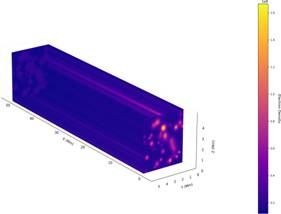
The research was conducted by Ms. Ambika Saxena, a PhD student at ARIES, and Prof. Vaibhav Pant from the Department of Physics at IIT Delhi. They used advanced three-dimensional MHD simulations along with forward modelling to study an open-field coronal region containing density variations across its structure. In simple terms, they created a simulated magnetic plume in the solar corona, introduced transverse waves from the lower boundary, and then studied how the plasma emission would appear in the Fe XIII 10749 Å coronal spectral line.
The results, published in The Astrophysical Journal, showed a clear pattern. As transverse waves travelled through a structured magnetic plume, the plasma did not move uniformly. Because the plume contained density variations, the wave motion gradually produced fine-scale structuring through a process called phase mixing. This led to turbulence and created small-scale variations in velocity and density inside the magnetic structure.
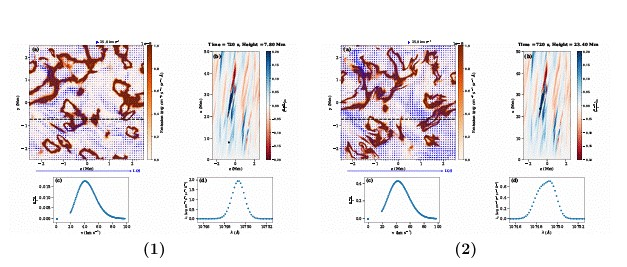
This matters because the solar corona is optically thin. That means light from many different parts of the structure overlaps along the observer’s line of sight. When different parts of the same structure are moving at different speeds, their combined emission does not produce a perfectly symmetrical spectral line. Instead, the line can develop alternating blue and red wing asymmetries that change with time and height as the wave travels outward.
The study found that these wave-driven spectral asymmetries could reach up to about 20% of the line peak intensity, with apparent secondary velocities of 30 to 40 km per second. The alternating red-blue pattern itself was also found to move outward at speeds consistent with the wave, strengthening the case that propagating transverse MHD waves can produce these signatures naturally.
The broader significance of the study is that it gives scientists a new way to look for hidden turbulence in the solar corona. If future high-resolution observations confirm these predicted spectral signatures, researchers may be able to use them as a diagnostic tool to understand how wave-driven turbulence behaves in the Sun’s outer atmosphere. This could help refine models of how energy is transported and dissipated in the corona.
The PIB release also notes that facilities with high spatial and spectral resolution, such as the Daniel K. Inouye Solar Telescope (DKIST), may soon make it possible to observe such effects more directly. That would be a major step forward, because proving the role of wave-driven turbulence through observation could bring scientists closer to explaining how the corona sustains such extreme temperatures.
For India, the study is another strong contribution to global solar physics. ARIES and IIT Delhi have not only addressed a complex theoretical question but also provided a possible observational pathway for future solar research. The work shows how advanced simulations, Indian research institutions and international observational capabilities can come together to solve some of the most challenging problems in astrophysics.
Publication link: https://iopscience.iop.org/article/10.3847/1538-4357/ae2482
You may also like
-
Indian Researchers Study RAD51 DNA-Repair Gene Variant in Prostate Cancer
-
TDB Backs Multi Nano Sense With ₹37.51 Crore to Build Indigenous Multi-Gas Sensor Platform
-
IISER Berhampur and NIT Rourkela Researchers Explore Cotarnine Derivatives for Wound Healing and Biomedical Applications
-
IISER Tirupati Develops pH-Responsive DNA Nanostructures for Controlled Drug Delivery
-
India and France Expand Space Cooperation Into Human Spaceflight, TRISHNA and Start-up Ecosystem
