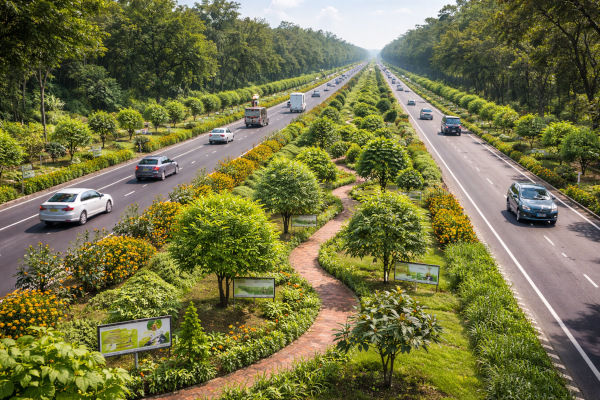
The National Highways Authority of India has announced a new green initiative titled ‘NHAI Arogya Van’, under which medicinal tree plantations will be developed on vacant land parcels along national highways. The programme is aimed at improving biodiversity, strengthening ecological resilience, and integrating sustainability more visibly into highway development.
In the first phase, NHAI has prepared an action plan covering 17 land parcels spread across 62.8 hectares, where around 67,462 medicinal trees will be planted. The sites are located along highway projects in Madhya Pradesh, Haryana, Delhi-NCR, Andhra Pradesh, Gujarat, Karnataka, Odisha, Tamil Nadu, Rajasthan, Maharashtra, and Chhattisgarh.
According to the PIB release, about 36 medicinal tree species have been identified for plantation, including Neem, Amla, Imli, Jamun, Lemon, Gular, and Maulsari. These will be selected according to local agro-climatic suitability, with priority given to visible and high-footfall highway locations such as toll plazas, wayside amenities, interchanges, and cloverleaf junctions so that the plantations also serve a public awareness role.
The initiative will be implemented in line with Government of India guidelines on landscaping and tree plantation. NHAI said it has also identified around 188 hectares of vacant land for plantation during the upcoming monsoon season, with the timing intended to improve survival rates and long-term sustainability.
Beyond roadside greening, the project is being positioned as a bridge between infrastructure, ecology, and traditional knowledge. The government said the medicinal plantations are expected to support pollinators, birds, and microfauna, while also promoting awareness of Ayurveda and the conservation of indigenous medicinal flora.
Overall, the Arogya Van initiative reflects an attempt to turn stretches of highway land into green knowledge corridors that combine environmental restoration with cultural and educational value.
Reference: PIB
You may also like
-
NABARD Report Highlights Growing Strength of Women-Led Farmer Producer Organisations in India
-
Indian Banks Expected to Record 25.4% Profit Growth in Q2 FY27 as Lending Expands and Margins Prepare for Recovery
-
India Targets 1 Billion 5G Users by 2030 as Telecom Sector Prepares for Global 6G Leadership
-
GHCL Begins Production at 2,800-Tonne Bromine Manufacturing Facility in Gujarat
-
BHEL Awards ₹52.68 Crore Indigenous Gas Turbine Component Contract to Azad Engineering
