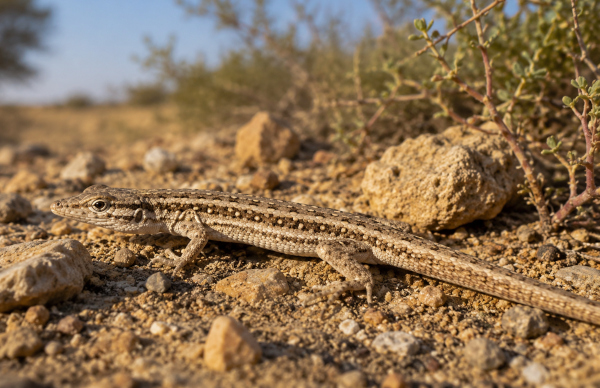
India’s desert biodiversity has received a major scientific addition with the discovery of a new lizard species from Rajasthan. The species, named Mesalina bishnoi, was found near Gajner in Bikaner district and represents the first confirmed record of the genus Mesalina in India. The discovery is significant because it expands the known range of this arid-zone lizard group and highlights the hidden reptile diversity of the Thar landscape.
Mesalina lizards are small, swift, day-active reptiles usually associated with arid and semi-arid regions. They are adapted to dry terrain, open ground, sparse vegetation and harsh desert conditions. Until now, the presence of this genus in India remained uncertain. A historical reference by British zoologist Malcolm A. Smith in 1935 had mentioned Mesalina watsonana from Jaisalmer, but that record lacked specimen-based confirmation. The new discovery from Bikaner now provides verified scientific evidence that Mesalina occurs in India.
The species was discovered during a field survey in August 2025. Researchers were travelling near the Gajner forest area when a small lizard spotted near a roadside location caught their attention. What first appeared to be a field observation soon turned into a major taxonomic discovery. After detailed study, the specimen was found to represent a species previously unknown to science.
The research involved scientists from the Zoological Survey of India and other collaborators. The team used both morphological examination and genetic analysis to confirm the identity of the lizard. Morphology helped document its body structure, scale patterns, colouration and physical characters, while DNA evidence showed that the species is genetically distinct from its known relatives. This combination of traditional taxonomy and modern molecular study strengthened the conclusion that the Bikaner specimen belongs to a separate evolutionary lineage.
The new species belongs to the Mesalina watsonana species complex. It is a small-bodied lizard with a snout-vent length of about 39.2 mm. Its body shows greyish to olive-brown colouration, with a pair of dorsolateral stripes running from the neck towards the tail. It also has dark markings behind the eyes, irregular dark blotches across the body and white spots that create a mottled desert pattern. The underside is pale grey to off-white, helping it blend with the dry, rocky soil of its habitat.
The habitat of Mesalina bishnoi is typical of Rajasthan’s arid ecology. The species was found in an open semi-desert landscape with hard, rocky soil and sparse desert vegetation. Such habitats often appear empty to the casual eye, but they support specialised reptiles, snakes, insects and small mammals that have evolved to survive intense heat, low moisture and limited cover. The same area also supports other reptiles such as Sahgal’s gecko, the spotted desert racer and the saw-scaled viper.
The name Mesalina bishnoi carries a strong cultural and conservation message. It honours the Bishnoi community, which is widely respected for its deep commitment to wildlife, trees and desert ecology. The Bishnoi tradition has long been associated with protection of animals such as blackbuck, chinkara and birds, along with the preservation of vegetation in dry regions. By naming the species after the community, the researchers have connected modern taxonomy with India’s living conservation heritage.
At present, Mesalina bishnoi is known only from its type locality in Bikaner district and is considered endemic to the Thar biogeographic province. This makes the discovery especially important from a conservation perspective. A species known from a limited area requires careful habitat study, repeated field surveys and long-term monitoring. Its current distribution, population size, breeding behaviour and ecological role still need deeper investigation.
The discovery also shows that western India’s desert ecosystems remain scientifically underexplored. The Thar Desert is often viewed through the lens of heat, sand, drought and pastoral life, but it also contains a complex web of specialised biodiversity. Lizards, geckos, snakes and other reptiles occupy microhabitats that can be easily missed without focused fieldwork. Each new species adds another layer to the biological identity of the desert.
Taxonomic discoveries like this are important because conservation begins with recognition. A species must first be identified, described and named before it can be properly studied or protected. Without taxonomy, many small animals remain invisible in policy, habitat management and public awareness. Mesalina bishnoi reminds us that even in well-known regions like Rajasthan, science can still uncover life forms that have remained undocumented.
The finding also reinforces the importance of combining field surveys with museum science and DNA analysis. Historical records can provide clues, but fresh specimens, modern methods and careful comparison are needed to confirm species identity. In this case, the new lizard does more than add one name to India’s reptile list. It resolves an old uncertainty about the presence of Mesalina in the country and opens a new chapter in the study of desert lizards in South Asia.
Mesalina bishnoi is therefore more than a small reptile from Bikaner. It is a symbol of India’s still-unfolding biodiversity story. It links the Thar Desert’s rugged ecology, the Bishnoi community’s conservation ethic and the scientific value of patient field research. Its discovery proves that even in harsh landscapes, nature still holds quiet secrets waiting to be recognised.
You may also like
-
IISc Scientists Show How Strong Magnetic Fields Could Allow White Dwarfs to Exceed Chandrasekhar Limit
-
IIT Madras to Launch Global Mission to Map 100 Human Brains in 3D
-
3,898 Indian Scientists Feature in 2026 Global Top 2% Research Database; IISc Leads Indian Institutions
-
New Metal-free Porous Material can Help Produce Affordable Clean Energy
-
A Decade of Cosmic Flickering Reveals New Clues About A Rare Giant Binary Black Hole System
