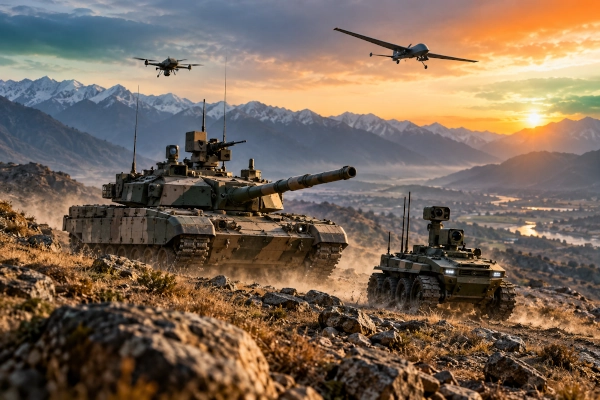
Hyderabad-based EdgeForce Solutions Private Limited has reportedly emerged as the L1 bidder for an Indian Army Armoured Corps requirement for a Manned–Unmanned Teaming system, marking a potentially important step in the Army’s move toward integrated battlefield robotics and networked unmanned operations.
The development was reported on 24 September 2026, with the company’s bid placed at around ₹1.4 crore. The procurement is understood to involve an integrated architecture combining unmanned ground vehicles, unmanned aerial vehicles and a command-and-control station capable of supporting manned armoured formations.
At present, the development represents an L1 procurement milestone and not a confirmed contract award. No formal Indian Army or Ministry of Defence announcement has yet confirmed final placement of the order.
Manned–Unmanned Teaming for Armoured Formations
Manned–Unmanned Teaming, commonly referred to as MUM-T, is designed to allow crewed military platforms and unmanned systems to operate as part of the same tactical network.
For armoured formations, the concept can be particularly useful because unmanned vehicles can move ahead of tanks and other crewed platforms, collect battlefield information and investigate potentially dangerous areas before soldiers or manned combat vehicles enter them.
The reported Indian Army requirement brings together aerial and ground-based unmanned platforms under a common control architecture. This allows information collected by different systems to be processed and distributed more effectively across the battlefield.
UGV, UAV and Command-and-Control Station Form the Core System
The reported MUM-T configuration includes an unmanned ground vehicle, unmanned aerial vehicles and a central command-and-control station.
The ground vehicle is expected to operate as a modular platform capable of carrying different mission payloads. Available procurement reporting indicates a payload range of approximately 500 to 1,000 kg, speeds of around 30 to 40 km/h and endurance that could extend to approximately 10 to 12 hours in a hybrid configuration.
The wider system is expected to incorporate technologies such as electro-optical sensors, infrared imaging, thermal cameras, LiDAR, navigation systems and secure communications.
Together, these capabilities can give commanders a more detailed picture of the terrain and tactical environment while reducing the need to expose personnel to unnecessary risk.
Autonomous Navigation Is a Key Element
Autonomous navigation is expected to be one of the most important elements of the proposed EdgeForce MUM-T architecture.
The unmanned ground vehicle is reportedly designed to use technologies including simultaneous localisation and mapping, obstacle detection and avoidance, stereo vision and LiDAR-based navigation.
Such systems allow unmanned vehicles to understand their surroundings, identify obstacles and navigate through unfamiliar terrain with reduced operator intervention.
For battlefield use, autonomous mobility is particularly important because communications links may be disrupted, terrain may be difficult and vehicles may have to operate beyond direct visual control.
Modular Payloads Could Expand Battlefield Roles
The reported requirement appears to envisage the unmanned ground vehicle as more than a simple reconnaissance platform.
A modular design can allow the same vehicle to be configured for different tasks depending on the mission. Surveillance sensors, logistics payloads, communication equipment or other specialised systems can potentially be integrated onto a common robotic platform.
Available reporting has also referred to possible weaponised configurations, including remote weapon stations, medium machine guns and anti-tank guided missile systems. The exact configuration that may eventually be adopted by the Army, however, will depend on the final procurement requirement, technical evaluation and operational trials.
Integration with UAVs would further expand the system’s reach by allowing aerial sensors to work together with ground robots and manned formations.
EdgeForce Solutions Builds Presence in Defence Robotics
EdgeForce Solutions has been building a presence in areas including robotics, autonomous systems, simulation and defence technology.
Public procurement records show that the company has already participated in multiple Ministry of Defence and Indian Army requirements.
In September 2026, EdgeForce emerged as the successful bidder for a robot-based material handling equipment requirement under the Department of Military Affairs. The company has also secured work involving a VR-based training simulator, adding to its defence technology portfolio.
These procurements indicate that EdgeForce is developing capabilities across several areas relevant to the Indian Army’s increasing use of robotics and autonomous systems.
Why MUM-T Matters for the Indian Army
The significance of Manned–Unmanned Teaming lies in the way it changes the role of battlefield robots.
Instead of operating as isolated drones or remotely controlled vehicles, unmanned systems become integrated components of a larger combat network. Information from aerial drones, ground robots, sensors and manned vehicles can be combined and used by commanders in near real time.
For armoured formations, this can improve reconnaissance, route surveillance, target detection and battlefield awareness.
An unmanned ground vehicle can move ahead of a tank column, examine difficult terrain or inspect areas where mines, ambushes or enemy positions may be present. UAVs can simultaneously provide an overhead view, while the command station combines information from both systems.
This creates a more layered battlefield picture without requiring every observation task to be performed by soldiers or manned vehicles.
Indian Army Expands Focus on Battlefield Robotics
The reported EdgeForce MUM-T procurement fits into the Indian Army’s broader effort to incorporate autonomous systems, drones, unmanned ground vehicles and artificial intelligence-enabled battlefield technologies.
Recent conflicts have demonstrated the growing importance of unmanned platforms for surveillance, targeting, logistics and battlefield reconnaissance. Militaries are increasingly moving toward systems where autonomous and remotely controlled platforms operate alongside conventional formations rather than separately from them.
For India, developing indigenous MUM-T systems can also strengthen domestic capability in robotics, secure communications, sensor integration, autonomous navigation and battlefield command systems.
These technologies have applications far beyond a single unmanned vehicle and can contribute to the development of a wider indigenous defence ecosystem.
L1 Status Is Not Yet a Contract Award
The current development needs to be viewed within the normal procurement process.
Being declared the L1 bidder means that EdgeForce reportedly submitted the lowest eligible financial bid after the relevant evaluation stage. It does not by itself mean that the Indian Army has placed an order.
Further administrative procedures, approvals and contractual processes can still take place before procurement is formally concluded.
There is currently no publicly available official announcement confirming that the Army has awarded the MUM-T contract to EdgeForce Solutions.
The appropriate description at this stage is therefore that EdgeForce Solutions has reportedly emerged as the L1 bidder for the Indian Army’s Manned–Unmanned Teaming requirement.
A Step Toward Indigenous Networked Warfare
If the procurement progresses to contract award and operational deployment, the system could represent an important step in the Indian Army’s transition toward networked manned–unmanned operations.
The combination of autonomous ground vehicles, drones, sensors and command systems can create new options for armoured formations operating in contested environments.
For EdgeForce Solutions, the reported L1 position also represents an opportunity to move from individual robotics and simulation projects toward a more comprehensive battlefield architecture.
The development reflects the broader expansion of India’s indigenous defence technology sector, where private companies are increasingly participating in advanced areas including autonomous vehicles, battlefield robotics, artificial intelligence, secure communications and unmanned warfare systems.
References
Infralens / GeM Procurement Data — Robot-Based Material Handling Equipment, Department of Military Affairs, September 2026
https://tenders.infralens.in/gem/robot-based-material-handling-equipment-727060
TenderKart / GeM Procurement Data — VR Based Training Simulator, Indian Army, August 2026
https://tenderkart.in/tender/0fd667a3-4a4d-4cdb-9ebb-f6237744f96b
TenderKart — Autonomous Weapon System for Small Arms Procurement, 2026
https://tenderkart.in/tender/5fd561d8-73d2-48f4-98cb-9a8eba71d434
You may also like
-
Indian Semiconductor Companies Propose New Manufacturing and Chip Design Investments in Madhya Pradesh
-
CSIR-CRRI Partners with Industry to Develop Advanced Indigenous Airport Runway and Pavement Materials
-
Paras Semiconductors Secures 43 Acres in Madhya Pradesh for Proposed ₹6,200 Crore Advanced Chip Packaging Facility
-
Indian Army Special Forces Depart for Indonesia for Exercise Garuda Shakti 2026
-
India to Train 600 Nigerian Army Soldiers in Specialised Jungle and Mountain Warfare
