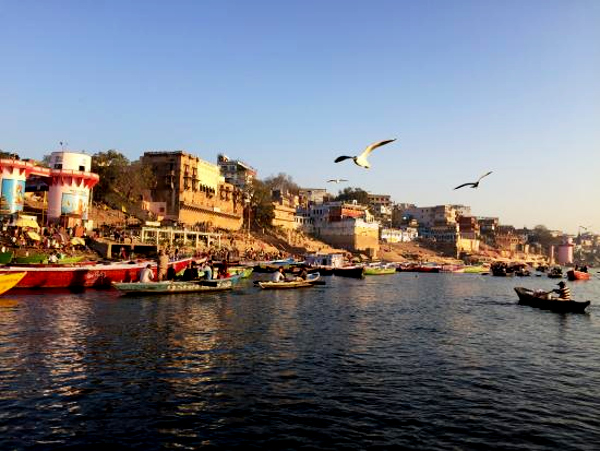
The Centre’s Namami Gange programme has moved well beyond a narrow river-cleaning mission into a broader ecological restoration effort, with 524 projects sanctioned at a cost of ₹43,030 crore and 355 completed as of February 2026. In a written reply to the Lok Sabha, Minister of State for Jal Shakti Raj Bhushan Choudhary said the programme, launched in 2014-15 for rejuvenating the Ganga and its tributaries, has combined wastewater treatment, riverfront management, e-flow enforcement, afforestation, biodiversity conservation and public participation under a single umbrella. The scheme, originally intended to run till March 2021, has been extended till March 2026.
A major share of the effort has gone into sewage infrastructure, long seen as the core weakness in the Ganga basin. Under the National Mission for Clean Ganga, 218 sewerage infrastructure projects worth ₹35,794 crore have been taken up, creating a treatment capacity of 6,610 million litres per day. Of these, 138 sewage treatment plant projects with a combined capacity of 4,050 MLD have already been completed and made operational. The ministry said the PRAYAG online dashboard is now being used for continuous monitoring of river water quality and sewage treatment plant performance on the Ganga and Yamuna.
The government also said it has operationalised minimum environmental flow norms notified in October 2018, with compliance monitored by the Central Water Commission. Alongside this, afforestation has been carried out across 33,024 hectares along the main stem of the Ganga at an expenditure of about ₹414 crore, while seven biodiversity parks in Uttar Pradesh and five priority wetlands across Uttar Pradesh, Bihar and Jharkhand have been sanctioned as part of a wider ecological approach to river restoration.
Biodiversity conservation has emerged as one of the more visible components of the programme. The ministry said 203 lakh Indian Major Carp fingerlings have been released into the river system to strengthen fish biodiversity and support the prey base for river dolphins. India’s first Dolphin Rescue Ambulance was inaugurated on January 13, 2026 at the Wildlife Institute of India in Dehradun, and eight Gangetic dolphins have so far been rescued and released. The programme has also expanded grassroots conservation through a Soons-Saathi volunteer network, trained personnel, dolphin clubs and local awareness campaigns.
On other endangered riverine species, the ministry highlighted that gharial assessments across 22 rivers recorded 3,037 individuals, even as habitat modelling showed that only 5.6 percent of habitat remained highly suitable, underlining the fragility of river ecosystems. It also reported rewilding efforts for threatened turtle species in the Yamuna, Sarju and Ganga rivers, along with hatchery protection for 387 vulnerable nests of endangered Batagur turtles in the Chambal, yielding a hatch success rate of 96.7 percent. SMART-based river patrolling has also been institutionalised across a 210-km stretch of the Chambal in Uttar Pradesh.
On water quality, the government said pH and dissolved oxygen levels in the Ganga now meet bathing criteria at all monitored locations. It added that, based on January-August 2025 median water-quality data, biochemical oxygen demand also met bathing norms across the entire Ganga stretch in Uttarakhand, Jharkhand, Bihar and West Bengal, with only a few stretches in Uttar Pradesh still falling short, including Farrukhabad to Purana Rajapur in Kanpur, Dalmau in Raebareli, and downstream stretches from Mirzapur to Tarighat in Ghazipur. The Centre also cited improvements in polluted river stretches compared with 2018, including the removal of Uttarakhand’s main-stem polluted stretch classification.
Industrial pollution control has also shown measurable gains. Three Common Effluent Treatment Plants were sanctioned under the programme at Jajmau, Banther and Mathura, of which the Mathura and Jajmau projects have been completed. Since annual inspections of grossly polluting industries began in 2017, the government said biochemical oxygen demand load has fallen from 26 tonnes per day in 2017 to 10.75 tonnes per day in 2024, while effluent discharge has declined by about 23.9 percent, from 349 MLD to 265.56 MLD over the same period.
Outside the Ganga basin, the National River Conservation Plan continues parallel work on other rivers across the country. The ministry said the scheme has covered 58 rivers in 100 towns across 17 states, with a total sanctioned cost of ₹8,970.51 crore and sewage treatment capacity of 3,019 MLD created so far.
Taken together, the latest update suggests that Namami Gange is increasingly being positioned not just as a sewage-abatement scheme but as a full-spectrum river restoration programme, combining infrastructure, monitoring, ecological repair and community participation. Whether that translates into durable river health across the basin will depend on how consistently those gains are maintained beyond the programme’s current March 2026 timeline.
Reference: PIB
You may also like
-
Sindhu: The Indus Kingdom of Jayadratha in the Mahabharata
-
Kuninda or Kulinda: The Himalayan Realm of the Mahabharata in Uttarakhand and Himachal Pradesh
-
Durga versus Mahishasura: Weapons, Battlefield Tactics and the Triumph of Shakti
-
Kuluta: The Kullu Valley Kingdom of the Mahabharata
-
Starlink-Ukraine, Myanmar and Drug Smuggling: Why India Must Regulate Satellite Internet for National Security
