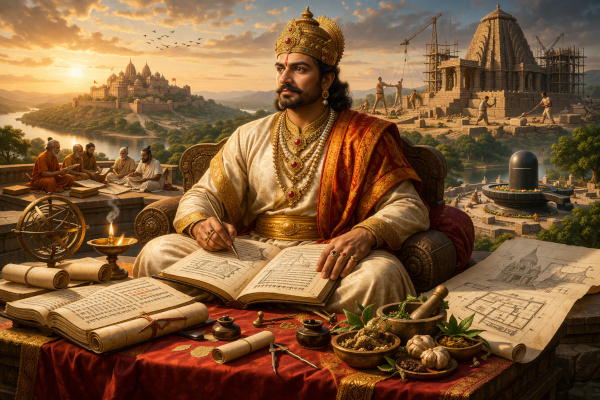
Bhoja of the Paramara dynasty, who ruled from Dhara in Malwa in the first half of the 11th century, occupies a rare place in Indian history: he was unquestionably a king, often an embattled one, but his enduring reputation rests less on conquest than on intellect. Modern historians usually place his reign at about 1010–1055 CE, based on inscriptional evidence such as the Modasa copper plates of 1010–11 and records from 1055 associated with the close of his reign. He inherited the Paramara realm in central India and ruled from Dhara, today’s Dhar in Madhya Pradesh. At the height of his power, his influence stretched roughly from Chittor in the north to upper Konkan in the south, and from the Sabarmati basin in the west to Vidisha in the east, though like many early medieval Indian monarchs, his actual authority varied by frontier, alliance, and military circumstance. Even in sources that acknowledge his campaigns, Bhoja emerges not primarily as a territorial empire-builder on the model of a Samudragupta or Rajendra Chola, but as a ruler whose court converted political capital into cultural capital on an extraordinary scale.
That distinction matters. Bhoja did fight repeatedly: against the Chalukyas of Kalyani, the powers of Lata and Konkan, the Kalachuris, and other neighboring dynasties. Yet the record of these wars is mixed, and scholars do not read his military career as a simple sequence of triumphant annexations. Early medieval inscriptions, as usual, exaggerate, and later literary tradition magnified him still further into a near-legendary universal sovereign. The more sober historical picture is of a formidable regional king whose campaigns were real, ambitious, and sometimes successful, but whose long afterlife in memory came from something else. Bhoja’s reign became famous because Dhara under him was remembered as one of the great intellectual centers of early medieval India, and because later generations treated him as the archetype of the philosopher-king. This is why his name endured not just in dynastic lists, but in literary memory alongside the great idealized rulers of Sanskritic political imagination.
The strongest reason Bhoja matters is that an astonishing range of learned works came to be associated with him. Historians remain cautious here: not every text attributed to Bhoja can safely be assumed to have been personally written by him. In some cases, authorship may reflect royal sponsorship, courtly compilation, or later attribution to a famous name. But the scale of that attribution is itself historically significant, because it shows how the king was remembered. Bhoja was linked to grammar, poetics, architecture, astronomy, yoga, medicine, and allied sciences, and that breadth is not merely legendary inflation. His authorship of the great aesthetic treatise Śṛṅgāra-Prakāśa is widely accepted, and its sheer size and intellectual ambition are enough to explain why he became the emblem of learned kingship. The work survives in a text running to 36 chapters, and modern scholarship has treated it as one of the most detailed and provocative discussions of rasa in Sanskrit poetics. P. V. Kane regarded it as encyclopaedic in scope, while later editors emphasized that it drew together an immense range of prior literary and philosophical material.
His reputation in grammar rests above all on the Sarasvatī-Kaṇṭhābharaṇa, a massive Sanskrit grammatical treatise traditionally attributed to him. This work is structured in eight chapters, consciously echoing the prestige of Pāṇini’s Aṣṭādhyāyī, though reorganized in its own manner. That Bhoja should be associated both with poetics and grammar is highly revealing. He was not simply a patron funding poets for courtly ornament; he was remembered as a ruler engaged with the architecture of language itself. That is why later scholars placed him in a lineage of system-builders rather than merely connoisseurs. He also came to be associated with the Rājamārtaṇḍa, a commentary on Patañjali’s Yoga Sūtras, and with medical compilations bearing the same or related names in later tradition. Whether every one of these texts can be treated as autograph writing is debatable, but taken together they show that Bhoja’s court projected an image of kingship inseparable from textual production and scholastic prestige.
In architecture and applied knowledge, Bhoja’s historical profile becomes even more concrete. The Samarāṅgaṇa-Sūtradhāra, attributed to him, is one of the major Sanskrit treatises on architecture and vāstuśāstra. The extant text survives in a form of 83 chapters and about 7,430 verses, making it a full-scale technical and theoretical compendium. Its importance is heightened by the material remains at Bhojpur, where the unfinished Bhojeshwar temple is associated with Bhoja’s patronage. The temple, now on India’s UNESCO Tentative List, is one of the grandest surviving monuments tied to his name. UNESCO’s dossier describes it as a square-plan temple of about 20.1 by 20.1 metres, with four interior columns about 12 metres high and a colossal liṅga approximately 2.3 metres high and 5.4 metres in circumference, seated on a pedestal around 8 metres high. The site also preserves architectural line drawings carved on nearby rock, an exceptionally rare survival that gives historians unusual insight into design process, planning, and construction practice in 11th-century India. If one wants evidence that Bhoja’s intellectual life was not abstract but connected to engineering, measurement, and monumental building, Bhojpur is the clearest answer.
The same pattern appears in astronomy and calendrical science. Works associated with Bhoja include the Rājamṛgāṅka or Rājamṛgāṅka-karaṇa, and histories of Indian astronomy note an epoch of 21 February 1042 for the Rājamṛgāṅka. Even where attribution is discussed cautiously by specialists, the association is telling: Bhoja’s name was attached not only to belles-lettres but to precise computational and scientific traditions. Likewise, traditions around Yukti-Kalpataru connect him with practical arts including shipbuilding and technical knowledge, though scholars are right to be more careful with this text than with Śṛṅgāra-Prakāśa or Samarāṅgaṇa-Sūtradhāra. The broader point remains firm. Bhoja’s historical image is that of a ruler at the intersection of statecraft and śāstra, a monarch whose legitimacy was articulated through mastery, or claimed mastery, over organized knowledge.
This helps explain why Bhoja’s reign is often described as an intellectual zenith of early medieval India. The phrase is not empty praise. In Bhoja’s world, the court was not merely a military headquarters or ritual center; it was also a site where grammar, literary theory, temple design, yoga exegesis, medicine, astronomy, and perhaps other technical disciplines were gathered into a royal ecumene of knowledge. Dhara’s prestige under him became so strong that later rulers sought comparison with Bhoja as a compliment of the highest order. The memory of Bhoja thus outlived the political fortunes of the Paramaras. His dynasty, like others, rose and later weakened under external assault, but Bhoja as a historical figure passed into a different register altogether: the scholar-king whose authority was measured not simply in cavalry or tribute but in texts, ideas, and monuments.
Bhoja’s end, around 1055 CE, carries a note of tragic irony. The king who had spent decades turning Malwa into one of early medieval India’s great centres of learning appears to have died just as political danger closed in around his kingdom. Historical tradition holds that in the last phase of his life, Malwa was threatened by a combined invasion from the Chaulukya ruler Bhima I and the Kalachuri king Karna, and that Bhoja died of illness during this crisis rather than in a final blaze of battlefield conquest. That detail matters, because it sharpens the contrast at the heart of his legacy: Bhoja’s body may have failed amid siege, uncertainty, and the hard arithmetic of power, but his fame outlived the armies that pressed upon his frontiers.
If one had to summarize Bhoja in a single judgment, it would be this: he was not a ruler who abandoned politics for scholarship, nor a conqueror who happened to patronize letters. He represented a specifically early medieval Indian ideal in which kingship itself aspired to encyclopaedic range. His military record was real but uneven; his cultural record was transformative. He stands as one of the clearest examples of how power in premodern India could seek permanence through knowledge: through books, systems, monuments, and the prestige of learned sovereignty.
Reference:
https://www.britannica.com/topic/Paramara
https://en.wikipedia.org/wiki/Bhoja
https://en.wikipedia.org/wiki/Samarangana_Sutradhara
https://en.wikipedia.org/wiki/Shringara-Prakasha
https://en.wikipedia.org/wiki/Sarasvati-Kanthabharana
https://whc.unesco.org/en/tentativelists/6733/
https://archive.org/details/historyofsanskritpoeticspandurangvamankane
https://archive.org/details/in.gov.ignca.1603
https://archive.org/details/bhojassringaraprakasaraghavanv.1978
https://archive.org/stream/in.ernet.dli.2015.205661/2015.205661.History-Of_text.pdf
https://ignca.gov.in/divisionss/academic-unit/short-term-certification-course/vastu-shastra/
https://ignca.gov.in/mausam/Malabar_Coast_pre-modern_period_KS_Mathew.pdf
You may also like
-
Yavana in the Mahabharata: Greek Connections, Pandava Campaigns and the Warriors of Kurukshetra
-
India and Sri Lanka Launch SAMHiTA Manuscript Digitisation Project to Preserve Ancient Buddhist Heritage
-
ASI Uses Ground-Penetrating Radar to Investigate Ancient Buddhist Stupa at Ujjain After Nearly 90 Years
-
Pahlava: The Parthian World Beyond India’s Northwestern Frontiers in the Mahabharata
-
Namami Gange in 2026: 368 Projects Completed, 4,339 MLD Sewage Treatment Capacity Created as Ganga Rejuvenation Advances
