
A unique transistor developed using single molecules, controlled by mechanical forces could pave the way for advancements in areas like quantum information processing, ultra-compact electronics and sensing applications.
In a breakthrough in electronics, scientists at the S. N. Bose National Centre for Basic Sciences an autonomous institute, have developed a unique transistor using single molecules, controlled by mechanical forces rather than traditional electrical signals.
Using a piezoelectric stack, the researchers meticulously break a macroscopic metal wire to create a sub-nanometer gap precisely sized for a single molecule like ferrocene. The technique is known as mechanically controllable break junction (MCBJ). This molecule, structured with an iron atom sandwiched between two cyclopentadienyl (Cp) rings (See Figure 1, schematic of the molecule), exhibits altered electrical behaviour when mechanically manipulated, demonstrating the potential of mechanical gating in controlling electron transport at the molecular level.
Through experiments and calculations Dr. Atindra Nath Pal and Biswajit Pabi, in collaboration with their team, discovered that the orientation of ferrocene molecules between silver electrodes significantly affects the transistor’s performance1. Depending on the molecular orientation, the device can either enhance or diminish electrical conductivity through the junction, underscoring the importance of molecular geometry in transistor design.
Further research explored gold electrodes with ferrocene at room temperature2. This combination resulted in a surprisingly low resistance, nearly five times the quantum of resistance (around 12.9 kΩ), but significantly lower than the typical resistance of a molecular junction (around 1 MΩ). This suggests the possibility of creating low-power molecular devices. These devices could pave the way for advancements in areas like low-power molecular devices, quantum information processing and sensing applications.
References:
- Biswajit Pabi, Jakub Sebesta, Richard Korytár, Oren Tal*, Atindra Nath Pal*. ‘Structural regulation of mechanical gating in molecular junctions’. Nano Lett. , 23 (9), 3775–3780 (2023).
https://doi.org/10.1021/acs.nanolett.3c00043
- Biswajit Pabi, Štepán Marek, Adwitiya Pal, Puja Kumari, Soumya Jyoti Ray, Arunabha Thakur, Richard Korytár, Atindra Nath Pal*. ‘Resonant transport in a highly conducting single molecular junction via metal-metal covalent bond’. Nanoscale, 15 (31), 12995-13008 (2023).
https://doi.org/10.1039/D3NR02585C
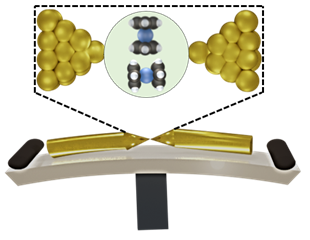
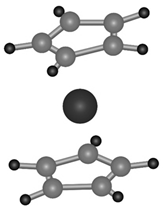
| Ferrocene | Mechanically controllable break junction schematic |
Figure 1: molecular structure of Ferrocene and schematic of break junction set up

Figure 2 : Mechnical gating response of Ferrocene molecule connected between two silver electrodes
You may also like
-
Molecular Geometry Tweak Opens New Way for Smart Biomaterials
-
ISRO’s Indo-French TRISHNA Satellite Enters Advanced Development Stage, Launch Expected in 2027–28
-
IISc Scientists Show How Strong Magnetic Fields Could Allow White Dwarfs to Exceed Chandrasekhar Limit
-
IIT Madras to Launch Global Mission to Map 100 Human Brains in 3D
-
3,898 Indian Scientists Feature in 2026 Global Top 2% Research Database; IISc Leads Indian Institutions
