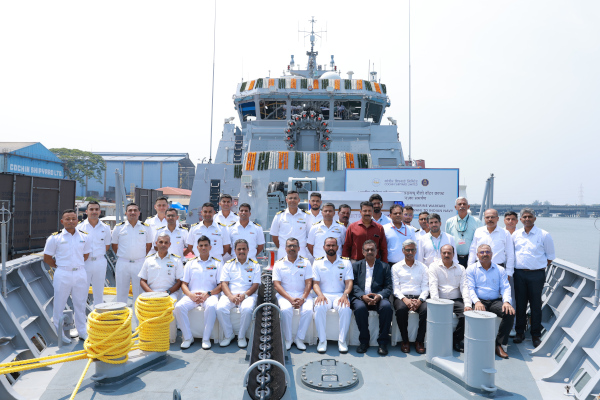
India’s efforts to strengthen its near-shore anti-submarine warfare capability received another boost on March 31, 2026, with the delivery of “Malwan,” the second of eight Anti-Submarine Warfare Shallow Water Craft (ASW SWC) built by Cochin Shipyard Limited (CSL), Kochi, to the Indian Navy. The delivery marks another important step in the Navy’s larger push to induct specialised, indigenous platforms tailored for coastal underwater surveillance and littoral combat operations.
Designed and constructed in India by CSL to the Navy’s requirements and in accordance with DNV classification rules, Malwan represents a purpose-built platform for a mission area that is becoming steadily more important in the Indian maritime environment. In an era of expanding submarine activity, contested sea spaces, and growing infrastructure security concerns, shallow-water anti-submarine vessels fill a critical niche by operating effectively in coastal zones where larger warships may be less optimised.
The vessel is equipped for underwater surveillance, anti-submarine warfare in coastal waters, low-intensity maritime operations, and mine warfare, giving it a versatile role in India’s layered maritime defence architecture. PIB said the craft measures around 80 metres in length, displaces about 1,100 tonnes, and uses waterjet propulsion, a configuration that improves manoeuvrability in shallow waters. It is armed with torpedoes and multifunctional anti-submarine rockets, and fitted with advanced sensors including modern radar and sonar systems.
The name Malwan also carries naval and historical resonance. The ship is named after the coastal town of Malwan in Maharashtra, a region associated with the maritime legacy of Chhatrapati Shivaji Maharaj. The name also revives the memory of the earlier INS Malwan, a naval minesweeper that served until 2003, continuing the Indian Navy’s tradition of preserving distinguished warship names across generations of platforms.
From an industrial standpoint, the vessel underscores the growing depth of India’s domestic naval manufacturing base. With over 80% indigenous content, Malwan incorporates equipment and systems developed and integrated by India’s defence industry, including contributions from MSMEs. That makes the delivery significant beyond fleet numbers alone: it reflects the widening maturity of India’s ecosystem for warship construction, systems integration, and maritime defence production under the broader Aatmanirbhar Bharat framework.
Though platforms such as destroyers and aircraft carriers attract greater public attention, vessels like Malwan serve in one of the most operationally demanding and strategically vital spaces: the shallow coastal battlespace, where surveillance, reaction speed, acoustic detection, and persistence can matter enormously. The delivery of the second ship in the class therefore signals not only steady programme execution by CSL, but also the Indian Navy’s intent to strengthen a specialised capability that is central to coastal defence, port security, and underwater threat management in the years ahead.
Reference: PIB
You may also like
-
Indian Navy Vice Chief Inspects Japan’s Mogami-Class Stealth Frigate as India-Japan Shipbuilding Cooperation Expands
-
Philippine Marine Wargames Reportedly Show BrahMos Can Penetrate Chinese Destroyer Air Defences
-
Safran Signs 18 Agreements with Indian Aerospace Suppliers, Expanding Make in India Manufacturing Partnerships
-
Indian Army’s Vajra Corps Certifies First Batch of Drone Operators, Strengthens Battlefield Surveillance
-
India to Seek 35% Increase in Defence Modernisation Budget for FY 2027–28
