GI Produce of India — 08
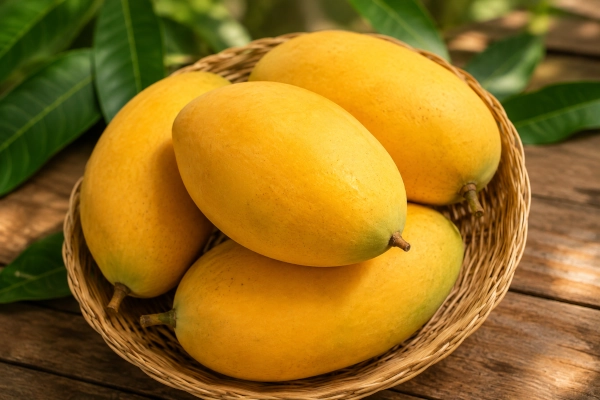
Among the mangoes of Bengal, few inspire the affection reserved for Himsagar. Its appearance is comparatively restrained: a medium-sized fruit, generally oval, with skin that moves from green towards a muted yellowish green as maturity approaches. Cut it open, however, and the character changes completely. Beneath the skin lies rich saffron-orange to deep yellow pulp, almost entirely free from troublesome fibre, intensely sweet and filled with the characteristic fragrance that has made Himsagar one of West Bengal’s most treasured table mangoes.
In Malda, the variety is officially protected under the name Malda Khirsapati (Himsagar) Mango. The dual name is important. Himsagar is the name most familiar to consumers across Bengal, while Khirsapati is firmly embedded in the registered geographical identity of the Malda fruit. India’s Geographical Indications Registry formally records the product as “Malda Khirsapati (Himsagar) Mango.” The application was filed in 2007 and geographical protection was granted on 9 September 2008, recognising the relationship between this celebrated cultivar and the mango-growing landscape of West Bengal.
For Malda, Himsagar is not simply another commercial cultivar. The district administration describes it as the “king of Malda”, a premium early-season mango distinguished by saffron-orange flesh, fibreless pulp and exceptional eating quality. Its brief appearance during late May and June makes the fruit all the more eagerly awaited.
Khirsapati and Himsagar — Two Names Within One GI Identity
The naming of this mango can initially appear confusing. In markets across West Bengal, consumers commonly ask for Himsagar, while official GI documentation uses Khirsapati (Himsagar). Both names are therefore preserved within the protected geographical indication rather than being treated as separate GI products.
APEDA lists the fruit as Malda Khirsapati (Himsagar) Mango and describes it as an oval mango with a yellowish-green exterior, very sweet taste and characteristically pleasant flavour. The National Horticulture Board separately lists Himsagar among the important mango varieties of West Bengal and describes it as a medium-sized, ovate, early-season table mango with good keeping quality.
The combined GI name is useful because it preserves both horticultural and regional identity. A consumer may know the fruit simply as Himsagar, but when the name Malda Khirsapati (Himsagar) Mango appears in GI documentation, it identifies a protected agricultural product tied to West Bengal’s recognised geographical production landscape.
This distinction will become increasingly important as premium mangoes are marketed nationally and internationally. The more famous a cultivar becomes, the more valuable reliable geographical identification becomes.
Malda — Bengal’s Great Mango Landscape
Malda occupies one of the most important mango-growing landscapes in eastern India. Situated in northern West Bengal, the district is shaped by the Ganga, Mahananda, Kalindi and other river systems, whose long history of deposition created deep alluvial soils capable of supporting intensive agriculture and perennial orchards.
The district belongs largely to West Bengal’s old alluvial agro-climatic zone. The combination of deep loamy soils, hot summers, seasonal monsoon rainfall and a pronounced dry period before the rains provides favourable conditions for mango cultivation.
These environmental characteristics are only part of the story. Mango growing has developed in Malda over generations, producing not one famous fruit but an entire orchard culture. Himsagar grows alongside Laxman Bhog, Fazli, Gopalbhog, Langra, Ashwina, Brindabani, Rakhal Bhog and numerous other cultivars.
That diversity has made Malda much more than a district where mangoes happen to be cultivated. Mango has become one of the defining agricultural products of the region.
The scale of the modern industry illustrates this importance. The Malda district administration’s Aamar Malda initiative records approximately 31,958 hectares under mango cultivation during 2025–26, producing around 380,776 tonnes of fruit. Approximately 480,000 people are estimated to depend directly or indirectly upon the mango economy, while more than 96,000 orchard owners participate in the district’s production system.
Within this enormous orchard economy, Himsagar occupies the premium early-season segment.
Why the Old Alluvial Soil Matters
Mango trees require deep soils because a mature tree develops an extensive root system capable of exploring a considerable volume of ground for moisture and nutrients. Well-drained loamy and alluvial soils are particularly suitable because they combine moisture retention with sufficient aeration around the roots.
The National Horticulture Board identifies deep, well-drained, aerated alluvial and loamy soils rich in organic matter as particularly favourable for mango cultivation. It also notes that the distribution of rainfall is more important than total rainfall alone. Dry conditions before flowering favour blossom development, while rain during flowering can interfere with pollination and increase disease problems.
Malda’s river-shaped landscape provides many of these conditions.
The soils store enough moisture to support trees through the increasingly hot pre-monsoon months, yet successful orchards depend on drainage because prolonged waterlogging can damage mango roots. The annual alternation between dry winter weather, increasing spring heat and monsoon rainfall creates the seasonal rhythm within which Himsagar develops.
The mango’s geographical reputation therefore emerges from both genetics and environment. The cultivar determines what the fruit can become. Malda’s soils, weather and orchard management influence how successfully those characteristics are expressed.
A Mango That Looks Modest Until It Is Opened
Himsagar does not depend on brilliant red skin, enormous size or dramatic shape to attract attention. The fruit is generally medium-sized and ovate, with a relatively smooth exterior that changes from green towards yellow or yellowish green during ripening.
APEDA describes the GI fruit as oval in shape and yellowish green, while NHB characterises Himsagar as a medium-sized ovate mango with yellow coloration and good keeping quality.
Its reputation lies inside.
Malda’s official mango guide describes Himsagar as possessing saffron-orange, fibre-free flesh, exceptionally juicy pulp and premium eating quality. The absence of coarse fibres gives the fruit a smooth texture, allowing the pulp to melt easily in the mouth rather than leaving stringy material around the seed.
For consumers who judge mangoes principally by eating quality rather than size, this combination is highly desirable.
The fruit is sweet without requiring processing or culinary transformation. Himsagar is therefore overwhelmingly a table mango, meant to be cut, sliced, scooped or eaten directly when fully ripe.
Why Fibreless Flesh Matters
Fibre content is one of the most important but sometimes overlooked differences among mango cultivars.
Some traditional varieties contain strong fibres running through the pulp. These fibres can be desirable in particular culinary applications, especially where fruit is used for juice, chutney or processing, but they alter the experience of eating the mango fresh.
Himsagar lies at the opposite end of this spectrum.
Its fine, fibreless pulp gives the fruit a smooth, almost creamy eating quality. This is one reason why the variety is frequently discussed alongside India’s most prized dessert mangoes even though its outward appearance is comparatively simple.
Low fibre also increases the usefulness of the edible pulp. When the stone is separated from a good Himsagar, comparatively little coarse material remains trapped around it.
This combination of sweetness, aroma and texture explains why consumers in Bengal often treat Himsagar not merely as one mango among many but as a seasonal delicacy whose arrival deserves attention.
The Fragrance at the Stem
Colour alone cannot reliably indicate mango ripeness.
Malda’s district mango guide specifically advises consumers to use aroma when judging strongly fragrant varieties such as Himsagar, Lakshmanbhog and Gopalbhog. As the fruit ripens, its scent becomes increasingly noticeable around the stem end.
This is especially useful because external colour varies between individual fruits. A mango may still retain green patches even while internal ripening is well advanced.
A ripe Himsagar should also begin yielding slightly under gentle pressure. The shoulders around the stem become rounded rather than sunken, indicating that the fruit had developed sufficiently before harvest.
These apparently simple observations connect modern consumers with the accumulated knowledge of orchardists and fruit traders.
Experienced buyers rarely judge mangoes through one characteristic alone. They combine colour, aroma, firmness, weight, shoulder development and familiarity with the season.
A Short Season Creates Greater Desire
Himsagar’s fame is intensified by the fact that its main season is relatively short.
Malda’s current official variety guide places the principal Himsagar season from late May through June, identifying it as one of the district’s early premium mangoes. The National Horticulture Board likewise classifies Himsagar as an early-season variety.
This creates a distinctive place for Himsagar within Malda’s mango calendar.
Gopalbhog is among the first notable varieties to enter the market. Himsagar and Laxman Bhog then dominate important portions of late May and June. Langra becomes prominent as the season progresses, while Fazli, Brindabani and eventually Ashwina carry Malda’s mango harvest deeper into July and August.
The district therefore experiences not one mango season but a procession of varieties.
Each arrives for its own window.
Each changes the appearance and fragrance of local markets.
Himsagar’s period is particularly intense because consumers know that the fruit will not remain abundant for long.
Mango Season Begins During Winter
Although Himsagar reaches consumers around late May and June, the biological process producing that fruit begins months earlier.
Mango trees initiate flowering during the relatively cool, dry part of the year. Thousands of small flowers develop on branched panicles, attracting pollinating insects and creating the possibility of a crop.
Only a tiny proportion of those flowers ultimately become mature mangoes.
The flowering period is therefore one of the most delicate moments in the orchard calendar. Untimely rain can interfere with pollination. Excessive humidity can increase fungal pressure. Abnormal temperatures can change flowering behaviour, while poor tree nutrition can influence both blossom development and fruit retention.
Once the young mangoes have set, spring heat becomes increasingly important.
Fruit expands through March, April and May as Malda moves towards its hottest part of the year. Soil moisture, irrigation, tree nutrition and pest management now influence fruit size and quality.
By the time consumers see Himsagar mangoes in June, the orchard has already passed through several months of biological risk.
Grafting Preserves the Himsagar Identity
Like India’s other established mango cultivars, Himsagar cannot be faithfully reproduced simply by planting the stone from a particularly good fruit.
Mango seedlings display genetic variation.
The tree emerging from a seed represents a new genetic combination and may eventually produce fruit quite different from the mango from which that seed came.
Commercial orchards therefore depend upon vegetative propagation, especially grafting.
A rootstock seedling is first established. Scion material taken from an authentic Himsagar tree is then joined to the rootstock. The scion develops into the fruit-bearing canopy, preserving the characteristics of the selected cultivar.
This method allows a mango variety to survive through generations even as individual trees age and disappear.
Grafting is therefore one of the invisible technologies behind India’s mango heritage.
Without it, names such as Himsagar, Alphonso, Dusseheri or Langda would describe far less stable populations of fruit.
The Importance of Genuine Nursery Material
The reliance on grafting makes nursery quality critically important.
A farmer establishing a mango orchard does not receive immediate proof that a plant is correctly identified. Several years may pass before the tree produces enough fruit for its varietal identity to become obvious.
If a nursery accidentally or deliberately supplies incorrect material, years of investment can be lost.
This problem becomes especially serious for GI products because geographical branding depends on delivering the fruit consumers expect. A region cannot build a premium reputation if its orchards gradually fill with misidentified trees.
Maintaining healthy mother blocks, verified scion sources and reliable nurseries is therefore central to protecting Malda Himsagar.
The GI may legally protect the name, but the orchard must protect the genetics.
Managing the Orchard Through the Year
A productive Himsagar orchard requires attention long after planting.
Mature mango trees need balanced nutrition, soil-moisture management, canopy maintenance and protection from pests and diseases. Excessive vegetative growth can reduce productive flowering, while crowded canopies can restrict sunlight and air movement.
Older mango orchards often develop enormous trees because earlier generations planted at wide spacing and allowed canopies to expand naturally. These trees can remain productive, but harvesting and plant-protection operations become more difficult as height and canopy density increase.
Modern orchard management increasingly includes strategic pruning and canopy regulation.
The aim is not simply to make trees smaller. Better canopy structure allows sunlight to reach more leaves and fruiting shoots, improves air movement, facilitates spraying and makes harvesting safer.
Thus, even a traditional variety such as Himsagar increasingly depends on scientific orchard management.
Fruit Bagging and the New Premium Mango
One of the newer techniques being promoted in Malda is fruit bagging, especially for mangoes intended for high-value and export markets.
The Aamar Malda advisory system specifically targets GI varieties including Himsagar, Fazli and Lakshmanbhog for protective bagging. Individual developing mangoes can be covered with suitable paper or non-woven bags around the early fruit-development stage.
The purpose is practical rather than cosmetic alone.
Bagging can reduce direct fruit-fly damage, protect skin from insects and surface injury, and improve the visual grade of harvested fruit. The district advisory estimates that appropriate bagging can substantially reduce fruit-fly damage and improve the likelihood that fruit qualifies for higher commercial grades.
For a premium mango, visual quality matters.
A Himsagar with superficial damage may taste excellent but still be rejected from export or high-end retail markets.
Protecting the fruit while it is still hanging on the tree therefore becomes part of increasing its final value.
The Mango Economy Beyond the Tree
Himsagar supports a much larger economic system than the orchard alone suggests.
Nurseries raise grafted plants. Agricultural labourers manage soil, nutrition and tree care. Additional workers arrive during the harvest season to pick fruit.
After harvesting, another chain begins.
Mangoes must be sorted according to size, maturity and appearance. They are packed for local markets, Kolkata, other Indian cities or, increasingly, international buyers. Transporters, wholesalers, retailers, commission agents and exporters all participate.
Malda’s enormous overall mango production means that these activities create employment far beyond orchard owners.
The district’s current estimate that approximately 480,000 people are directly or indirectly connected with mango cultivation and trade illustrates just how deeply the fruit economy penetrates rural life.
When Himsagar season arrives, it therefore represents not simply a change in what consumers eat.
It represents the most economically intense weeks of the year for thousands of farming households.
The Challenge of Harvesting at the Correct Moment
A mango destined for a nearby village market can be allowed to ripen more fully than one that must travel hundreds or thousands of kilometres.
Premium commercial fruit is therefore normally harvested at physiological maturity while it remains firm enough to survive transportation.
This requires considerable judgement.
If Himsagar is harvested too early, the fruit may soften later without developing its expected sweetness, fragrance or deep pulp colour. If harvested too late, it may arrive bruised or overripe.
Growers judge maturity through several characteristics rather than a single sign. Fruit size, shape, shoulder development, skin appearance, the time elapsed since flowering and familiarity with orchard conditions all contribute.
After harvest, fruit continues ripening.
The supply chain therefore has to manage a living biological product whose quality is changing every hour.
This is one reason why mango export requires much more sophisticated handling than the ordinary appearance of a fruit box might suggest.
Malda’s Three GI Mangoes
One of the remarkable features of Malda’s horticultural identity is that it possesses not one but three major GI-protected mangoes from the same registration period.
Alongside Malda Khirsapati (Himsagar) Mango are Malda Laxman Bhog Mango and Malda Fazli Mango. All three applications were taken through the GI system by the Patent Information Centre of the West Bengal State Council of Science & Technology.
The three varieties demonstrate how dramatically mangoes can differ even when grown within the same broad geographical region.
Himsagar represents the premium early-season dessert mango, prized for fibreless saffron-orange flesh and sweetness. Laxman Bhog offers its own aroma, colour and eating characteristics around a similar early-season window. Fazli arrives later and is dramatically larger, supporting both table and processing markets.
Together they allow Malda to build a geographical identity around mango diversity rather than a single cultivar.
That is an unusually valuable advantage.
The Road to GI Protection
The formal effort to secure geographical protection for Himsagar began when the Patent Information Centre of the West Bengal State Council of Science & Technology, Department of Science & Technology, Government of West Bengal, filed an application for Malda Khirsapati (Himsagar) Mango on 19 September 2007.
The application was assigned GI Application No. 112 under Class 31 for agricultural goods.
It was subsequently published in Supplementary GI Journal No. 2, which became available on 26 May 2008.
Formal registration followed on 9 September 2008, when Certificate No. 95 was issued.
The registration was later renewed and is presently recorded as valid until 18 September 2027. Both the Intellectual Property India database and APEDA’s current West Bengal GI listing confirm these particulars.
GI Details at a Glance
- Geographical Indication: Malda Khirsapati (Himsagar) Mango
- State: West Bengal
- Product: Agricultural
- Class: 31
- Application Number: 112
- Date of Filing: 19 September 2007
- GI Journal: Supplementary 2
- Journal Availability Date: 26 May 2008
- Certificate Number: 95
- GI Certificate Date: 9 September 2008
- Registered Proprietor: Patent Information Centre, West Bengal State Council of Science & Technology, Department of Science & Technology, Government of West Bengal
- Geographical Area: West Bengal
- Registration Valid Until: 18 September 2027
What the GI Tag Actually Protects
Himsagar trees are not biologically confined to Malda.
The National Horticulture Board records Himsagar cultivation in West Bengal and Bihar, and the cultivar is known in other eastern Indian mango landscapes as well.
This does not conflict with geographical indication protection.
A mango cultivar is biological material. Graftwood can travel from one location to another.
A GI protects the geographical identity and reputation associated with a particular product from a recognised region.
This distinction becomes especially important when a famous name begins commanding premium prices. Fruit grown elsewhere may genuinely belong to the Himsagar cultivar, but it should not automatically acquire the geographical identity of Malda Khirsapati (Himsagar) Mango.
The GI is therefore ultimately about origin.
Why Traceability Matters
The ordinary consumer cannot determine geographical origin simply by looking at a mango.
A Himsagar grown in another region may share the same general shape, colour and flavour characteristics as one grown in Malda.
This creates opportunities for geographical names to be misused.
Traceability provides the solution.
A credible GI supply chain should connect fruit with recognised orchards, growers, producer groups, pack houses and traders. Packaging should communicate origin clearly, while authorised producers must be able to demonstrate that their fruit comes from the protected region.
This becomes even more important in export markets, where buyers may never visit the producing district.
The name Malda can add commercial value only when overseas consumers and importers can trust that the name is genuine.
Himsagar Enters the International Market
Himsagar has already participated in India’s efforts to take GI mangoes from eastern India into international retail markets.
In June 2021, APEDA facilitated the export and promotion of sixteen Indian mango varieties in Bahrain, including the GI-certified Khirsapati and Lakshmanbhog from West Bengal. The fruit was sourced from farmers in Bengal and Bihar and marketed through thirteen stores of the importing retail group.
The following month, GI-certified Khirsapati from Malda was among the Indian mangoes promoted in Doha, Qatar, together with Malda Laxman Bhog, Fazli and varieties from Uttar Pradesh.
The Government of India subsequently cited exports of West Bengal’s Fazli, Khirsapati and Laxmanbhog to Bahrain and Qatar among notable efforts to promote GI agricultural products internationally.
These initiatives were important because India’s premium mango export identity had traditionally been dominated by varieties from western and southern India.
Malda’s GI mangoes offered eastern India an opportunity to build a stronger position in the premium fresh-fruit trade.
From Mango Festivals to Export-Ready Orchards
International promotion alone cannot create a sustainable export industry.
The fruit itself must satisfy demanding standards.
In July 2025, APEDA and ICAR-Central Institute for Subtropical Horticulture’s Krishi Vigyan Kendra in Malda organised a dedicated programme to strengthen mango exports from the district. Scientists specifically called for greater focus on the GI-protected Himsagar, Lakshmanbhog and Fazli varieties and emphasised Good Agricultural Practices, responsible pesticide use, appropriate nutrition, branding and market development.
The effort intensified in 2026.
In May, ICAR-KVK Malda and APEDA brought together around one hundred growers, exporters, farmer producer organisations, scientists and officials to improve the production of residue-free, traceable and export-compliant mangoes.
A further district-level initiative launched in June 2026 under the AMAR Malda branding programme focused on production standards, post-harvest management, entrepreneurship, export facilitation and international market linkages.
These developments show how the modern future of Himsagar increasingly begins inside the orchard.
Residue-Free Fruit Becomes a Market Requirement
Premium export markets scrutinise fruit differently from ordinary wholesale markets.
Pesticide-residue limits can determine whether a consignment is accepted or rejected. Phytosanitary regulations may require particular treatments or certifications. Buyers demand uniform size, maturity and surface quality.
Farmers therefore need to plan export production long before harvest.
Spray schedules must account for waiting periods and maximum residue limits. Integrated Pest Management can reduce unnecessary pesticide use, while pheromone traps, sticky traps and biological methods can help control important mango pests.
ICAR’s Malda programmes have promoted these approaches together with fruit bagging and improved harvesting equipment.
For Himsagar, the implication is clear.
The mango’s flavour may have built its reputation, but modern export markets demand flavour plus verifiable production quality.
Post-Harvest Science Determines How Far a Mango Can Travel
Himsagar is a living, ripening product after it leaves the tree.
Respiration continues. Starch and complex carbohydrates convert into sugars. Aroma compounds develop. Flesh softens, while microorganisms and physical damage can shorten market life.
Temperature management therefore becomes critical.
Fruit must remain cool enough to slow deterioration without being exposed to temperatures that cause chilling injury. Ventilation matters because mangoes generate heat and respiratory gases. Packaging must protect the fruit without trapping damaging moisture.
The longer the journey, the more important these factors become.
A mango sold a few kilometres from an orchard can tolerate handling practices that would be disastrous for a fruit travelling from Malda through Kolkata and onward to the Gulf or Europe.
Modern cold chains therefore effectively extend the geographical reach of the orchard.
Malda’s Emerging Global Mango Brand
The district administration is now attempting to bring production, marketing and identity together under the Aamar Malda initiative.
The programme describes Malda as the mango capital and provides a structured directory linking growers with exporters, private pack houses, plant-quarantine facilities, residue-testing laboratories, APEDA and ICAR-CISH KVK.
This infrastructure could be especially valuable for GI varieties such as Himsagar.
Small orchardists generally cannot build independent laboratories, pack houses or export networks. Collective systems allow growers to participate in higher-value markets while maintaining production at family or village scale.
The geographical indication provides the identity.
The modern value chain provides the mechanism through which that identity can reach consumers.
Himsagar and the Wider Indian Mango Export Story
India produces an extraordinary diversity of mangoes, but the quantity entering international trade remains relatively small compared with national production.
This creates both a challenge and an opportunity.
Indian mangoes compete internationally not merely on volume but on diversity, flavour and distinctive regional identities. A country capable of offering Alphonso, Kesar, Dusseheri, Banaganapalle, Langda, Zardalu, Himsagar and dozens of other premium cultivars has an advantage that cannot easily be reproduced through industrial-scale cultivation of one standard variety.
Himsagar fits naturally within this premium-origin strategy.
Its selling point is not enormous size or exceptional shelf life.
It is eating quality.
The challenge is developing logistics capable of delivering that eating quality to consumers thousands of kilometres from Malda.
Climate Variability and the Fragile Flowering Season
The future of Malda Himsagar will depend increasingly upon how orchards respond to climate variability.
Mango flowering is strongly influenced by winter and early-spring weather. Abnormally warm conditions can affect flower induction, while rain or excessive humidity during flowering can increase disease pressure and interfere with pollination.
Later, extreme heat can increase moisture stress.
Thunderstorms, hail and strong winds can cause fruit drop after farmers have already invested months of labour in the crop. Heavy pre-monsoon rain can also complicate harvesting and increase disease pressure.
The National Horticulture Board notes that dry weather before flowering generally benefits mango production, while rain during flowering can damage the crop and strong winds during fruiting can cause substantial losses.
For a perennial crop, adaptation is particularly difficult.
A mango orchard cannot simply be moved or replanted every season.
Trees represent investments intended to last decades.
Combining Traditional Knowledge With Modern Forecasting
Malda orchardists possess generations of practical experience with mango.
They understand how trees respond to seasonal conditions, when flowering appears unusual, which orchard areas retain moisture and when fruit is approaching harvest maturity.
Modern agricultural science adds another layer.
Weather forecasts can provide warning of storms or rainfall. Pest-monitoring systems can identify emerging infestations. Soil testing can improve fertiliser decisions, while irrigation can be scheduled more efficiently.
The most resilient future for Himsagar is therefore likely to emerge from combining these systems rather than choosing one over the other.
Traditional knowledge understands the orchard as a living landscape.
Scientific tools provide measurements that help growers respond when that landscape changes.
Protecting Malda’s Mango Diversity
The commercial prestige of Himsagar should not lead to the disappearance of less famous cultivars.
Malda’s strength lies precisely in its diversity.
The district’s modern mango catalogue includes Amrapali, Ashwina, Brindabani, Fazli, Gopalbhog, Himsagar, Lakshmanbhog, Langra, Mallika, Mohanbhog and Rakhal Bhog, while many additional cultivars survive outside this principal commercial list.
Each variety represents a different genetic combination.
One may flower earlier. Another may tolerate particular climatic stress. A third may possess stronger disease resistance or better keeping quality.
Such traits can become enormously valuable to future mango breeding.
The preservation of Himsagar should therefore occur within a larger effort to conserve the orchard biodiversity of Malda.
The Tree Behind the GI Certificate
A geographical indication ultimately depends on something surprisingly fragile: living plant material.
The government can register a name.
A marketing programme can create a premium brand.
Exporters can design attractive cartons.
But none of these can produce Himsagar without authentic trees.
Mother plants must therefore be conserved. Nurseries must maintain genuine scion sources. New orchards must be established with correctly identified planting material, and old orchards need enough economic value to prevent their premature removal.
The future of the GI is consequently tied to the future of the farmers who maintain those trees.
If geographical recognition increases producer income, it can encourage orchard conservation.
If the premium disappears before reaching the grower, the GI becomes much less effective as a heritage-protection mechanism.
The Mango That Defines Malda’s Early Summer
Himsagar arrives before Malda’s mango season reaches its full length.
For a few weeks around late May and June, orchards deliver fruit whose appeal seems almost disproportionate to its outward appearance.
The fruit exists because river systems created deep alluvial soils, because the climate provides a distinctive annual flowering and ripening cycle, because generations of orchardists preserved desirable trees through grafting, and because a vast rural economy continues caring for those orchards today.
The 9 September 2008 Geographical Indication registration formally recognised that relationship under the name Malda Khirsapati (Himsagar) Mango.
Since then, the mango has begun travelling into GI promotions in Bahrain and Qatar, while modern programmes in Malda are attempting to transform its long-established reputation into a stronger export opportunity through traceability, residue management, fruit bagging and better post-harvest infrastructure.
Yet for all this modern technology, the essence of Himsagar remains remarkably simple.
It is still a fruit that appears for only a short part of the Bengali summer, cut open at the table and eaten because generations before found precisely the same combination of fragrance, sweetness and fibreless flesh irresistible.
Malda Khirsapati Himsagar is therefore more than one of West Bengal’s finest mangoes. It is the saffron-fleshed expression of Malda’s orchard country—a seasonal treasure shaped by alluvial soil, riverine geography, inherited horticultural knowledge and the enduring appetite of Bengal for an exceptional mango.
You may also like
-
Chak-Hao Black Rice: The Fragrant Purple-Black Grain of Manipur and Nagaland
-
Pune Startup Hyperonic Engineering Develops Indigenous Hydrogen Refuelling Systems for Clean Transportation
-
IIT Madras Startup Folium Sensing Develops Fibre-Optic Technology to Monitor Railways, Pipelines and Border Security
-
IIT Roorkee Startup Metastable Materials Develops Indigenous Technology to Recover Critical Battery Metals
-
Chennai Startup Evoxia Develops Hydrogen Plasma Technology for Indigenous Silicon Manufacturing
%20Mango%20—%20Bengal’s%20Saffron-Fleshed%20Summer%20Jewel%20and%20the%20Orchard%20Heritage%20of%20Malda)