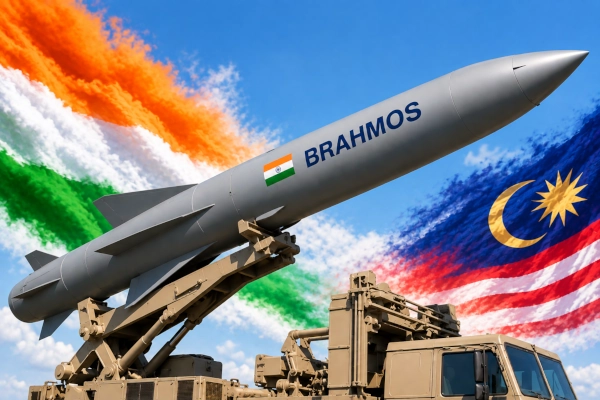
Malaysia has officially confirmed that it is exploring the acquisition of India’s BrahMos air-launched missile, potentially opening a new chapter in defence cooperation between New Delhi and Kuala Lumpur and creating another major export opportunity for the Indo-Russian supersonic cruise missile programme.
Malaysian Prime Minister Anwar Ibrahim confirmed the discussions on September 13, 2026, a day after meeting Prime Minister Narendra Modi on the sidelines of the BRICS Summit in New Delhi. Anwar said the two leaders had discussed the missile and acknowledged that initial-level discussions had already taken place, while stressing that Malaysia had not yet made a final procurement decision.
The Malaysian leader also made clear that further technical evaluation should be handled by the Royal Malaysian Air Force, which would have the expertise required to determine whether the weapon meets Malaysia’s operational requirements. His remarks move the BrahMos discussion beyond speculation by establishing at the highest political level that Malaysia is actively examining the Indian missile system.
Anwar Backs Further Discussions
Speaking about the possible acquisition, Anwar said he was supportive of taking the discussions forward and linked the proposal to the growing trust between India and Malaysia.
The importance of the statement lies not in the announcement of a contract, because none has yet been signed, but in Malaysia’s willingness to publicly acknowledge that an Indian strategic weapon is being considered by its air force.
The confirmation followed the September 12 meeting between Modi and Anwar in New Delhi. According to India’s Prime Minister’s Office, the two leaders reviewed cooperation across several areas, including defence and security, and reaffirmed their commitment to strengthening the India-Malaysia Comprehensive Strategic Partnership.
Defence cooperation has steadily become a more prominent part of the relationship. India and Malaysia have previously agreed to expand defence-industry collaboration and defence research and development, alongside military exchanges, exercises and capacity building.
Malaysia Is Looking at the Air-Launched BrahMos
The particular significance of the latest discussions is that Malaysia is not merely examining the shore-based BrahMos coastal-defence configuration. Anwar’s comments, as reported by Malaysia’s national news agency Bernama, specifically referred to the BrahMos air-to-surface missile system.
The air-launched version of BrahMos was developed for the Indian Air Force’s Su-30MKI fighter fleet. The missile can attack both land and maritime targets from stand-off distances, allowing the launch aircraft to release the weapon without having to approach the target as closely as it would when employing conventional bombs or shorter-range missiles.
BrahMos Aerospace describes the air-launched weapon as capable of precision attacks against both sea and land targets and designed for day-and-night, all-weather operations. The system was first successfully flight-tested from an Indian Su-30MKI against a maritime target in November 2017, followed by successful land-attack testing in 2019.
The Indian government said during the 2019 trials that the air-launched BrahMos weighed approximately 2.5 tonnes and travelled at around Mach 2.8, giving the Su-30MKI a powerful precision-strike capability against targets at sea and on land.
Malaysia’s Su-30MKM Creates an Obvious Technical Question
Malaysia operates the Su-30MKM, a Malaysian variant of the Sukhoi Su-30 family. The aircraft remains an important component of the Royal Malaysian Air Force’s combat fleet, and Malaysia’s Ministry of Defence continues to operate and maintain the type.
That naturally raises the possibility of adapting an air-launched BrahMos configuration for the Malaysian Sukhoi fleet. The Indian Air Force operates the closely related Su-30MKI, which already carries BrahMos.
However, Malaysia has not officially stated that the BrahMos would be integrated with the Su-30MKM, and no integration contract has been announced. The distinction is important because adapting a weapon as large and heavy as BrahMos to an aircraft requires significant engineering work rather than simply attaching it to an existing weapons station.
The Indian Su-30MKI programme involved mechanical, electrical and software modifications to the aircraft. HAL performed major airframe-related modifications, while Indian Air Force engineers participated in software integration. The process eventually produced an operational combination capable of carrying the large missile beneath the aircraft’s fuselage.
Any Malaysian programme would therefore require technical assessment of the intended launch aircraft, structural integration, avionics compatibility, fire-control software, certification and flight-testing before the weapon could enter operational service.
Indian and Malaysian Sukhois Already Cooperate
There is already a useful foundation for technical interaction between the two air forces.
The Royal Malaysian Air Force operates Su-30MKMs while the Indian Air Force operates Su-30MKIs, and the two countries have conducted exchanges involving their respective Sukhoi fleets. During Exercise Udara Shakti, Malaysian Su-30MKMs and Indian Su-30MKIs have operated together, while Indian Air Force specialists have also participated in technical exchanges involving Malaysian Su-30 maintenance facilities.
These exchanges do not mean that BrahMos integration is already underway, but they show that the two air forces have an existing working relationship involving closely related aircraft.
That familiarity could become relevant if the Royal Malaysian Air Force eventually selects an aircraft from its current fleet for the missile.
BrahMos Would Add a Powerful Maritime Strike Capability
For Malaysia, the attraction of an air-launched supersonic cruise missile would extend well beyond conventional land attack.
Malaysia has extensive maritime interests and sits astride strategically important sea lanes connecting the Indian Ocean and the Pacific. An air-launched anti-ship weapon would allow Malaysian combat aircraft to project precision firepower over considerable distances without requiring the launching fighter to close directly with a hostile naval formation.
BrahMos is particularly suited to this type of mission because it maintains supersonic velocity during its flight and can attack maritime as well as land targets.
An aircraft-launched weapon also offers mobility that a fixed or road-mobile coastal battery cannot completely replicate. Fighter aircraft can rapidly redeploy between bases, approach the launch area from different directions and extend the effective geographic reach of the missile by carrying it hundreds of kilometres before release.
That combination of aircraft range and missile stand-off distance is one of the principal reasons the Indian Air Force developed BrahMos for the Su-30MKI.
A Significant Export Opportunity for India
If Malaysia ultimately proceeds with an order, the deal would have significance well beyond the number of missiles acquired.
India has increasingly promoted BrahMos as one of the flagship products of its defence-export strategy. The Philippines became the first foreign customer for the shore-based BrahMos system, demonstrating that the missile could move beyond Indian service into the inventories of friendly foreign armed forces.
A Malaysian acquisition of the air-launched system would represent a different kind of export milestone. Instead of exporting a self-contained coastal missile battery, India and BrahMos Aerospace would potentially be involved in integrating a sophisticated heavy cruise missile with a foreign air force’s combat aircraft.
Such a programme would involve not just missile deliveries but also engineering, aircraft modification, testing, training, logistics and long-term support.
It could therefore establish an important reference point for future BrahMos air-launched exports.
India-Malaysia Defence Relations Are Expanding
The BrahMos discussions are taking place against a broader expansion of strategic relations between the two countries.
India and Malaysia elevated their relationship to a Comprehensive Strategic Partnership and agreed to intensify defence exchanges, exercises, industrial cooperation and defence research. During Modi’s visit to Malaysia in February 2026, the two leaders again reviewed defence and security cooperation as one of the priority areas of the bilateral relationship.
The September meeting in New Delhi continued that process. The PMO said Modi and Anwar reviewed progress in defence and security alongside trade, semiconductors, infrastructure, digital technologies and energy.
Malaysia’s public confirmation of BrahMos discussions now gives that defence relationship a potentially important capability-development dimension.
No Contract Has Yet Been Signed
Despite the significance of Anwar’s statement, the programme remains at an exploratory stage.
Malaysia has not announced the number of missiles it might acquire, the potential contract value, the aircraft that could carry the weapon, an acquisition timetable or a delivery schedule. There has also been no announcement of an agreement with BrahMos Aerospace for aircraft integration.
Anwar explicitly said that no final decision had been made and indicated that the Royal Malaysian Air Force should continue the technical process.
The correct interpretation is therefore that Malaysia has officially confirmed its interest and ongoing discussions, not that Malaysia has ordered BrahMos.
That distinction does not diminish the importance of the development. Until now, reports of Malaysian interest could be treated as defence-market speculation. The Malaysian prime minister has now publicly acknowledged that BrahMos was discussed directly with Modi and that initial discussions have taken place.
BrahMos Moves Deeper Into Southeast Asia
The Malaysian discussions also illustrate the growing strategic reach of India’s defence industry in Southeast Asia.
The Philippines has already brought the shore-based BrahMos system into its coastal-defence architecture. A Malaysian air-launched programme, if eventually approved, would expand the missile’s presence into an entirely different operational domain and demonstrate the adaptability of the BrahMos family across land, naval and airborne applications.
For Malaysia, the decision will ultimately depend on operational requirements, integration feasibility, cost, sustainment and the Royal Malaysian Air Force’s assessment of how the weapon fits into its future force structure.
For India, however, the political breakthrough has already occurred. Malaysia’s prime minister has publicly confirmed that the BrahMos air-launched missile is under consideration and has expressed support for allowing the technical discussions to continue.
The next stage will determine whether that political interest can be translated into an actual weapons programme. If it does, Malaysia could become an important overseas operator of one of India’s most capable air-launched precision-strike systems and give the BrahMos export programme another major foothold in Southeast Asia.
You may also like
-
JSW Steel’s Crude Steel Production Rises 5% to 7.27 Million Tonnes in Q2 FY2027
-
Kabra Extrusiontechnik’s GEON Commissions 20 MWh Battery Storage Project in Rajasthan
-
OBSC Perfection Secures ₹8.9 Crore Israeli Defence Order for Precision Fuze Components
-
NTPC Subsidiary NVVN Targets 1,000 MWh Battery Storage Capacity by March 2027
-
India and Russia Explore New Defence Co-Production and Joint Technology Development Opportunities
