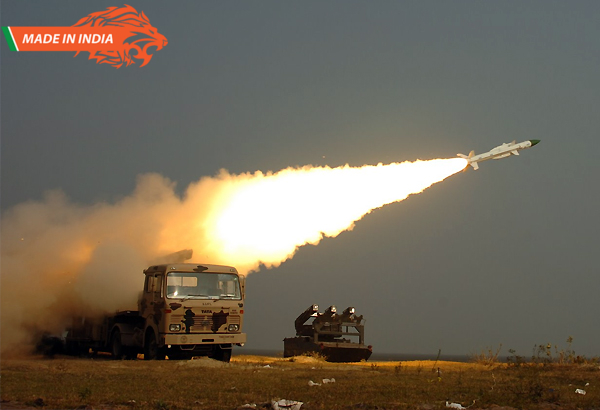
The Indian Air Force has successfully demonstrated the ability of its Akash and SPYDER surface-to-air missile systems to engage precision-guided stand-off weapons, providing an important indication of India’s growing capability to defend high-value targets against modern air-launched munitions.
According to details contained in the Ministry of Defence’s Annual Report 2025–26, the trials were conducted during a Specialist Weapon Firing Camp at the Pokhran Range from September 1 to 12, 2025, followed by another firing activity on November 11, 2025. During the trials, SPICE and HAMMER stand-off weapons released from Su-30MKI and Rafale fighter aircraft were successfully engaged by SPYDER and Akash surface-to-air guided weapon systems.
The significance of the exercise lies in the nature of the targets involved. Rather than restricting the trials to conventional aircraft or unmanned aerial vehicles, the IAF used precision stand-off weapons as aerial targets, testing whether its ground-based air-defence systems could respond to relatively compact, fast-moving weapons approaching defended installations.
Testing Air Defence Against Precision-Guided Weapons
Modern air forces increasingly rely on stand-off weapons because they allow combat aircraft to attack targets without flying directly into the engagement zones of hostile air-defence systems. Instead of attempting to penetrate a defended area, a fighter can release a precision weapon from a considerable distance and turn away while the weapon continues independently towards its target.
This creates a different challenge for air defenders. Destroying the launch aircraft is only one layer of the problem. If a stand-off weapon has already been released, ground-based air-defence systems may also have to detect, track and intercept the incoming munition before it reaches the protected installation.
The Pokhran trials indicate that the IAF has been actively testing this second layer of defence. By releasing operational stand-off weapons from frontline fighters and attempting to engage them with Akash and SPYDER, the Air Force was able to evaluate its air-defence systems against representative precision-strike threats under controlled conditions.
The Ministry of Defence material describes the weapons as having been successfully engaged. It is therefore more accurate to retain that terminology rather than assume details about individual hit assessments or the destruction of every target unless those results are separately disclosed.
SPICE Represents a Difficult Stand-Off Threat
SPICE, developed by Israel’s Rafael Advanced Defense Systems, is a family of precision air-to-surface weapons designed to attack targets from stand-off distances.
Rafael describes the SPICE family as autonomous precision-strike systems capable of operating even when satellite navigation is disrupted. SPICE guidance kits employ electro-optical seekers and scene-matching technology, allowing the weapon to compare imagery captured during its terminal approach with reference imagery stored before the mission.
The SPICE family includes several configurations with different ranges and warhead classes. Rafael lists SPICE 1000 and SPICE 2000 as guidance systems for 1,000-pound and 2,000-pound-class warheads, while SPICE 250 is a lighter complete weapon intended for high-volume precision strikes.
The Ministry of Defence account of the Pokhran exercise refers simply to SPICE stand-off weapons and does not publicly identify the exact SPICE variant used in the interception trials. It would therefore be incorrect to automatically describe the target as SPICE-2000 or another particular version.
HAMMER Brings a Different Precision-Strike Profile
The other weapon used during the exercise was the French AASM HAMMER, or Highly Agile Modular Munition Extended Range, manufactured by Safran Electronics & Defense.
HAMMER combines a conventional bomb body with a guidance system and range-extension kit, transforming it into an autonomous precision stand-off weapon. Safran describes the system as an all-weather air-to-surface weapon offering a stand-off range exceeding 70 kilometres in appropriate configurations.
Different HAMMER versions can employ INS/GPS, infrared or laser guidance. The weapon can also be launched from different altitudes and trajectories, giving combat aircraft considerable flexibility when striking defended targets. Safran says the system is designed for both close-air-support and deep-strike missions and can operate in environments where satellite-navigation signals are denied or disrupted.
HAMMER is closely associated with the Rafale, making its release from an IAF Rafale during an air-defence firing exercise especially useful for creating a realistic stand-off attack profile.
Akash Demonstrates a Broader Air-Defence Role
The indigenous Akash system is one of the principal components of India’s medium-range ground-based air-defence network. Developed by DRDO and produced with extensive participation from Bharat Dynamics Limited and Bharat Electronics Limited, the missile system is operational with both the Indian Air Force and the Indian Army.
DRDO describes Akash as a mobile surface-to-air missile system intended to protect vulnerable areas and vulnerable points against aerial attack. The system can simultaneously engage multiple targets and incorporates electronic counter-countermeasure capabilities to operate in contested electronic environments.
Akash has previously demonstrated the ability to handle demanding multi-target engagements. In December 2023, an IAF firing exercise demonstrated the simultaneous engagement of four aerial targets by a single Akash firing unit at ranges of approximately 25 kilometres.
The SPICE and HAMMER engagements add another dimension to that capability. Precision-guided munitions can present smaller radar signatures and different flight profiles compared with conventional aircraft, meaning that successful engagement demands effective detection, tracking, command-and-control and interceptor performance.
SPYDER Adds a Quick-Reaction Layer
The IAF’s SPYDER system provides another layer of short-range and quick-reaction air defence. Developed by Rafael, the system employs missiles derived from the Python and Derby families and is designed to engage a broad spectrum of aerial threats.
Rafael describes SPYDER as a mobile air-defence system capable of countering aircraft, helicopters, unmanned aerial vehicles and other sophisticated airborne threats. Newer variants can employ I-Derby and Python 5 interceptors, while the system’s modular architecture allows different configurations depending on operational requirements.
The manufacturer has also continued expanding SPYDER’s ability to deal with difficult targets. During recent trials, upgraded configurations demonstrated interceptions against low-radar-signature unmanned targets, illustrating the broader effort to adapt the system to increasingly complex aerial threats.
Within the IAF’s layered network, a quick-reaction system such as SPYDER can complement longer-range weapons by providing close protection to air bases, command centres, radars and other critical installations.
Why Intercepting the Weapon Matters
The evolution of precision warfare means that defending against aircraft alone is no longer sufficient. Fighter aircraft can increasingly remain outside heavily defended zones while launching glide bombs, powered stand-off weapons and cruise missiles towards military infrastructure.
An effective air-defence network therefore requires several opportunities to defeat an attack. Long-range fighters and surface-to-air missiles may attempt to engage the launch aircraft before weapon release. Once the weapon has been launched, however, shorter-range air-defence systems become responsible for preventing the munition from reaching its target.
This creates what is effectively a layered interception problem. Surveillance radars must first detect the incoming object, command networks must classify and prioritise it, and an appropriate interceptor must then be assigned within the limited time available before impact.
The Pokhran exercise suggests that the IAF is testing precisely this type of defensive architecture rather than treating its missile systems purely as anti-aircraft weapons.
Lessons From Recent Conflicts
Recent conflicts have demonstrated how large numbers of relatively inexpensive unmanned aircraft and precision-guided weapons can be combined with cruise missiles and ballistic missiles to overwhelm air defences.
Attackers may deliberately launch different types of weapons simultaneously, forcing defenders to decide which threats require interception and which interceptor should be used against each target. Protecting airfields, ammunition depots, command centres and radar installations therefore increasingly requires an integrated network rather than reliance on a single missile system.
India has been developing such a layered structure using systems ranging from short-range weapons to Akash, MR-SAM and the much longer-range S-400, supported by sensors, airborne surveillance and command-and-control networks.
The ability of Akash and SPYDER to engage stand-off precision weapons strengthens the lower and middle layers of that architecture, particularly around fixed assets that could themselves become the targets of enemy precision strikes.
A More Demanding Test Than a Conventional Target Drone
The use of SPICE and HAMMER during the firing camp is also notable because these are actual precision-strike systems rather than simple aerial target drones designed primarily for training.
A stand-off weapon can present a different radar signature, trajectory and terminal behaviour from a conventional target aircraft. Successfully detecting and engaging such objects gives air-defence crews a more representative opportunity to practise against threats they could face during a real precision-strike campaign.
At the same time, the Ministry of Defence report does not disclose the precise engagement ranges, altitude profiles, missile variants, number of stand-off weapons involved or which particular interceptor was assigned to each target. Those details should therefore not be inferred from the limited information released publicly.
Strengthening India’s Layered Air Defence
The trials provide a useful glimpse into how the Indian Air Force is preparing for an increasingly complex aerial-threat environment.
Akash and SPYDER were originally introduced primarily to protect Indian airspace and critical assets against hostile aircraft, helicopters, UAVs and related threats. Demonstrating their ability to engage precision-guided stand-off weapons expands their relevance to the type of saturation and multi-vector attacks increasingly seen in modern warfare.
The result is important not because it proves that any single air-defence system can provide an impenetrable shield, but because it demonstrates the development of multiple defensive layers. A hostile aircraft may face interception before reaching its launch point, while weapons that nevertheless get airborne can encounter additional missile defences as they approach their intended targets.
The Specialist Weapon Firing Camp at Pokhran therefore represented more than another routine missile firing. By putting SPICE and HAMMER stand-off weapons against Akash and SPYDER, the Indian Air Force tested the interaction between offensive precision weapons and ground-based air defence under controlled conditions.
As stand-off weapons become increasingly central to air warfare, the ability to detect and engage the weapon after launch will be just as important as the ability to threaten the aircraft carrying it. The IAF’s 2025 trials show that this challenge is already being incorporated into India’s air-defence training and operational preparation.
You may also like
-
JSW Steel’s Crude Steel Production Rises 5% to 7.27 Million Tonnes in Q2 FY2027
-
Kabra Extrusiontechnik’s GEON Commissions 20 MWh Battery Storage Project in Rajasthan
-
OBSC Perfection Secures ₹8.9 Crore Israeli Defence Order for Precision Fuze Components
-
NTPC Subsidiary NVVN Targets 1,000 MWh Battery Storage Capacity by March 2027
-
India and Russia Explore New Defence Co-Production and Joint Technology Development Opportunities
