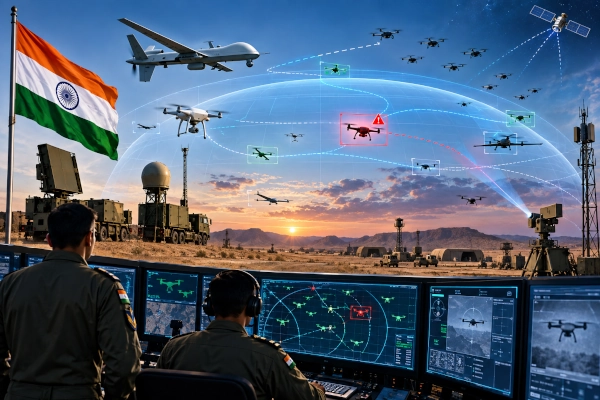
The Indian Air Force has demonstrated an indigenously developed unmanned traffic management system designed to track, coordinate and manage growing numbers of military and civilian drones operating in increasingly congested airspace.
Named Vayu UTtaM, the multi-mode Unmanned Traffic Management system was demonstrated during the opening day of the IAF’s maiden Dronathon-2026 at the Pokhran Field Firing Range in Jaisalmer on September 14.
During the real-time demonstration, Vayu UTtaM successfully detected and tracked both military and civilian Unmanned Aircraft Systems. According to the Ministry of Defence, the system is intended to support the coordinated management of drone operations while also assisting in the identification and timely mitigation of unauthorised or rogue UAS.
Managing an Increasingly Crowded Drone Battlespace
The emergence of Vayu UTtaM addresses a problem that is becoming progressively more important for modern air forces.
Military airspace can now contain conventional aircraft, helicopters, reconnaissance drones, loitering munitions, swarm systems and other unmanned platforms operating simultaneously. Civilian drones may also be present near military installations, airports and critical infrastructure.
Managing this environment requires more than simply detecting an airborne object. Commanders need to understand which unmanned aircraft are authorised, where they are operating and whether an unidentified platform represents a navigation conflict or a possible threat.
Vayu UTtaM is intended to provide that management layer.
The IAF describes it as a multi-mode UTM system capable of real-time detection and management of both military and civilian UAS, with the wider objective of creating safer and more resilient airspace as drone activity expands.
Rogue Drone Identification Adds a Security Role
Although Vayu UTtaM is primarily an unmanned traffic management system, its role extends into airspace security.
The Ministry of Defence said the system can support the identification of unauthorised or rogue drones and enable their timely mitigation.
This does not make Vayu UTtaM a standalone counter-drone weapon. Instead, it can form part of a wider counter-UAS architecture by providing information on drone activity and identifying platforms that do not correspond with authorised traffic.
Once a drone has been classified as unauthorised or potentially hostile, that information can be passed to appropriate counter-UAS systems or security agencies for action.
The distinction is important. Detection, identification and airspace management are separate from the physical or electronic means used to defeat a hostile drone.
Real-Time Tracking Demonstrated at Pokhran
The Pokhran demonstration gave the IAF an opportunity to evaluate Vayu UTtaM under operationally relevant conditions rather than presenting the system purely as a laboratory technology.
During the exercise, the system detected and tracked military and civilian UAS in real time, demonstrating its ability to maintain awareness of different categories of unmanned aircraft operating within the same airspace.
That capability becomes increasingly important when large numbers of friendly drones are operating simultaneously.
Future military operations could involve surveillance UAVs, communications relays, autonomous platforms and drone swarms operating alongside manned aircraft. Without an effective traffic-management layer, the growing number of airborne systems could itself create confusion and interfere with friendly operations.
Vayu UTtaM is intended to help prevent that problem by providing coordinated management of unmanned traffic.
Applications Beyond the Battlefield
The Ministry of Defence has also identified potential applications for Vayu UTtaM outside the military domain.
The technology could contribute to airspace safety, critical infrastructure protection, civil aviation and public safety, particularly as commercial and government drone operations become more common.
Airports, power stations, refineries, military bases and major public events increasingly face the challenge of distinguishing legitimate drone operations from unauthorised activity.
A traffic-management system capable of maintaining a recognised picture of authorised unmanned aircraft could help security agencies identify abnormal activity more quickly.
This dual-use potential makes Vayu UTtaM relevant not only to military airspace management but also to India’s rapidly expanding civilian drone ecosystem.
Dronathon-2026 Tests Indigenous UAS Technologies
Vayu UTtaM was demonstrated as part of the first IAF Dronathon, being held at Pokhran from September 14 to 16.
The event brings together more than 20 Indian defence companies, start-ups, MSMEs, defence public-sector enterprises and technology innovators, with systems being evaluated under realistic operational conditions.
The IAF had earlier said Dronathon-2026 would focus on surveillance and reconnaissance systems, autonomous operations, drone swarms, electronic warfare and counter-UAS technologies.
Unlike a conventional technology exhibition, the objective is to evaluate how emerging systems perform when exposed to demanding operational conditions and whether they can deliver useful combat effects.
The Air Force is assessing systems for reliability, operational effectiveness and their ability to adapt to changing threats and battlefield requirements.
IAF Releases UAS Roadmap for Indian Industry
Air Marshal Ashutosh Dixit, Vice Chief of the Air Staff, inaugurated Dronathon-2026 and also released the IAF UAS Roadmap during the event.
The roadmap is intended to provide Indian industry with greater clarity regarding the Air Force’s future unmanned-system requirements.
By outlining capability priorities, the IAF hopes defence companies, start-ups, universities and research organisations will be able to direct investment and development towards technologies with clear operational relevance.
The initiative also reflects an attempt to shorten the distance between experimental drone technologies and systems that can eventually enter operational service.
Unmanned Systems Becoming Integral to Air Operations
The IAF has made clear that it does not view unmanned aircraft as replacements for manned combat aviation.
Instead, UAS are increasingly being treated as complementary platforms capable of increasing the reach, persistence, responsiveness and flexibility available to commanders.
Drones can remain airborne for prolonged periods, conduct surveillance without risking aircrew, operate as communications relays and potentially function as swarms or collaborative platforms alongside manned aircraft.
But as the number of unmanned aircraft increases, the ability to coordinate their movement and maintain situational awareness becomes just as important as the drones themselves.
Vayu UTtaM addresses precisely that problem.
Building the Complete Unmanned Ecosystem
Dronathon-2026 also illustrates how the IAF’s unmanned strategy extends beyond the acquisition of individual drone airframes.
The Ministry of Defence said the Air Force’s indigenisation effort covers the wider UAS ecosystem, including propulsion, sensors and payloads, communications, autonomy, electronic warfare, countermeasures and airspace management.
Vayu UTtaM therefore represents one component of a much larger architecture.
A future drone-heavy battlespace will require not only aircraft capable of surveillance, strike and electronic warfare, but also the networks required to identify them, coordinate their operations and distinguish friendly systems from unknown or hostile platforms.
The IAF’s demonstration of Vayu UTtaM at Pokhran shows that airspace management is now being treated as an integral part of India’s unmanned warfare effort.
As military and civilian drone numbers continue to grow, controlling the information surrounding those aircraft — knowing which platforms are present, where they are operating and whether they are authorised — could become as important as controlling the drones themselves.
You may also like
-
JSW Steel’s Crude Steel Production Rises 5% to 7.27 Million Tonnes in Q2 FY2027
-
Kabra Extrusiontechnik’s GEON Commissions 20 MWh Battery Storage Project in Rajasthan
-
OBSC Perfection Secures ₹8.9 Crore Israeli Defence Order for Precision Fuze Components
-
NTPC Subsidiary NVVN Targets 1,000 MWh Battery Storage Capacity by March 2027
-
India and Russia Explore New Defence Co-Production and Joint Technology Development Opportunities
