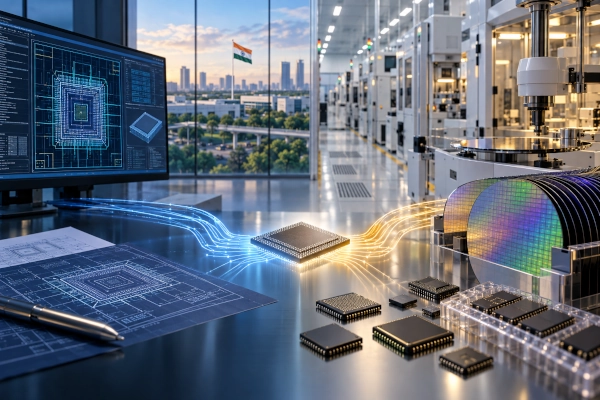
L&T Semiconductor Technologies and Tata Electronics have announced a strategic partnership to expand the indigenous manufacturing of semiconductor products designed in India, bringing together domestic chip design with Indian foundry, packaging and testing capabilities.
The partnership, announced on 18 September 2026, is intended to help convert L&T Semiconductor’s chip designs into commercially manufactured products using Tata Electronics’ semiconductor infrastructure. The collaboration will support products aimed at automotive, industrial, communications, security and intelligent-edge applications.
The agreement is significant because it links two different parts of the semiconductor value chain that India is attempting to strengthen simultaneously: indigenous chip design and domestic semiconductor manufacturing.
From Indian Chip Design to Domestic Manufacturing
L&T Semiconductor Technologies operates as a fabless semiconductor company, meaning that it focuses on chip architecture, design and product development without owning its own fabrication plants.
Under the new partnership, Tata Electronics will provide access to its semiconductor foundry, packaging and testing capabilities, allowing L&T Semiconductor to explore domestic fabrication and packaging opportunities for its existing and future products.
The two companies will also work on optimising chip designs for fabrication, an important step in moving a semiconductor product from the design stage into repeatable high-volume manufacturing.
This process can involve adapting layouts, verifying manufacturing rules, improving yields and ensuring that the final design is compatible with the process technologies available at the selected foundry.
Collaboration Covers Current and Future L&T Semiconductor Products
The partnership is not limited to a single chip.
L&T Semiconductor and Tata Electronics plan to jointly evaluate fabrication and packaging opportunities across L&T Semiconductor’s current and future product portfolio.
L&T Semiconductor is developing devices across power electronics, compute, analog and mixed-signal products, IoT modules and radio-frequency technologies.
These products are intended for markets including automotive electronics, industrial systems, energy, data centres and telecommunications.
By pairing these designs with Tata Electronics’ manufacturing infrastructure, the companies are seeking to create a domestic pathway from semiconductor design through fabrication, packaging, testing and eventual deployment.
Automotive and Industrial Applications Form Major Focus Areas
Automotive electronics are expected to be one of the major target sectors for the collaboration.
Modern vehicles increasingly depend on semiconductors for power management, motor control, sensors, communications, safety systems and software-defined functions.
Industrial equipment presents a similar opportunity because factories, automation systems, robotics, power electronics and connected machinery require large volumes of reliable semiconductors designed for long operating lifetimes.
The partnership will also cover communications, security and intelligent-edge applications, where chips must often process data locally with low latency and high reliability.
These markets are particularly suited to mature and specialised semiconductor technologies, where product reliability, power efficiency and long-term availability can matter more than simply achieving the smallest possible transistor size.
Tata Electronics Provides Foundry, Packaging and Testing Capability
Tata Electronics is building an increasingly broad semiconductor manufacturing platform in India.
Its planned semiconductor fab at Dholera in Gujarat will provide front-end wafer fabrication capability, while its semiconductor packaging operation at Jagiroad in Assam is intended to support assembly, packaging and testing.
The company is positioning itself as an integrated semiconductor manufacturing partner capable of serving customers across foundry manufacturing, packaging, testing and design services.
That combination is especially relevant for a fabless company such as L&T Semiconductor, which needs external manufacturing partners to convert completed chip designs into physical devices.
The collaboration therefore gives L&T Semiconductor a potential domestic manufacturing pathway rather than depending entirely on overseas foundries and packaging providers.
Design-to-Fabrication Optimisation Will Be Important
One of the technically important elements of the agreement is the planned cooperation on chip design-to-fabrication optimisation.
A semiconductor design cannot simply be transferred unchanged from a computer-aided design environment to any manufacturing line. Each fabrication process has its own design rules, materials, electrical characteristics and manufacturing limitations.
Engineers must therefore optimise a chip for the specific process technology that will manufacture it.
This work can affect transistor layout, interconnects, power characteristics, thermal behaviour, reliability and manufacturing yield.
Closer cooperation between the design company and the foundry can reduce development cycles and improve the likelihood that a new semiconductor enters commercial production successfully.
Packaging Becomes an Increasingly Important Part of Chip Performance
The partnership also extends beyond wafer fabrication into semiconductor packaging.
Modern chip packaging increasingly influences electrical performance, thermal management, power efficiency and system integration.
For some applications, advanced packaging can allow multiple semiconductor dies or functional components to be combined within a single package, creating more capable systems without relying entirely on smaller manufacturing nodes.
Tata Electronics is investing heavily in semiconductor packaging capacity in India, giving the partnership another domestic manufacturing layer after wafer fabrication.
L&T Semiconductor will therefore be able to evaluate both chip fabrication and packaging within the same broader Indian semiconductor ecosystem.
L&T Semiconductor Building an India-Based Product Portfolio
L&T Semiconductor Technologies was established as a wholly owned subsidiary of Larsen & Toubro to build an Indian semiconductor products business.
The company is developing a portfolio spanning power semiconductors, compute products, analog and mixed-signal devices, IoT modules and RF technologies.
Its strategy is centred on creating India-designed semiconductor products that can serve both domestic and international markets.
The company has established operations in Bengaluru and Noida while also maintaining an international presence in the United States, Europe and Japan.
The Tata Electronics partnership gives these product-development efforts access to a domestic manufacturing partner capable of supporting the transition from design into commercial production.
Partnership Comes as L&T Expands Its Chip Portfolio
The agreement coincides with a broader expansion of L&T Semiconductor’s product pipeline.
The company has been developing semiconductor products for areas including power conversion, automotive electronics, motor control, communications and intelligent systems.
Its approach reflects a shift in India’s semiconductor strategy from focusing primarily on design services towards the creation of complete semiconductor products owned and developed by Indian companies.
A domestic manufacturing route could strengthen this model further by allowing more of the product value chain to remain within India.
Reducing Dependence on Overseas Manufacturing
India has long possessed a strong semiconductor design workforce, but much of the physical manufacturing of chips designed by Indian engineers has historically taken place abroad.
This separation has meant that intellectual-property development, fabrication, packaging and testing often occur across different countries.
The L&T Semiconductor–Tata Electronics partnership attempts to connect more of these stages within India.
If the collaboration progresses into large-scale manufacturing, Indian-designed devices could be fabricated, packaged and tested domestically before being supplied to Indian or global customers.
This would not eliminate dependence on international equipment, materials or intellectual property, but it would deepen India’s participation in the semiconductor value chain.
Supply-Chain Resilience Is a Major Objective
The partnership also reflects the importance companies now place on semiconductor supply-chain resilience.
The global chip shortages of recent years demonstrated how dependence on a small number of manufacturing regions can disrupt industries ranging from automobiles to communications equipment.
Creating additional semiconductor manufacturing capacity in India could provide companies with another production option while diversifying global supply networks.
For Indian manufacturers, domestic semiconductor production could also reduce exposure to international shipping delays and provide closer coordination between chip designers and manufacturing facilities.
Supporting India’s Full-Stack Semiconductor Ambition
Tata Electronics has described its strategy as contributing to the development of a full-stack semiconductor ecosystem in India.
Such an ecosystem would include chip design, wafer fabrication, advanced packaging, testing, materials, equipment, engineering services and skilled manpower.
L&T Semiconductor contributes the product-design side of this equation, while Tata Electronics is building the manufacturing infrastructure required to fabricate and package those products.
The partnership therefore represents a practical example of how separate Indian semiconductor investments could begin operating as an integrated ecosystem rather than as isolated projects.
Designed in India, Manufactured in India, Sold Globally
The commercial ambition behind the partnership extends beyond the Indian market.
Both companies have indicated that the semiconductor products developed and manufactured through the collaboration are intended to serve global customers.
This is important because semiconductor manufacturing facilities require scale. Domestic demand can provide an initial market, but competitive fabs and packaging plants generally need international customers to maintain high utilisation rates.
Developing India-designed products for overseas markets could therefore support both L&T Semiconductor’s growth and Tata Electronics’ ambitions to become a global semiconductor manufacturing supplier.
A Significant Step in India’s Semiconductor Industrialisation
The L&T Semiconductor–Tata Electronics partnership brings together two capabilities that India has spent years trying to connect: domestic chip design and domestic manufacturing.
L&T Semiconductor contributes product architecture, engineering and semiconductor intellectual property, while Tata Electronics provides the foundry, packaging and testing infrastructure required to industrialise those designs.
If the cooperation progresses successfully, semiconductor products conceived and engineered in India could move through fabrication, packaging and testing within the country before entering domestic and global markets.
That would represent an important shift from India being primarily a semiconductor design centre towards becoming a more complete semiconductor product and manufacturing ecosystem.
References
- L&T Semiconductor Technologies / Larsen & Toubro — L&T Semiconductor and Tata Electronics Partner to Expand Indigenous Manufacturing of Market-Leading Chip Products for Global Customers, 18 September 2026
https://www.larsentoubro.com/pressreleases/2026/2026-09-18-lt-semiconductor-and-tata-electronics-partner-to-expand-indigenous-manufacturing-of-market-leading-chip-products-for-global-customers/ - Tata Electronics — L&T Semiconductor and Tata Electronics Partner to Expand Indigenous Manufacturing of Market-Leading Chip Products for Global Customers, 18 September 2026
https://www.tataelectronics.com/w/l-t-semiconductor-and-tata-electronics-partner-to-expand-indigenous-manufacturing-of-market-leading-chip-products-for-global-customers - Tata Electronics — Semiconductor Assembly and Test
https://www.tataelectronics.com/semiconductor-assembly-and-test - Tata Electronics — Corporate Semiconductor Manufacturing and Design Capabilities
https://www.tataelectronics.com/
You may also like
-
Sensorise Launches Made-in-India Wega M1 4G Module for EVs, Smart Meters and Industrial IoT
-
Katarni Rice — Bihar’s Fragrant Ceremonial Grain from the Gangetic Plains
-
Nayan Technologies Selected by JSW MG Motor to Advance AI-Based Road Monitoring and Smart Mobility
-
From ‘We Will Coup Whoever We Want’ to Starlink in India: Elon Musk, Corporate Pressure and National Sovereignty
-
Indian Navy to Commission Indigenous Anti-Submarine Warfare Ship Mangrol on October 12
