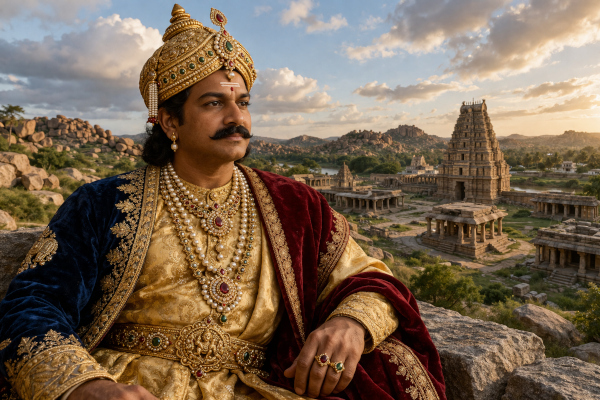
Krishnadevaraya is often remembered in popular history as a victorious emperor and patron of poets, but that neat summary understates the scale of what he actually did. Reigning from 1509 to 1529, he ruled at the moment when Vijayanagara became the most formidable power in peninsular India, and even standard reference works describe him as the greatest of the Vijayanagar kings. Under him, the kingdom reached a new peak of internal consolidation and military power, while its influence stretched deep into the Deccan and the eastern coast. Britannica notes that during his reign the Raichur doab was secured, Udayagiri was captured in 1514, and major defeats were inflicted on Bijapur in 1520. A major scholarly study likewise places his northeastern expansion in the 1510s and says his campaigns pushed Vijayanagara’s reach as far as the Godavari river and delta.
What made Krishnadevaraya strategically important was not simply that he won wars, but that he changed the balance of power in South India. The Deccan in his time was not a simple Hindu-versus-Muslim chessboard; it was a volatile arena of shifting alliances, fort warfare, cavalry mobility, prestige politics, and revenue competition. Krishnadevaraya’s achievement was to prevent Vijayanagara from remaining a defensive southern kingdom and instead turn it into the decisive arbiter of peninsular politics. His campaigns in the early years of his reign were directed first to the north and then to the southeast, and from about 1514 onward he undertook a sequence of major operations that substantially enlarged the empire. The result was not only territorial expansion but political deterrence: rival powers had to calculate around Vijayanagara, not merely against it.
His most famous battlefield triumph, the Battle of Raichur in 1520, deserves attention not just as a heroic episode but as a military watershed. Modern scholarship describes it as one of the earliest major South Asian battles to feature cannon, matchlocks, and European mercenaries in a significant way. Richard Eaton’s study of the battle argues that it marked the earliest substantial appearance of cannon in offensive and defensive roles, the earliest known appearance of matchlock firearms, and the first major use of European mercenaries in such a conflict. That alone makes Raichur historically larger than a regional war. At the same time, the enormous troop totals often repeated in older narratives need caution. Later retellings and traveller-based accounts speak of forces running into the hundreds of thousands, and one source associated with the Portuguese tradition lists 32,600 cavalry, 550 elephants, and a vast infantry host; such figures are useful for showing the scale that contemporaries wanted to convey, but modern historians do not treat every number literally. What is beyond dispute is that Raichur was a decisive Vijayanagara victory and a demonstration that Krishnadevaraya could combine conventional force, siege warfare, and new military technologies better than his rivals at a crucial moment.
Yet Krishnadevaraya was not merely a conqueror in armor. His deeper strength lay in administration, and here he is strangely under-discussed in popular writing. One of the most revealing windows into his political mind is his Telugu work Āmuktamālyada, which is not just a devotional literary masterpiece but also a text with ideas about kingship, welfare, and statecraft. Scholars of the text have shown that it carries a clear political theory: kingship is tied to order, moral responsibility, practical intelligence, and careful management of the realm. In one passage discussed by modern interpreters, Krishnadevaraya advises giving refuge to foreigners displaced by drought, disease, and calamity, which suggests a ruler thinking not only in terms of conquest but of managed prosperity and humane statecraft. Another scholarly discussion of the text highlights his preference for appointing trustworthy Brahmins to command forts, not out of abstract piety but because he viewed them as politically safer instruments of authority in a world where military decentralization could quickly become rebellion. This is the language of a ruler obsessed with durability, not simply glory.
His administrative imagination also had a hard material side: water, revenue, cultivation, and infrastructure. Vijayanagara’s core zone lay in a relatively dry landscape, with some studies noting annual rainfall around 500 mm in the Hampi region, which meant that agrarian stability could not depend on monsoon luck alone. That context makes irrigation policy central to understanding his reign. A historical study of tanks in Karnataka cites a Vijayanagara-era statement attributed to Krishnadevaraya that righteousness and economic prosperity both increase when tanks and irrigation canals are built. That line is not decorative idealism; it is almost a governing formula. Major irrigation works associated with his era, including the Cumbum tank tradition, show how water control, settlement support, and agrarian expansion were treated as royal responsibility. The International Commission on Irrigation and Drainage notes that the Cumbum Tank, constructed in the Krishnadevaraya era, is about 7 km long and 3.5 km wide, with irrigation benefits extending to thousands of acres. Whether or not every later legend attached to such works is accepted as literal history, the broader pattern is clear: state power under Krishnadevaraya expressed itself through hydraulic investment as much as through military spectacle.
This is also why foreign visitors found Vijayanagara astonishing. Portuguese observers encountered not a loose camp-city of a warlord, but a highly organized imperial center with fortifications, bazaars, palace zones, temple complexes, and layered urban planning. A University of Hyderabad thesis based on European travel accounts describes Paes’ account of successive fortifications, great streets, royal enclosures, and bazaars, while also preserving the sort of army listings and urban detail that suggest an empire run through administrative segmentation rather than improvisation. Even when one discounts the tendency of travellers to exaggerate scale, the consistency of their descriptions matters: Vijayanagara under Krishnadevaraya looked to outsiders like a capital of immense wealth, disciplined movement, market density, and ceremonial order. This urban confidence was part of his strategy. A capital that looked invincible helped make the empire seem invincible.
His cultural legacy is just as consequential. Krishnadevaraya’s reign is widely treated as a golden age of Telugu literature, but the phrase should be understood properly. He did not merely “support writers”; he turned court culture into an instrument of imperial prestige. He himself authored Āmuktamālyada, and modern scholarship treats it as one of the major works of Telugu literature. His court became associated with the celebrated Aṣṭadiggajas, while literary production under him flourished across Telugu, Sanskrit, Kannada, and Tamil. This multilingual patronage is important because Vijayanagara was not a culturally uniform state. Krishnadevaraya’s genius lay partly in making a plural empire feel ideologically coherent without flattening its linguistic worlds. He became, in effect, a cultural sovereign as well as a military one.
Religion, too, under him was not a private ornament but a public language of sovereignty. His repeated patronage of major temples helped convert devotion into legitimacy, memory, and inscriptional permanence. The Tirumala tradition is particularly striking: later accounts note that out of roughly 1,250 published temple epigraphs at Tirumala, 229 are attributed to Krishnadevaraya, an extraordinary numerical footprint for a single ruler. His donations of gold and jewels to the temple are also part of the historical memory preserved around the site. Such acts were not simply pious gifts; they were political declarations, embedding royal authority in sacred geography. In a polity spread across multiple linguistic and regional zones, temple patronage helped bind the imperial image to institutions that ordinary people trusted more than court proclamations.
In the end, Krishnadevaraya matters not because he fits the comforting template of a “great Hindu king,” but because he was one of the rare premodern rulers in India who combined battlefield audacity, territorial expansion, literary authorship, hydraulic vision, institutional intelligence, and ideological self-awareness in one reign. He did not simply resist the Deccan Sultanates; he forced them to reckon with a South Indian empire operating at full strategic maturity. He did not merely patronise Telugu literature; he helped define an era in which literature itself became a mode of kingship. And he did not just leave monuments; he left a model of rule in which war, welfare, religion, language, and infrastructure were fused into a single imperial project. That is why he should be read not as a picturesque relic of late medieval India, but as one of the subcontinent’s most sophisticated state-builders.
Reerence:
Encyclopaedia Britannica. Krishna Deva Raya | emperor of India. Available at: https://www.britannica.com/biography/Krishna-Deva-Raya Eaton, Richard M. “‘Kiss My Foot,’ Said the King: Firearms, Diplomacy, and the Battle for Raichur, 1520.” Modern Asian Studies. Cambridge University Press. Available at: https://www.cambridge.org/core/journals/modern-asian-studies/article/kiss-my-foot-said-the-king-firearms-diplomacy-and-the-battle-for-raichur-1520/C1119D2078354BEEC93D5F35517A700F Eaton, Richard M. “‘Kiss My Foot,’ Said the King: Firearms, Diplomacy, and the Battle for Raichur, 1520.” JSTOR record. Available at: https://www.jstor.org/stable/pdf/20488080.pdf IGNOU / eGyanKosh. Unit 8: Amuktamalyada and Rayavachakamu. Available at: https://egyankosh.ac.in/bitstream/123456789/84175/3/Unit-8.pdf International Commission on Irrigation and Drainage (ICID). Cumbum Tank. Available at: https://icid-ciid.org/award/his_details/131 Tirumala Tirupati Devasthanams (TTD) eBooks. Inscriptions Of Krishnarayas Time From 1509 A.D. To 1531 A.D. Available at: https://ebooks.tirumala.org/read?id=82&title=Inscriptions+Of+Krishnarayas+Time+From+1509+A+D+To1531+A+D HathiTrust Catalog. Inscriptions of Krishnaraya’s time, from 1509 A.D. to 1531 A.D. Available at: https://catalog.hathitrust.org/Record/102049751
You may also like
-
Sindhu: The Indus Kingdom of Jayadratha in the Mahabharata
-
Kuninda or Kulinda: The Himalayan Realm of the Mahabharata in Uttarakhand and Himachal Pradesh
-
Durga versus Mahishasura: Weapons, Battlefield Tactics and the Triumph of Shakti
-
Kuluta: The Kullu Valley Kingdom of the Mahabharata
-
Israel to Honour Indian Pilot Smit Machchhar with Highest Civilian Bravery Award for Saving Flydubai Flight
