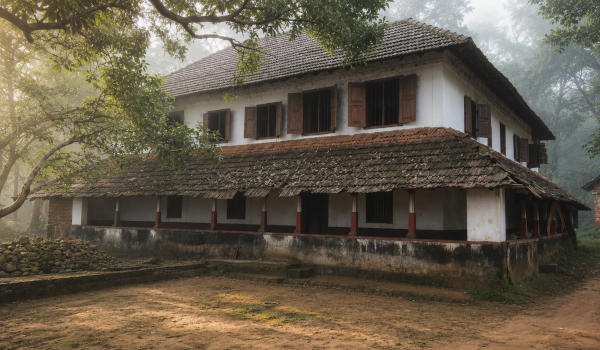
The Kottayam Rajas of Malabar occupy a proud place in the history of northern Kerala. Long before British dominance reshaped the political map of Malabar, the Kottayam royal house ruled over an important region that covered parts of present-day Kannur and Wayanad. This was the royal lineage from which Kerala Varma Pazhassi Raja emerged, the warrior-prince later remembered as the “Kerala Simham,” or Lion of Kerala.
This Kottayam should be understood as Kottayam of Malabar, located in northern Kerala, and not the present-day Kottayam district in central Kerala. In historical records, the kingdom is often referred to as Kottayam, Cotiote or Kotiote. Its royal dynasty was known as the Purannatt Swarupam, and its political influence extended across a landscape of hills, forests, pepper-growing regions, trade routes and strategic passes linking Malabar with the highlands.
The early origins of the Kottayam royal house are wrapped in tradition. One account connects the family with Harischandra Perumal, who is said to have built a fort at Puralimala and made it a centre of authority. Because of this association, the rulers were also linked with names such as Puralisas and Purannattu Rajas. Over time, the royal family became one of the important ruling houses of North Malabar, situated within a political world shaped by the Kolathiris, local chieftains, temple networks, warrior houses and trade interests.
The kingdom’s geography gave it both wealth and strategic importance. The Kottayam-Malabar region lay close to the spice-producing areas of the Western Ghats and the ports of the Malabar coast. Black pepper, forest produce, hill routes and access to Wayanad made the territory highly valuable. The rulers had to manage a complex political landscape that included coastal trade, hill communities, neighbouring principalities and later the military ambitions of Mysore and the British East India Company.
The Kottayam royal family had three major branches: the eastern branch, the southern branch and the western branch. The western branch, known as the Padinjare Kovilakam, was located at Pazhassi. This branch became famous across Kerala because of Kerala Varma Pazhassi Raja, who rose from within the Kottayam royal family during one of the most turbulent periods in Malabar’s history.
The Kottayam Rajas were also associated with cultural refinement. The kingdom is remembered in Kerala’s artistic history for its contribution to Kathakali. The Kottayam royal house produced patrons and scholars who helped refine the art form during its formative period. Kottayath Thampuran, often remembered as Vidwan Thampuran, is traditionally credited with major contributions to Kathakali literature through the composition of Attakathas. This shows that the dynasty was not only a political power but also a cultural force.
The 18th century transformed the destiny of the Kottayam kingdom. When Hyder Ali of Mysore expanded into Malabar in the 1770s, many local rulers were forced into difficult choices. The Raja of Kottayam sought refuge in Travancore, creating a political vacuum in the kingdom. During this period, Kerala Varma Pazhassi Raja, though not originally first in line to rule, emerged as the effective leader of the Kottayam resistance.
Pazhassi Raja’s rise was rooted in the strength of the Kottayam royal house and its relationship with the people of the region. He understood the terrain, the forest routes, the hill passes and the social networks of Malabar. He built support among local warriors, peasants and tribal communities, especially in Wayanad. His authority came from royal legitimacy as well as his ability to defend the land during a time of external pressure.
The Kottayam kingdom first faced the power of Mysore under Hyder Ali and later Tipu Sultan. Pazhassi Raja resisted Mysorean authority with determination. After the Third Anglo-Mysore War, when Malabar came under British influence, the political situation changed once again. The British East India Company attempted to control revenue collection and administration in Kottayam, creating conflict with local authority and customary rights.
This led to the famous Pazhassi resistance, also known as the Cotiote War. While the struggle is often remembered through the heroic figure of Pazhassi Raja, it was deeply connected to the political legacy of the Kottayam Rajas. The conflict was not merely the rebellion of an individual. It was the defence of a regional order, local autonomy, traditional rights and the dignity of a royal house that had ruled parts of northern Kerala before colonial consolidation.
The forests and hills of Wayanad became the theatre of resistance. Pazhassi Raja used guerrilla warfare, mobility, local intelligence and terrain advantage against a much larger colonial force. His struggle gave the Kottayam royal house a permanent place in the memory of Kerala. The dynasty that once ruled pepper-rich Malabar became remembered as the house that produced one of India’s earliest and most admired anti-colonial warriors.
The importance of the Kottayam Rajas also lies in their connection with Malabar’s regional identity. Their kingdom stood at the meeting point of coast and highland, trade and agriculture, palace culture and forest resistance. Their history tells us how smaller Kerala polities functioned before modern state boundaries were created. They governed through lineage, local alliances, martial networks, temple relationships and control over strategic landscapes.
Today, the memory of the Kottayam Rajas survives most vividly through Pazhassi Raja, but the dynasty’s legacy is wider. It includes political leadership in North Malabar, cultural patronage of Kathakali, control of spice-linked territories, resistance to Mysorean expansion and later opposition to British domination. The remaining palace traditions, local place names and historical circuits of Kannur and Wayanad continue to keep this memory alive.
The Kottayam Rajas of Malabar deserve to be remembered as one of northern Kerala’s significant royal houses. They ruled a strategic region, shaped cultural life and produced a leader whose name became a symbol of courage. In the story of Kerala’s kings, warriors and dynasties, the Kottayam royal house stands as the lineage that gave Malabar its resistance spirit and Kerala its Lion.
You may also like
-
Namami Gange in 2026: 368 Projects Completed, 4,339 MLD Sewage Treatment Capacity Created as Ganga Rejuvenation Advances
-
ASI’s Kashipur Archaeological Site Reveals Ancient Govisana, Gupta-Era Temples and Mahabharata Traditions
-
Parasika in the Mahabharata: Tracing the Persian Lands Through Modern Iran
-
Kapisa: The Ancient Kingdom North of Kabul at the Gateway of the Hindu Kush
-
Lampaka: The Mountain Kingdom of Laghman on the Kabul River Frontier
