GI Produce of India | Goa | Spices and Agricultural Heritage
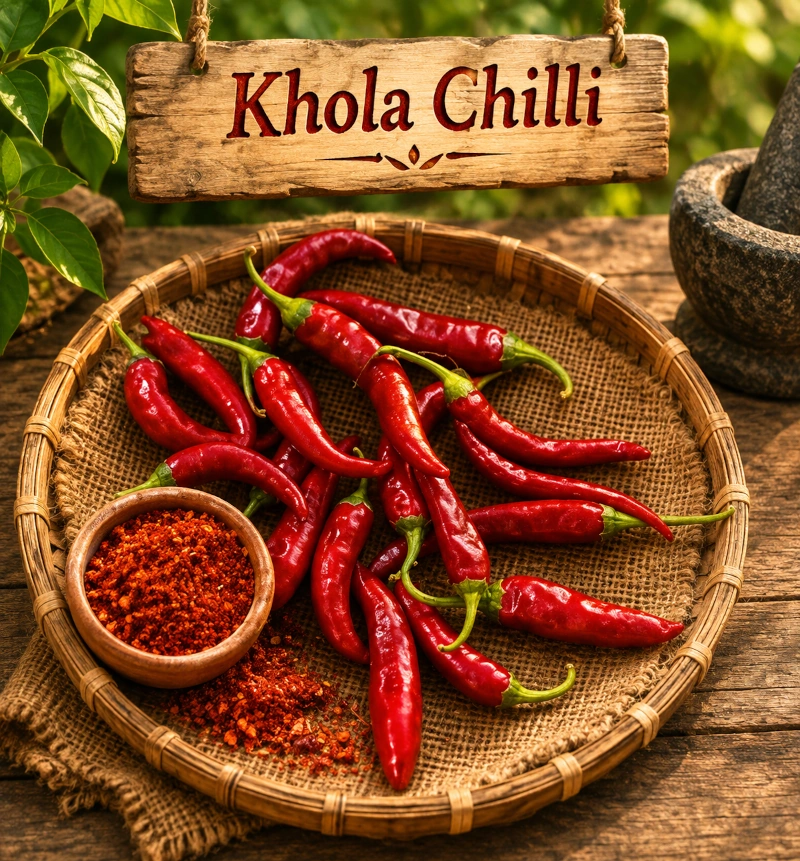
Khola Chilli, one of Goa’s distinctive traditional agricultural products, represents the farming heritage, culinary traditions, and indigenous agricultural knowledge of the state’s southern coastal hinterland. Recognised for its brilliant red colour, moderate pungency, smooth and comparatively thick skin, and characteristic flavour, this traditional chilli variety has been preserved through generations of cultivation by farming communities in the hills of Canacona.
Known locally as Kholchi Mirsang and also called Canacona Chilli, this distinctive spice derives its name from Khola, a village in the Canacona taluka of South Goa. The chilli is traditionally cultivated on hill slopes under rainfed conditions during the kharif season, with farmers relying on locally adapted cultivation practices and organic sources of soil fertility.
Unlike chilli varieties grown primarily for intense heat, Khola Chilli is particularly valued for its attractive red colour, balanced pungency, and suitability for traditional Goan culinary preparations. Its thick outer covering also provides advantages during drying, storage, and transportation, contributing to its commercial reputation.
The product received Geographical Indication protection on 28 August 2019, formally recognising its distinctive geographical identity. Its agricultural significance was further strengthened in June 2024 when Khola Chilli became Goa’s first farmer plant variety registered under the Protection of Plant Varieties and Farmers’ Rights framework.
Historical Origins and the Agricultural Heritage of Khola
The history of Khola Chilli is closely connected with the development of chilli cultivation along India’s western coast. Chillies originated in the Americas and entered the Indian subcontinent through maritime trading networks during the early modern period. Portuguese maritime activity played an important role in introducing New World crops to India’s western coastal regions, including Goa.
Over subsequent centuries, chilli cultivation became firmly established in Goa’s agricultural and culinary traditions. Different local varieties developed through adaptation to the state’s tropical climate, seasonal rainfall, agricultural soils, and traditional farming practices.
The village of Khola, located in the hilly landscape of Canacona, became associated with a distinctive chilli variety valued for its brilliant red colour and moderate pungency. Farming communities preserved the crop through generations of seed selection, cultivation, harvesting, and processing.
The traditional cultivation of Khola Chilli has been particularly associated with the local tribal farming communities, who maintained the variety within diversified agricultural systems. Farmers developed knowledge of suitable planting periods, soil preparation, crop management, and seed preservation, allowing the chilli to remain part of the region’s agricultural heritage.
The crop gradually acquired commercial recognition beyond the immediate village because of its colouring properties and suitability for traditional Goan food preparations. Its reputation also contributed to the wider appreciation of locally adapted agricultural varieties from Goa.
The historical importance of Khola Chilli therefore lies in the transformation of an introduced crop into a distinctive regional agricultural product through generations of local cultivation and conservation.
Geographical Origin and the Agricultural Landscape of Canacona
Khola Chilli is traditionally cultivated in Khola village, also written as Cola, in Canacona taluka of South Goa district. The village is located within a landscape characterised by hill slopes, rocky terrain, agricultural settlements, and tropical vegetation.
The region experiences a warm and humid tropical climate, with substantial seasonal rainfall associated with the southwest monsoon. The agricultural landscape includes hill slopes and relatively shallow or rocky soils that require careful management to support crop production.
Khola Chilli is traditionally cultivated under rainfed conditions during the kharif season. Farmers take advantage of seasonal rainfall while adapting their cultivation methods to the terrain and soil characteristics of the region.
The crop is particularly associated with hillside cultivation, where agricultural practices differ from those followed in extensive irrigated plains. Traditional farmers prepare suitable growing areas and use locally available organic materials to maintain soil fertility.
Green manuring has been an important feature of Khola Chilli cultivation. The incorporation of green plant material into the soil helps improve organic matter content and supports soil fertility.
The relationship between the chilli and its geographical origin extends beyond climatic conditions. The accumulated knowledge of local farming communities, the preservation of traditional planting material, and the continued use of locally adapted agricultural practices have contributed to the product’s distinctive identity.
What Makes Khola Chilli Unique?
The most recognisable characteristic of Khola Chilli is its brilliant red colour, accompanied by moderate pungency and a comparatively thick, smooth outer covering. These qualities distinguish it from several other traditional chilli varieties cultivated in Goa.
Khola Chilli belongs to the species Capsicum annuum, which includes numerous commercially important chilli varieties differing in fruit size, shape, colour, and pungency.
The fruits are generally elongated, with documented lengths ranging from approximately 5.6 to 7.4 centimetres and diameters of around 1.2 to 1.4 centimetres. Their elongated appearance distinguishes them from several shorter local chilli varieties.
The outer covering is relatively thick and smooth, providing some protection against physical damage during drying, handling, and transportation. This characteristic also contributes to the chilli’s storage suitability when appropriate post-harvest conditions are maintained.
The most distinctive commercial quality of Khola Chilli is its attractive red pigmentation. When dried and processed into powder, the chilli contributes a rich red colour to traditional food preparations.
Its moderate pungency makes it suitable for culinary applications where flavour and colouring properties are required without the extreme heat associated with highly pungent chilli varieties.
The combination of physical characteristics, colouring strength, and traditional geographical association has established Khola Chilli as a distinctive agricultural product within Goa’s spice economy.
Capsaicin, Colour, and the Scientific Characteristics of Khola Chilli
The pungency of Khola Chilli is associated with capsaicinoids, naturally occurring compounds found in chilli fruits. Capsaicin and dihydrocapsaicin are among the principal substances responsible for the characteristic burning sensation produced by pungent chillies.
According to documented product specifications, Khola Chilli has a pungency of approximately 17,100 Scoville Heat Units. This places it within the moderately pungent range of commercial chilli varieties, although actual values may vary according to cultivation conditions, plant characteristics, fruit maturity, and processing.
The documented capsaicin content is approximately 0.11%, providing a further indication of its pungency.
Khola Chilli is also recognised for its red colouring characteristics. Its recorded ASTA colour value is approximately 34.3, a measurement used in the spice industry to assess extractable colour.
The bright-red appearance of mature chilli fruits is associated with carotenoid pigments, particularly capsanthin and capsorubin. These naturally occurring compounds contribute to the colour of the dried fruit and the chilli powder produced from it.
The combination of moderate heat and desirable colouring properties makes Khola Chilli suitable for food preparations requiring a balanced flavour profile.
Although the documented measurements provide useful indicators of the variety’s characteristics, they should not be regarded as fixed values for every harvested fruit. Agricultural and environmental conditions can influence the chemical composition of chilli crops.
Traditional Cultivation and Farming Practices
Khola Chilli cultivation is closely associated with the traditional farming knowledge of the agricultural communities of Canacona. Farmers have preserved the variety through seed selection and continued cultivation under the region’s rainfed agricultural conditions.
The crop is traditionally grown during the kharif season, taking advantage of the southwest monsoon rainfall. Farmers prepare suitable planting areas on hill slopes and rocky agricultural land, adapting their methods to local terrain and soil characteristics.
Seedlings are generally raised before being transplanted into prepared fields. Appropriate spacing and soil preparation support plant growth while facilitating crop management.
Traditional cultivation practices place considerable emphasis on maintaining soil fertility through organic materials. Green manuring is particularly associated with the cultivation of Khola Chilli, reflecting the importance of locally available resources in traditional agricultural systems.
The crop requires adequate moisture during establishment and growth, but prolonged waterlogging can adversely affect plant health. Farmers therefore rely on their understanding of local rainfall patterns and drainage conditions when managing cultivation.
Weeding, crop observation, and protection against pests and diseases are important parts of agricultural management. Chilli plants may be affected by insects such as thrips and mites, as well as fungal and viral diseases.
Modern agricultural research can support traditional cultivation through improved nursery practices, soil testing, appropriate nutrient management, and integrated pest management.
Maintaining the distinctive characteristics of Khola Chilli while improving productivity remains an important consideration as commercial interest in the variety expands.
Harvesting, Drying, and Traditional Processing
Harvesting Khola Chilli requires careful observation of fruit maturity because colour development is an important factor determining commercial quality.
Farmers generally collect the fruits when they reach the desired stage of maturity. Green chillies may be used in certain household preparations, while mature red fruits are particularly valuable for drying and producing chilli powder.
The crop is traditionally harvested after the main growing period, although the precise harvesting schedule depends on planting dates, rainfall, and local conditions.
After harvesting, the chillies are dried to reduce moisture and prepare them for storage, transportation, and commercial processing. Traditional sun-drying remains associated with chilli production in many parts of Goa.
Proper drying is particularly important for preserving the bright-red colour and characteristic flavour of Khola Chilli. Excessive moisture can encourage fungal growth and deterioration, while unsuitable handling can affect the appearance and commercial quality of the produce.
The comparatively thick outer covering of the chilli provides advantages during handling and storage by reducing susceptibility to physical damage.
Once adequately dried, the chillies can be stored whole or processed into powders, flakes, and other value-added products.
Modern processing methods increasingly emphasise hygienic drying surfaces, moisture control, suitable packaging, and protection against contamination.
These improvements can help maintain the quality of Khola Chilli while expanding opportunities for commercial processing.
Culinary Importance in Traditional Goan Cuisine
Khola Chilli occupies an important place in Goa’s culinary traditions, where dried red chillies are used extensively in spice pastes, curries, pickles, chutneys, and traditional masala preparations.
Goan cuisine reflects a combination of local agricultural ingredients, coastal food traditions, and historical cultural influences. Chillies are important components of many characteristic preparations, contributing colour, pungency, and flavour.
Khola Chilli is particularly valued for its ability to impart an attractive red colour without overwhelming food preparations with excessive heat.
One of its important culinary applications is in the preparation of recheado masala, a traditional Goan spice paste commonly associated with fish and other stuffed or marinated preparations. Red chillies contribute colour and flavour to the masala, complementing ingredients such as garlic, vinegar, and other spices.
The chilli is also used in traditional pickles, including green chilli and raw mango preparations. Its moderate pungency allows it to contribute flavour while maintaining a balance with the other ingredients.
Dried Khola Chilli can be ground into powder for use in curries, vegetable preparations, and spice mixtures. Its bright-red pigmentation makes it suitable for dishes where visual appearance is an important culinary characteristic.
The variety is also used in the preparation of chilli flakes, sauces, and papads, demonstrating its versatility in traditional and modern food products.
Its culinary significance therefore reflects the relationship between regional agriculture and Goa’s distinctive food culture.
Traditional Food Processing and Value Addition
Khola Chilli offers opportunities for agricultural value addition because of its colouring properties, moderate pungency, and established geographical reputation.
Traditional farming households have long processed chillies into preserved products to extend their usefulness beyond the fresh harvesting period. Drying, pickling, and grinding are common methods of preserving the crop.
Modern commercial applications include chilli powder, chilli flakes, red chilli sauces, pickles, and spice pastes.
Khola Chilli is particularly suitable for products where a rich red colour and balanced pungency are desirable. Its colouring characteristics also create potential applications in the production of food-grade natural colour extracts.
The development of hygienically processed and appropriately packaged products can help farmers and small enterprises obtain greater value from the crop.
Food-processing activities can also create opportunities for rural entrepreneurship, particularly among farming households and community-based producer organisations.
The geographical identity of Khola Chilli provides an additional opportunity to distinguish products made from authentic locally cultivated chillies.
The Role of Farming Communities in Conserving Khola Chilli
One of the most important aspects of Khola Chilli’s heritage is the role played by local farming communities in preserving the traditional variety.
The chilli has been maintained through generations of cultivation by farmers in Khola village, including members of the region’s tribal communities.
Traditional seed selection has helped preserve desirable characteristics such as fruit colour, size, pungency, and adaptation to local growing conditions.
The continued cultivation of Khola Chilli also reflects the importance of indigenous agricultural knowledge in conserving regional crop diversity.
The Khola/Canacona Chilli Cultivators Group has played an important role in organising farmers and supporting the protection of the traditional variety.
The group’s conservation efforts received national recognition in December 2016 when it was honoured with the Plant Genome Saviour Community Award under the Protection of Plant Varieties and Farmers’ Rights framework.
The award recognised the community’s contribution to preserving the traditional Khola Chilli variety and other locally adapted crops.
These conservation efforts demonstrate that agricultural biodiversity depends not only on scientific institutions but also on the continued participation of farming communities maintaining traditional varieties.
Geographical Indication Recognition and the Protection of Khola Chilli
Khola Chilli received formal protection under India’s Geographical Indications framework to safeguard its geographical identity and distinctive agricultural characteristics.
The application was submitted by the Khola/Canacona Chilli Cultivator’s Group Association, with the involvement of the Department of Science and Technology, Government of Goa.
The application was filed on 6 August 2018 under Class 30 and assigned Application No. 618.
ICAR’s Central Coastal Agricultural Research Institute, Goa, played an important supporting role in documenting the agricultural characteristics of the variety and facilitating cooperation between the farmers’ association and the government agencies involved in the registration process.
Following examination and submission of the required documentation, the application was published in Geographical Indications Journal No. 121 on 26 April 2019.
The Geographical Indications Registry issued Certificate No. 356 on 28 August 2019, formally recognising Khola Chilli as a registered geographical indication.
The registration established legal recognition for the geographical identity of the chilli and provided a framework for protecting its name against unauthorised commercial use.
The current registration remains valid until 5 August 2028, subject to renewal under the applicable provisions of India’s Geographical Indications legislation.
GI Tag Journey of Khola Chilli
The Geographical Indication recognition of Khola Chilli reflects the formal protection of a traditional agricultural variety preserved by farming communities in the hills of southern Goa. Its journey combines generations of indigenous cultivation, community-led conservation of agricultural biodiversity, scientific documentation, and modern legal recognition.
The GI registration process began in August 2018 following earlier efforts to document and protect the variety. The application underwent examination, formal scrutiny, and publication in the Geographical Indications Journal before receiving its registration certificate in August 2019. A further milestone was achieved in June 2024 when Khola Chilli received registration as a farmer plant variety under the Protection of Plant Varieties and Farmers’ Rights framework.
| Period / Date | Milestone |
|---|---|
| Historical period | Chilli cultivation became established in Goa following the introduction of chillies into the Indian subcontinent through maritime trading networks. |
| Generations of traditional cultivation | Farming communities in Khola village, Canacona, preserved a distinctive chilli variety through traditional seed selection and rainfed cultivation on hill slopes. |
| Traditional agricultural development | Khola Chilli acquired a regional reputation for its brilliant red colour, moderate pungency, thick outer covering, and suitability for Goan culinary preparations. |
| 21 December 2016 | The Khola/Canacona Chilli Cultivators Group received the Plant Genome Saviour Community Award for conserving traditional agricultural varieties, including Khola Chilli. |
| 7 March 2017 | An application was filed seeking registration of Khola Chilli as a farmer variety under the Protection of Plant Varieties and Farmers’ Rights framework. |
| 6 August 2018 | The Khola/Canacona Chilli Cultivator’s Group Association filed GI Application No. 618 for Khola Chilli under Class 30. |
| 25 September 2018 | The Geographical Indications Registry issued its formality check report concerning the application. |
| 22 October 2018 | The applicant submitted its response to the formality check report. |
| 13 February 2019 | The GI Registry issued its examination report concerning the Khola Chilli application. |
| 11 April 2019 | The applicant submitted its response to the examination report. |
| 26 April 2019 | The application appeared in Geographical Indications Journal No. 121, formally publishing the proposed registration of Khola Chilli. |
| 28 August 2019 | Khola Chilli received GI Certificate No. 356, formally recognising its geographical identity and association with Goa. |
| 10 June 2024 | Khola Chilli was granted registration as Goa’s first farmer plant variety under the Protection of Plant Varieties and Farmers’ Rights framework. |
| 9 June 2025 | The Government of Goa honoured women farmers from Canacona for their contributions to conserving traditional Khola Chilli cultivation and agricultural biodiversity. |
| 5 August 2028 | The current GI registration remains valid until this date, subject to further renewal. |
The registration timeline demonstrates the important role played by farming communities in securing formal recognition for Khola Chilli. The Plant Genome Saviour Community Award in 2016 acknowledged the conservation efforts of local growers, while the GI certificate issued in August 2019 established legal protection for the chilli’s geographical identity.
The farmer-variety registration granted in June 2024 represents a further achievement because it recognises the contribution of the Khola/Canacona Chilli Cultivators Group to preserving and maintaining the traditional variety. Together, these developments strengthen the institutional recognition of Goa’s agricultural heritage and provide opportunities for protecting traditional crop resources.
GI Details at a Glance
| Particular | Details |
|---|---|
| Geographical Indication | Khola Chilli |
| State | Goa |
| District | South Goa |
| Taluka | Canacona |
| Traditional Production Area | Khola (Cola) village |
| Other Names | Canacona Chilli, Kholchi Mirsang |
| Botanical Name | Capsicum annuum L. |
| Botanical Family | Solanaceae |
| Product Category | Agricultural |
| GI Class | 30 |
| Application Number | 618 |
| Date of Filing | 6 August 2018 |
| Registered Proprietor / Applicant | The Khola/Canacona Chilli Cultivator’s Group Association (TKCCGA), with the Department of Science and Technology, Government of Goa, identified as a co-applicant in APEDA records |
| Registered Proprietor’s Address | H. No. 356(2), Soliem, Khola (Cola), Canacona, Goa – 403702 |
| GI Journal | No. 121 |
| GI Journal Availability Date | 26 April 2019 |
| Certificate Number | 356 |
| GI Certificate Date | 28 August 2019 |
| Geographical Area | Goa, with traditional cultivation centred on Khola village in Canacona |
| Fruit Colour | Brilliant red when fully mature |
| Fruit Shape | Elongated, with a relatively thick and smooth outer covering |
| Fruit Length | Approximately 5.6–7.4 cm |
| Fruit Diameter | Approximately 1.2–1.4 cm |
| Pungency | Approximately 17,100 Scoville Heat Units |
| Capsaicin Content | Approximately 0.11% |
| ASTA Colour Value | Approximately 34.3 |
| Characteristic Flavour | Moderately pungent, with a distinctive chilli flavour |
| Traditional Cultivation | Rainfed hillside cultivation, traditionally using green manuring |
| Principal Growing Season | Kharif |
| Traditional Culinary Applications | Recheado masala, pickles, chutneys, curries, and chilli powders |
| Commercial Applications | Dried chillies, chilli powder, flakes, sauces, pickles, and natural colouring ingredients |
| Plant Genome Saviour Community Award | 21 December 2016 |
| Farmer Variety Registration | 10 June 2024 |
| Farmer Variety Registration Number | REG/2017/160 |
| Current GI Status | Registered |
| GI Registration Valid Until | 5 August 2028 |
The registration details are based on the official Geographical Indications Registry and APEDA records. The agricultural characteristics and traditional cultivation practices are supported by ICAR-Central Coastal Agricultural Research Institute, Goa, and technical documentation relating to the registered product.
Protecting Authenticity and Supporting Farming Communities
The Geographical Indication designation establishes a legally recognised connection between Khola Chilli and its geographical origin. However, maintaining the commercial value of the product requires continued attention to authenticity, product quality, and the preservation of traditional agricultural practices.
The distinctive characteristics of Khola Chilli, particularly its brilliant red colour, moderate pungency, elongated fruit shape, and thick outer covering, contribute to its commercial identity. Preserving these qualities is important because commercially similar chilli varieties may not possess the same geographical association or traditional cultivation history.
The GI framework allows eligible producers to seek authorised-user registration under the applicable legal provisions. Such recognition supports the legitimate commercial use of the protected geographical indication and helps distinguish authentic products from those originating outside the registered production area.
The Khola/Canacona Chilli Cultivator’s Group Association plays an important role in preserving the variety and representing the interests of traditional growers. Collective organisation can support improved access to agricultural information, processing facilities, and commercial markets.
The farmer-variety registration granted in 2024 provides a separate form of legal recognition under India’s plant variety protection framework. Unlike GI protection, which concerns the geographical identity of a product, farmer-variety registration recognises rights associated with the registered plant variety under the applicable legislation.
Together, these two forms of recognition strengthen the institutional framework available for conserving Khola Chilli and supporting the farming communities responsible for its continued cultivation.
Economic Importance and Rural Livelihoods
Khola Chilli cultivation contributes to the agricultural economy of Canacona by providing farming households with a distinctive crop that can be marketed fresh or processed into value-added products.
The crop is traditionally cultivated by small farming households, with agricultural activities involving seed preparation, field management, harvesting, drying, sorting, and marketing.
Its commercial importance extends beyond the sale of fresh chillies. Dried chillies, chilli powder, pickles, sauces, and traditional spice preparations provide opportunities for additional processing and rural entrepreneurship.
The recognition of Khola Chilli under the GI framework creates opportunities for developing a specialised market identity based on its geographical origin and distinctive characteristics.
However, farmers face challenges associated with small-scale production, seasonal rainfall, labour availability, limited processing infrastructure, and access to organised commercial markets.
Improved packaging, hygienic processing, suitable storage, and stronger connections with buyers can help increase the commercial value of the crop.
Farmer-producer organisations and community-based enterprises can also contribute to collective marketing and the development of products that emphasise the authenticity of Khola Chilli.
These measures can help strengthen rural livelihoods while preserving the agricultural practices associated with the variety.
Agricultural Research and the Recognition of Farmers’ Rights
Scientific research has played an important role in documenting the characteristics of Khola Chilli and supporting its formal recognition.
ICAR-Central Coastal Agricultural Research Institute, Goa, contributed to collecting, characterising, and documenting the variety. The institute also supported the registration process by providing technical information and facilitating cooperation with local farmers.
The research effort helped establish the distinctive characteristics of Khola Chilli and contributed to its recognition under the Geographical Indications framework.
The institute subsequently supported the application for farmer-variety registration under the Protection of Plant Varieties and Farmers’ Rights Act.
On 10 June 2024, Khola Chilli was registered as Goa’s first farmer plant variety, recognising the Khola/Canacona Chilli Cultivators Group as the breeder associated with the traditional variety.
The development represents an important example of cooperation between scientific institutions and farming communities in conserving agricultural biodiversity.
Research into the genetic characteristics, cultivation requirements, disease resistance, and post-harvest qualities of Khola Chilli can further support its long-term conservation and commercial development.
Scientific documentation is particularly valuable for traditional crop varieties because it provides a foundation for recognising and preserving characteristics maintained through generations of farmer selection.
Preserving Traditional Knowledge and Agricultural Biodiversity
The heritage of Khola Chilli is closely connected with the knowledge accumulated by farming communities over generations.
Traditional growers understand the importance of selecting suitable seeds, preparing hillside agricultural land, managing seasonal rainfall, and maintaining soil fertility through locally available resources.
These practices have contributed to the preservation of a chilli variety adapted to the ecological conditions of southern Goa.
The continued cultivation of Khola Chilli also reflects the importance of agricultural biodiversity within Goa’s traditional farming systems.
Locally adapted crop varieties contribute to the diversity of agricultural resources and preserve characteristics that may be valuable for future research and cultivation.
The recognition of the Khola/Canacona Chilli Cultivators Group through national conservation awards and farmer-variety registration demonstrates the importance of community participation in agricultural conservation.
Preserving traditional seed resources and farming knowledge will remain essential as agricultural production systems evolve and commercial pressures influence crop selection.
The geographical indication provides an additional mechanism for recognising the relationship between traditional agricultural knowledge and the distinctive identity of Khola Chilli.
Future Prospects for Khola Chilli
The future of Khola Chilli lies in combining its established agricultural heritage with improved cultivation, processing, and market development.
Its distinctive red colouring, moderate pungency, and geographical identity create opportunities for specialised spice products and traditional Goan food preparations.
Greater investment in hygienic drying, suitable storage, scientific packaging, and local processing facilities can help reduce post-harvest losses and increase the value of harvested produce.
The development of packaged chilli powders, traditional Goan masalas, pickles, sauces, and other value-added products can create opportunities for community-based enterprises and agricultural entrepreneurs.
Farmer organisations can also benefit from improved access to technical guidance, organised marketing systems, and quality-testing facilities.
The recognition of Khola Chilli as both a GI-protected product and a registered farmer variety provides a strong foundation for preserving its authenticity and supporting the communities responsible for maintaining it.
At the same time, conservation of traditional planting material and agricultural knowledge will remain essential to protecting the variety’s distinctive identity.
By integrating traditional farming practices with scientific research and responsible commercial development, Goa can strengthen the long-term prospects of Khola Chilli cultivation.
Khola Chilli — The Brilliant Red Agricultural Heritage of Goa
Khola Chilli represents the successful transformation of a traditional agricultural variety into a product of regional identity, culinary importance, and recognised agricultural heritage.
Its brilliant red colour, moderate pungency, thick outer covering, and distinctive flavour reflect the agricultural knowledge developed by farming communities in the hills of Canacona.
The Geographical Indication recognition obtained in 2019 formally acknowledged the relationship between the chilli and its traditional geographical origin. The farmer-variety registration granted in 2024 further recognised the contribution of local growers to preserving this distinctive agricultural resource.
For the farming communities of Khola village, the chilli represents generations of cultivation expertise, traditional food practices, and participation in Goa’s agricultural economy.
Its importance extends from household kitchens and village agricultural fields to specialised food-processing opportunities and the wider conservation of India’s agricultural biodiversity.
By preserving its authenticity, supporting traditional growers, and strengthening scientific cultivation and processing, Khola Chilli can continue to represent the distinctive agricultural heritage of southern Goa while contributing to India’s broader spice economy.
References
The principal official reference for this article is the Geographical Indications Registry, Intellectual Property India, which records Khola Chilli under Application No. 618, Certificate No. 356, dated 28 August 2019, with registration validity extending until 5 August 2028. Its application records document the registration proceedings, examination reports, responses, journal publication, and certification.
Additional institutional references include the Agricultural and Processed Food Products Export Development Authority (APEDA), which maintains information on Goa’s registered geographical indications, and ICAR-Central Coastal Agricultural Research Institute, Goa, which provided scientific and technical support for the documentation and legal recognition of Khola Chilli.
The Protection of Plant Varieties and Farmers’ Rights Authority and ICAR publications provide information concerning the Plant Genome Saviour Community Award, the conservation activities of the Khola/Canacona Chilli Cultivators Group, and the farmer-variety registration granted in June 2024.
The Directorate of Agriculture, Government of Goa, provides additional information on traditional chilli cultivation, local agricultural varieties, and crop-management practices in the state.
You may also like
-
India Tracks ₹38.11 Lakh Crore Infrastructure Investment Pipeline
-
Suzlon Energy Lays Foundation Stone for 1 GW AI-Enabled Wind Turbine Blade Factory in Tamil Nadu
-
Avore Electric Reports 90 Per Cent Domestic Component Sourcing for Electric Motorcycles
-
Indian Nuclear Startup SUK-M Secures Funding to Develop Indigenous Thorium Microreactor
-
Jupiter Wagons Partners South Korea’s Woojin to Manufacture Metro Trains and Propulsion Systems in India
