GI Produce of India
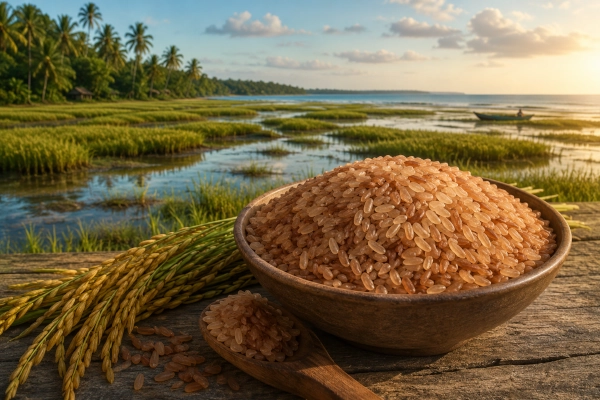
Along the brackish-water wetlands of North Kerala survives one of India’s most unusual rice-growing traditions. Kaipad Rice is cultivated in low-lying coastal fields where freshwater from the monsoon meets saline water carried inland by tides. Instead of attempting to completely separate agriculture from this constantly changing wetland environment, generations of farmers developed a system that works with it.
The traditional Kaipad landscape is concentrated in the northern Kerala districts of Kannur, Kasaragod and Kozhikode. Here, farmers grow salt-tolerant rice during the low-salinity monsoon months and subsequently allow fish, prawns and other aquatic organisms to occupy the same fields during the more saline part of the year. The result is an integrated rice–aquaculture system in which the paddy field functions simultaneously as farmland, seasonal wetland and aquatic habitat.
Kaipad Rice received Geographical Indication protection in 2014, recognising both the distinctive grain produced in these fields and the traditional agricultural ecosystem from which it originates. Its identity depends less upon a single rice cultivar than upon the relationship between salt-tolerant rice varieties, tidal water, monsoon rainfall, wetland soils and the traditional farming knowledge of North Kerala.
The Tidal Rice Fields of North Kerala
The word Kaipad is traditionally associated with kayalpadam—a paddy field connected with backwaters. The name accurately describes the landscape. Kaipad fields occur in coastal wetlands influenced by rivers, estuaries and tidal channels, where saline water can enter during the dry season and freshwater dominates during the monsoon.
These fields are found principally in Kannur, with additional tracts in Kozhikode and Kasaragod. Kerala’s official GI information describes approximately 4,100 hectares of traditional Kaipad landscape, of which around 3,400 hectares are in Kannur, approximately 500 hectares in Kozhikode and about 200 hectares in Kasaragod. Only a portion of this historical area remains under active cultivation, highlighting both the ecological importance of the surviving fields and the challenges facing the system.
The Kaipad landscape is quite different from a conventional irrigated paddy field. It consists of marshes, shallow wetlands, channels and low-lying fields whose water conditions change through the year. High tides can bring saline water inland, while heavy monsoon rainfall lowers salinity sufficiently for rice cultivation.
Farmers therefore do not control the landscape completely. They time their agricultural cycle to the natural rhythm of the coast.
Rice During the Monsoon, Fish After the Harvest
The defining feature of Kaipad agriculture is the rotation between rice cultivation and traditional aquaculture.
Rice is generally cultivated from approximately June to October, when monsoon rain and river discharge reduce the salinity of the fields to levels that salt-tolerant paddy can withstand. After the rice harvest, salinity gradually rises again and fish, prawns and shrimp become the principal biological production of the same wetland from roughly November through the dry-season months.
This creates a remarkable ecological partnership. Crop residues remaining after the rice harvest provide organic material that supports aquatic organisms. Fish and prawns entering the fields through tidal channels feed within this productive wetland environment. Their wastes and decomposing biological material subsequently contribute nutrients to the soil before the next rice crop.
The rice and aquatic phases are therefore not independent activities carried out on the same land. They form different stages of a single ecological farming cycle.
Farming Without Conventional Chemical Inputs
Traditional Kaipad cultivation is notable for its very limited dependence on outside agricultural inputs.
The established system does not traditionally rely on synthetic fertilisers or chemical plant-protection products. Instead, nutrients are replenished through sediments carried by tidal and river water, decomposed vegetation, paddy residues and organic material generated during the aquatic phase. Kerala’s official GI information describes Kaipad as a traditional natural farming system in which rice, fish and shrimp are produced without chemical fertilisers and pesticides.
The tidal exchange itself contributes to soil fertility. Water entering from rivers, backwaters and estuaries deposits organic matter and fine sediments, while mangroves and wetland vegetation surrounding many Kaipad areas participate in nutrient cycling.
This natural fertility is one reason Kaipad has increasingly attracted attention as an example of agriculture adapted to a fragile coastal ecosystem rather than imposed upon it.
Growing Rice in Saline Soil
Salinity is the principal agricultural challenge in Kaipad fields.
Ordinary rice varieties cannot necessarily survive in soils repeatedly exposed to brackish water. Farmers therefore preserved local varieties capable of tolerating saline conditions, seasonal inundation and the unusual soil chemistry of coastal wetlands.
Traditional Kaipad cultivars include Kuthiru, Orkayama, Kuttusan, Chovverian and Orthadian. Government agricultural planning documents identify these among the principal local salt-tolerant varieties historically cultivated in the system, with Kuthiru particularly widespread in surviving Kaipad fields.
These varieties represent valuable genetic resources. Their ability to survive in an environment that would damage many ordinary rice cultivars has become increasingly significant as agricultural scientists search for rice capable of coping with salinity, flooding and climate-related stress.
Kaipad’s value therefore extends beyond the rice harvested each year. Its traditional varieties preserve traits that could contribute to the resilience of future rice agriculture.
Rice Grown on Small Mounds
Traditional cultivation techniques are themselves adapted to the wetland.
Rather than always preparing a uniformly level field, farmers traditionally form small mounds in the soft Kaipad soil and place germinated seed on them. As seedlings become established and monsoon water fills the landscape, the growing plants adapt to the changing water level.
This method reduces the need for conventional transplanting in extremely soft and marshy terrain. It also reflects generations of experimentation with an environment where ordinary paddy-field practices can be difficult.
The cultivation remains highly dependent upon rainfall and tides. Too much salinity at the beginning of the season can prevent establishment, while excessive flooding can damage young plants. Successful Kaipad farming therefore requires close observation of rainfall, river conditions, tidal movement and water levels.
The farmer works according to the rhythm of the wetland rather than a completely controlled irrigation schedule.
A Landscape Nourished by Mangroves
Mangroves form an important part of the wider Kaipad ecosystem.
They occur along the fringes of estuaries and backwaters, where their roots stabilise mud, trap sediment and provide nursery habitat for fish and crustaceans. The Kaipad farming community recognises these wetlands as part of a broader ecological system supporting rice, aquaculture, birds and aquatic biodiversity.
Mangrove roots also contribute to nutrient cycling in waterlogged soils. Fish and prawn populations use these environments as breeding and feeding areas, while birds are attracted to the abundance of aquatic organisms.
Kaipad should consequently not be imagined as an isolated rice field surrounded by conventional farmland. It belongs to a mosaic of estuaries, tidal creeks, mangroves, marshes and cultivated wetlands.
This ecological setting is one of the strongest reasons for treating Kaipad Rice as a geographical product. The rice cannot be understood separately from the landscape that produces it.
The Grain Is Not Defined by One Variety
Like Palakkadan Matta, Kaipad Rice is important because its GI identity is not restricted to a single cultivar.
Several traditional rice varieties have historically been cultivated within the Kaipad system, and Kerala Agricultural University has subsequently developed improved varieties specifically suited to the region.
This means that Kaipad Rice can show differences in grain size, kernel colour and cooking behaviour according to the variety cultivated. Many important Kaipad varieties produce red kernels, but not every recognised variety is identical in colour or grain type.
What unites them is their adaptation to the saline Kaipad environment and their production within the traditional coastal farming system.
This diversity gives the GI an additional conservation role. Protecting Kaipad Rice encourages preservation not merely of one seed variety but of an entire group of rice genetic resources adapted to the wetlands of northern Kerala.
Kuthiru and Orkayama — Genetic Resources for Salinity Tolerance
Among the traditional varieties, Kuthiru and Orkayama have attracted particular scientific interest.
Research at Kerala Agricultural University identified these varieties as valuable genetic resources for salt tolerance. Scientists found Orkayama especially interesting because its mechanism of salinity tolerance appeared to differ from that of Pokkali, another famous salt-tolerant rice from Kerala.
Such diversity is valuable because salinity tolerance is not a single simple characteristic. Different plants can survive salt stress through different physiological and genetic mechanisms.
Maintaining multiple traditional varieties consequently provides plant breeders with a wider genetic toolbox.
As sea-level rise, saline intrusion and changing rainfall threaten coastal rice-growing regions around the world, crops such as Kaipad may become increasingly relevant to agricultural research far beyond Kerala.
Ezhome — Modern Rice Breeding from an Ancient Farming System
Kaipad has also become an important site for participatory rice breeding.
Kerala Agricultural University developed the Ezhome series of rice varieties specifically for the Kaipad environment, combining higher yield potential with tolerance to salinity, flooding and other stresses.
Ezhome-1, released in 2010, is tolerant of medium salinity and flooding and shows resistance or moderate resistance to several important rice pests and diseases. Ezhome-2, also released in 2010, was developed specifically for the Kaipad system and has shown little major pest or disease incidence under those conditions.
Ezhome-3, released in 2013, is a medium-duration variety tolerant of medium salinity and capable of performing in both Kaipad and Pokkali soils. Ezhome-4, released subsequently, was developed as a high-yielding, non-lodging, long-duration variety specifically suited to Kaipad lands.
This breeding programme demonstrates how traditional farming knowledge and modern agricultural science can reinforce one another. The objective has not been to replace the Kaipad ecosystem with conventional intensive rice farming, but to develop varieties capable of making traditional wetland agriculture more productive and economically sustainable.
A Natural Laboratory for Climate-Resilient Agriculture
Kaipad’s importance has grown as climate resilience has become a central concern in agriculture.
Sea-level rise and coastal salinisation threaten agricultural land in many densely populated regions. Salt water can penetrate soils and groundwater, making ordinary crops increasingly difficult to cultivate.
Kaipad farmers have dealt with precisely this challenge for generations.
Their solution has not been to eliminate salinity altogether. Instead, they cultivate during the portion of the annual cycle when rainfall lowers salt concentrations and use naturally tolerant rice varieties adapted to the remaining stress.
The same fields then shift into aquaculture when salinity rises.
This makes Kaipad a compelling example of seasonal adaptation rather than environmental confrontation. Instead of treating water, salt and tidal movement solely as problems, the farming system turns different stages of the same environmental cycle into different forms of food production.
Kaipad and Pokkali — Two Coastal Rice Traditions
Kaipad is closely related ecologically to Kerala’s better-known Pokkali farming system.
Pokkali is traditionally associated with the saline coastal wetlands of central Kerala, particularly around Ernakulam, Alappuzha and adjoining areas. Kaipad represents the corresponding brackish-water rice–aquaculture tradition of North Kerala.
A Kerala Coastal Zone Management Authority study describes the two systems as having fundamentally similar ecological characteristics, with both rotating or integrating salt-tolerant paddy cultivation and shrimp or fish production. Their principal distinction is geographical, together with local differences in varieties and management practices.
Both therefore represent rare surviving examples of traditional rice agriculture adapted to tidal landscapes.
Yet Kaipad possesses its own history, cultivars and farming communities, justifying its independent Geographical Indication.
The Taste of Kaipad Rice
Kaipad Rice developed a strong local reputation because consumers recognised a distinctive eating quality associated with rice grown in these wetland fields.
Kerala’s GI portal records that the rice traditionally commands a premium because of its special taste and perceived nutritional quality. It was consumed within North Malabar not merely as ordinary rice but as a grain closely identified with the farming communities of the coastal wetlands.
The precise sensory qualities vary somewhat between varieties because Kaipad encompasses multiple cultivars. Traditional red-kernelled types generally produce a comparatively substantial rice with a flavour and texture quite different from highly polished commercial white rice.
This diversity should be preserved rather than concealed. Kaipad’s identity comes from its ecosystem and traditional crop population, not from forcing every grain into one uniform commercial appearance.
Rice Flakes and an Old Tradition of Hospitality
Kaipad also possesses a small but revealing place in the social traditions of North Malabar.
Kerala’s official GI information records an old custom in which people from Kaipad farming communities would carry rice flakes made from Kaipad rice as gifts when visiting households outside the region.
Such practices show how an agricultural product becomes a marker of local identity.
Rice was not simply harvested, sold and forgotten. It represented the landscape from which the visiting family came and could be shared as something distinctive to their home region.
These everyday traditions are often as important as formal historical records in explaining why particular crop varieties survive.
Historical Memory of the Kaipad Fields
The saline rice fields of North Malabar have a long documented history.
Kerala’s GI records note descriptions of the region’s coastal rice tracts in accounts connected with Francis Buchanan, who travelled through parts of southern India around the beginning of the nineteenth century. Local farming communities and their kayal kandam or backwater paddy fields were already recognised as distinctive features of the region.
The system itself is likely considerably older than those written accounts.
Agricultural practices of this complexity rarely appear suddenly. They develop through generations of observation as farming communities determine which varieties tolerate salinity, when tidal water should be admitted or excluded and how rice production can coexist with fish and shrimp.
Kaipad therefore represents accumulated ecological knowledge preserved through practice.
Harvesting Before the Salinity Returns
The timing of harvest is closely connected with the coastal water cycle.
Rice cultivated during the monsoon generally reaches harvest by approximately October. As rainfall decreases, tidal influence strengthens and salinity in the wetland begins rising.
Farmers must therefore complete the rice crop before conditions become unsuitable.
After harvest, aquatic production gradually takes over. Fish and shrimp entering through tidal waterways use the flooded fields, feeding partly on microorganisms and organic matter generated by the preceding rice crop.
Several months later, the arrival of the next monsoon lowers salinity again and prepares the landscape for rice.
The annual agricultural calendar is consequently determined as much by hydrology and tides as by the biological duration of the rice variety itself.
A Farming System with Very Little Waste
One of Kaipad’s greatest strengths is the way biological material is reused within the ecosystem.
Rice straw and stubble remaining in the field contribute organic matter. Aquatic organisms feed within the flooded landscape. Their biological wastes help replenish soil fertility. Tidal water deposits additional nutrients and sediments.
The next rice crop consequently begins in a field already enriched by the previous aquatic season.
This cycling substantially reduces dependence on purchased fertiliser.
The system resembles what modern agriculture describes as circular or integrated farming, yet Kaipad communities developed it through traditional ecological knowledge long before such terminology became common.
The Challenge of Mechanisation
What makes Kaipad ecologically successful can make it economically difficult.
The fields are wet, soft and marshy, limiting the use of ordinary tractors, harvesters and other machinery designed for firm agricultural land. Government assessments of Kaipad agriculture have specifically identified the difficulty of mechanising coastal marshes as an important constraint.
Labour-intensive cultivation becomes increasingly problematic as rural wages rise and fewer workers remain available for traditional paddy operations.
Fields can therefore become uneconomic even when the rice commands a premium.
Solving this problem requires machinery and management practices designed for the wetland rather than attempts to transform the wetland into conventional dry agricultural land.
A Landscape That Has Shrunk
Kaipad once occupied a substantially larger active cultivation area than it does today.
Kerala’s official GI information estimates approximately 4,100 hectares of Kaipad landscape across the three northern districts but notes that only around one-fifth was under active cultivation at the time of the assessment.
Abandonment has several causes. Traditional paddy farming can provide relatively low returns compared with alternative land uses. Labour is expensive. Mechanisation is difficult. Some fields have been filled, converted or separated from their original tidal hydrology, while mangroves have naturally colonised portions of long-abandoned wetlands.
The decline matters because losing Kaipad cultivation means more than losing rice acreage.
It can also mean losing locally adapted seed varieties, farming knowledge, seasonal aquaculture traditions and a distinctive cultural landscape.
Reviving Abandoned Kaipad Fields
Agricultural scientists and local organisations have consequently undertaken efforts to bring abandoned Kaipad fields back into cultivation.
Kerala Agricultural University has demonstrated varieties such as Ezhome-1, Ezhome-2 and Ezhome-3 in previously fallow saline fields in Kannur and Kasaragod. Some long-abandoned areas have been successfully returned to rice production using varieties selected specifically for tolerance to salinity and flooding.
This approach is important because restoration cannot depend solely upon nostalgia for traditional agriculture.
Farmers need varieties that produce viable yields, resist lodging and tolerate environmental stresses while maintaining the ecological advantages of the Kaipad system.
Modern breeding therefore becomes an instrument for conserving a traditional landscape.
The Malabar Kaipad Farmers’ Society
Farmers themselves played the central role in obtaining GI recognition.
The Malabar Kaipad Farmers’ Society, headquartered at Ezhome in Kannur district, was established to represent Kaipad cultivators across the traditional region and became the registered proprietor of the Geographical Indication.
The Society worked with Kerala Agricultural University and other institutions to document the uniqueness of the production system, its traditional rice varieties and the characteristics connecting Kaipad Rice with the saline wetlands of North Kerala.
Its GI application was filed in September 2011, and registration was granted in March 2014.
The farmer-led nature of the initiative is significant. The GI protects an identity that belongs not simply to a commercial processor but to communities responsible for maintaining the farming system itself.
Building a Premium Market for Kaipad
Kaipad Rice cannot compete sustainably with ordinary commodity rice solely on tonnes produced per hectare.
Its economic future depends upon consumers recognising the value of geographical authenticity, natural cultivation, traditional varieties and ecological production.
GI recognition provides the foundation for such differentiation.
Proper branding can allow Kaipad Rice to reach specialised markets for heritage grains, naturally grown foods and regional Kerala products. Value-added products such as rice flakes, rice flour and traditional preparations can further increase the return obtained from relatively small harvests.
Direct marketing through farmer organisations also has the potential to retain a greater share of the final retail value within the communities maintaining the fields.
The objective is not to transform Kaipad into a mass-produced rice. Its strength lies precisely in being different.
An Agricultural Landscape Worth Conserving
Kaipad’s importance extends well beyond food production.
A functioning Kaipad field retains water during the monsoon, stores organic material, supports aquatic organisms and provides feeding habitat for birds. The surrounding estuarine and mangrove systems contribute additional biodiversity.
Such wetlands can also help moderate floods and retain sediments.
This makes the preservation of Kaipad agriculture unusually complex. The objective is not simply to maximise paddy production or aquaculture production independently. The ecological balance between agriculture, brackish water and wetland biodiversity is itself valuable.
Poorly planned conversion to intensive aquaculture or construction can permanently alter this balance.
GI Details at a Glance
- Geographical Indication: Kaipad Rice
- State: Kerala
- Product: Agricultural — Rice
- Class: 30
- Application Number: 242
- Date of Filing: 8 September 2011
- GI Journal: Journal No. 52
- Journal Availability Date: 30 October 2013
- Certificate Number: 199
- GI Certificate Date: 3 March 2014
- Registered Proprietor: Malabar Kaipad Farmers’ Society, Ezhome Grama Panchayath, Ezhome P.O., Kannur, Kerala
- Geographical Area: Kerala, traditionally concentrated in the Kaipad coastal wetlands of Kannur, Kozhikode and Kasaragod
- Registration Valid Until: 7 September 2031
The current Geographical Indications Registry records Kaipad Rice under Application No. 242 and confirms that its renewed registration remains valid until 7 September 2031.
The Rice That Follows the Rhythm of the Sea
Kaipad Rice represents an agricultural philosophy remarkably well adapted to the landscape in which it evolved.
When the monsoon arrives, freshwater pushes back the salt and rice rises from the tidal fields. When the rains retreat and salinity returns, the same land becomes habitat for fish, prawns and shrimp. Residues from one season help nourish the next, while salt-tolerant rice varieties survive conditions unsuitable for many conventional cultivars.
The system has endured because generations of North Kerala farmers understood that the wetland did not need to be conquered in order to become productive.
Today that accumulated knowledge has renewed importance. Coastal agriculture increasingly faces saline intrusion, flooding and unpredictable rainfall, precisely the conditions to which Kaipad farming has adapted for generations. Kerala Agricultural University’s development of improved salt- and flood-tolerant varieties shows that this traditional system can also contribute to modern agricultural science.
Kaipad Rice is therefore more than a speciality grain from North Malabar. It is the harvest of an entire tidal ecosystem—a rice shaped by monsoon rain, brackish water, mangrove-lined estuaries, fish-filled wetlands and the farming knowledge of Kerala’s northern coast.
You may also like
-
ICAR Scientists Develop Indigenous Protective Gloves for Cotton Farmers, Sign Commercial Manufacturing Agreement
-
BHEL–Coal India Joint Venture Begins Construction of ₹25,016 Crore Indigenous Coal Gasification Project in Odisha
-
PM Modi to Inaugurate RBI’s Tier IV Data Centre and Cybersecurity Training Institute in Bhubaneswar
-
India Creates 11 Crore Digital Farmer IDs Five Months Ahead of Target, Strengthening AgriStack Infrastructure
-
Chak-Hao Black Rice of Manipur and Nagaland: The Aromatic Purple Heritage Grain with GI Recognition
