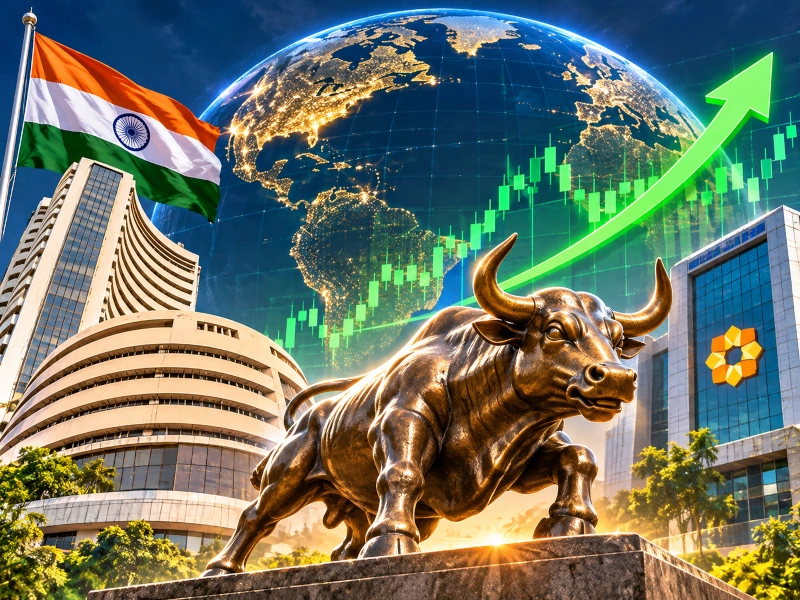
India has regained its position as the world’s fifth-largest stock market by market capitalisation, overtaking Taiwan following a strong recovery in domestic equities during November 2026. The combined valuation of Indian listed companies reached approximately US$5.4–5.5 trillion, equivalent to more than ₹500 lakh crore, reflecting renewed foreign investor interest, improving corporate earnings and favourable developments in international financial markets.
According to Bloomberg’s report published on November 12, 2026, India’s equity market returned to the world’s five largest after a sustained rally in benchmark indices. The recovery added approximately US$640 billion to the market’s valuation from late October, reversing part of the weakness experienced during earlier months.
Official statistics from the National Stock Exchange (NSE) recorded a market capitalisation of ₹508.27 lakh crore, equivalent to US$5.42 trillion, on November 12. The development placed India ahead of Taiwan in global equity market rankings, with the United States, China, Japan and Hong Kong occupying the four positions above it.
Strong Recovery in Indian Equity Markets
India’s return to the fifth position followed a sharp recovery in domestic stock prices during the first half of November. The benchmark Nifty 50 index gained substantially from its October lows, while the BSE Sensex also recorded a strong rebound.
On November 12, the Nifty 50 closed at 25,299.35 points, gaining 44.30 points or 0.18%, while the Sensex ended at 81,911.01 points, recording a marginal increase of 31.61 points.
The market recovery was particularly significant because Indian equities had experienced pressure during earlier months from foreign investment outflows, elevated international crude oil prices, inflation concerns and uncertainty surrounding global financial conditions.
The subsequent reversal in investor sentiment helped restore a substantial portion of the market value lost during the preceding decline. According to market reports, the capitalisation of companies listed on the Bombay Stock Exchange increased by more than ₹60 lakh crore over approximately 14 trading sessions ending November 12.
The improvement was not restricted to the largest companies. Several broader market segments also participated in the recovery, although individual sectors recorded differing performances.
Foreign Institutional Investment Supports Market Recovery
A major contributor to the recovery was the return of foreign portfolio investment into Indian equities.
According to Reuters, overseas investors purchased approximately US$6.43 billion worth of Indian shares during November up to the reporting period on November 12. The inflows represented the strongest monthly buying activity in more than two years, although the November figure was still a month-to-date total rather than a completed monthly investment figure.
The renewed interest followed an extended period during which foreign investors had reduced their exposure to Indian equities amid concerns about valuations, international interest rates and changing global investment opportunities.
The recovery in foreign investment coincided with improved sentiment towards Indian companies and a reassessment of investment allocations across major Asian equity markets.
Foreign portfolio investment plays an important role in India’s capital markets by contributing to market liquidity and influencing demand for listed securities. However, such investment flows can change rapidly in response to international financial conditions, exchange-rate movements and shifts in investor expectations.
Lower Crude Oil Prices and Global Investment Shifts
The recovery in Indian equities was also supported by declining international crude oil prices, which improved investor sentiment towards an economy that depends heavily on imported petroleum.
Lower crude oil prices can reduce India’s import expenditure and ease pressure on inflation, corporate operating costs and the current account balance. These factors are particularly relevant to sectors such as transportation, aviation, manufacturing and chemicals, where energy costs can significantly influence profitability.
Another important development was a change in global investor sentiment towards technology and artificial intelligence-related stocks.
International concerns surrounding valuations and investment spending in the artificial intelligence sector contributed to selling pressure in some technology-heavy markets. Taiwan, whose equity market has substantial exposure to semiconductor and technology companies, experienced a decline in market valuations during this period.
India’s equity market, with its significant representation of financial services, consumer businesses, industrial companies and other domestically oriented sectors, benefited from the broader reassessment of investment opportunities.
The combination of foreign capital inflows, lower energy prices and improving domestic market sentiment contributed to India’s recovery in the global market capitalisation rankings.
Corporate Earnings Strengthen Investor Confidence
The recovery was also supported by corporate earnings reported for the September 2026 quarter.
Several major Indian companies recorded improvements in profitability, while financial institutions benefited from developments in credit growth, asset quality and business activity.
The performance of Indian corporations helped reinforce investor interest at a time when global investment allocations were undergoing significant changes.
Financial services companies played an important role in the recovery, reflecting the sector’s substantial representation in India’s benchmark equity indices.
The broader improvement in investor sentiment was also accompanied by more favourable assessments of Indian equities from international financial institutions.
HSBC upgraded its investment view on India to overweight, while other international brokerages revised their assessments of the Indian equity market.
These developments reflected changing institutional expectations, although such assessments remain subject to market conditions and future corporate performance.
India Overtakes Taiwan in Global Stock Market Rankings
India’s recovery to fifth place was partly the result of rising domestic equity valuations and partly the consequence of weakening valuations in Taiwan’s technology-heavy stock market.
According to Bloomberg-based market reports, India’s market capitalisation reached approximately US$5.4 trillion, while Taiwan’s equity market valuation had declined following selling pressure in semiconductor and artificial intelligence-related stocks.
India had previously occupied the fifth position during 2026 before Taiwan moved ahead. The November recovery therefore represented a return to an earlier position rather than India’s first entry into the world’s five largest stock markets.
The rankings are based on the aggregate market value of listed companies and can fluctuate with changes in share prices, currency exchange rates and market conditions.
The distinction is important because stock market capitalisation measures the market valuation of corporate equity rather than the size of a country’s economy.
India’s return to fifth position consequently reflects the relative valuation of its listed companies at the time of measurement, rather than a change in its global GDP ranking.
What the $5.5 Trillion Valuation Represents
Stock market capitalisation is calculated by multiplying the prevailing market price of a company’s shares by the number of shares outstanding. The combined capitalisation of all listed companies provides an estimate of the total market value of publicly traded corporate equity.
India’s approximately US$5.5 trillion valuation therefore represents the aggregate market worth of listed shares, not the amount of money invested in the market during November.
Similarly, an increase in market capitalisation does not mean that an equivalent amount of fresh capital has entered the economy. Rising share prices can increase the recorded market value of existing shares without corresponding new investment.
Nevertheless, the scale of India’s equity market is relevant to its financial system. Large and liquid capital markets provide companies with access to equity financing and offer domestic and international investors opportunities to participate in corporate ownership.
The development also reflects the substantial size of India’s listed corporate sector and its position within the international financial system.
Significance for India’s Capital Markets
India’s return to the world’s five largest stock markets marks an important development in the evolution of its capital markets.
The country has developed a substantial equity investment ecosystem supported by the Bombay Stock Exchange, National Stock Exchange, domestic institutional investors, mutual funds, foreign portfolio investors and individual market participants.
The expansion of market participation has increased the role of equity investment in India’s financial system, while listed companies continue to use capital markets for fundraising and corporate financing.
The latest improvement in market capitalisation also highlights the influence of global investment flows on domestic valuations.
Despite the strong November recovery, Indian equities remain exposed to fluctuations in international energy prices, foreign investment flows, exchange rates, corporate earnings and broader economic conditions.
Market capitalisation rankings can consequently change even without major structural developments in the underlying economies.
Conclusion
India’s return to fifth position among the world’s largest stock markets represents a significant recovery in domestic equity valuations following a period of market weakness.
The improvement was supported by renewed foreign institutional investment, stronger corporate earnings, declining crude oil prices and changing investment sentiment across international equity markets.
With listed companies valued at approximately US$5.4–5.5 trillion in November 2026, India overtook Taiwan and regained its position among the five largest equity markets globally.
The milestone highlights the scale of India’s capital markets and the importance of domestic corporate performance and international investment flows in determining market valuations.
While the rankings remain sensitive to share prices and exchange-rate movements, the November recovery represents a notable development in India’s financial markets and its standing within the global equity investment landscape.
You may also like
-
India’s Exports Rise 16.66% to $568.84 Billion in April–October FY 2026–27
-
Indian Railways Approves Weekly Train Service Connecting Nepal’s Janakpur Dham with Ayodhya
-
Kandhamal Haladi of Odisha: The GI-Tagged Heritage of the Eastern Ghats’ Golden Turmeric
-
India’s Renewable Energy Capacity Expands as Solar Power Reaches 175 GW and Wind Power Crosses 59 GW
-
India Advances ₹68,816 Crore Ultra-High-Voltage Transmission Corridor to Strengthen National Power Grid
