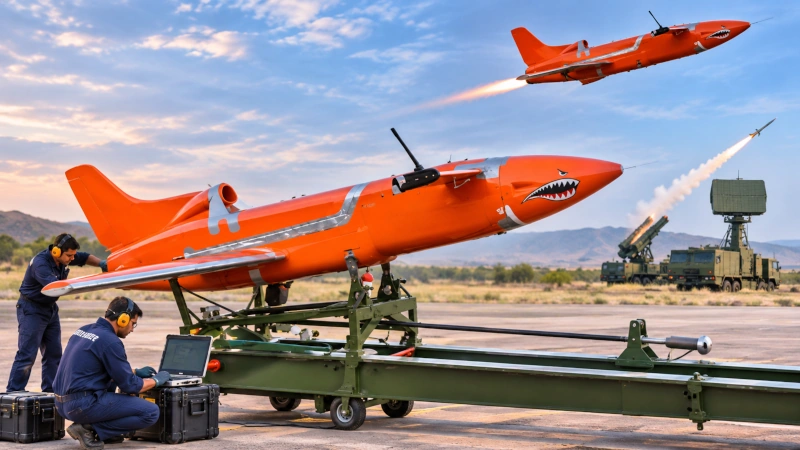
Bengaluru-based Kadet Defence Systems Private Limited has achieved a significant milestone in indigenous unmanned aviation with its JX3-30 multi-role jet-powered unmanned aerial vehicle completing 50 flights since its introduction. In an official company announcement on 24 November 2026, Kadet Defence Systems highlighted the platform’s performance across land and maritime environments, demonstrating progress in its flight-testing programme and multi-role capabilities. The achievement represents an important development in India’s growing private-sector unmanned aerospace manufacturing ecosystem.
The company reported successful flights at an operating altitude of 5,000 metres and speeds of 500 kilometres per hour, alongside mission demonstrations and successful aircraft recovery at Pokhran in Rajasthan. Kadet Defence Systems described the milestone as evidence of the platform’s increasing maturity, versatility and operational capabilities. The cumulative flight achievement reflects the company’s continuing efforts in indigenous aerospace engineering, system integration and flight validation.
Indigenous Multi-Role Jet-Powered UAV
The JX3-30, also known as Anudishya, has been developed by Kadet Defence Systems as a jet-powered unmanned aerial platform supporting multiple defence-related applications. According to the company, the aircraft complies with India’s Indigenously Designed, Developed and Manufactured (IDDM) framework and forms part of its expanding family of advanced unmanned systems. Kadet describes the JX3-30 as India’s first multi-role jet-based UAV.
The platform has been designed to support air defence training, aerial threat simulation and the evaluation of defence systems. Its jet-powered architecture enables it to reproduce the flight characteristics of relatively high-speed aerial threats, providing realistic training opportunities for air defence personnel. The development of such platforms domestically contributes towards expanding India’s capabilities in specialised aerospace engineering and defence testing infrastructure.
Flight Validation Across Land and Maritime Environments
Kadet Defence Systems confirmed that the JX3-30 has operated across both terrestrial and maritime environments during its flight programme. The completion of 50 flights provides the company with an expanding body of operational experience that can support further engineering refinements, reliability assessments and performance validation. Successful aircraft recovery at Pokhran also represents an important milestone in demonstrating the platform’s recoverability.
The company had previously reported that the JX3-30 participated in firing campaigns conducted from the Indian Army’s Army Air Defence College in Odisha. These activities reflect the platform’s involvement in air defence training and evaluation environments. However, the latest announcement does not constitute confirmation of a new procurement contract or formal military induction.
Strengthening Indigenous Air Defence Training Capabilities
Realistic aerial target systems constitute an important component of modern air defence training and equipment evaluation. Jet-powered unmanned platforms enable personnel to undertake training against representative high-speed aerial threats within controlled environments. Such systems also support the assessment of surveillance, tracking and interception capabilities.
The indigenous development of specialised aerial target platforms could help reduce dependence on imported training equipment while expanding domestic aerospace engineering expertise. Recoverable unmanned systems also offer opportunities for repeated training activities and improved resource utilisation. The JX3-30’s continuing flight programme contributes towards the development of this specialised segment of India’s defence industrial ecosystem.
Advancing India’s Private-Sector Aerospace Ecosystem
Kadet Defence Systems specialises in the design, development and manufacture of unmanned aerial systems, aerial targets and associated aerospace technologies. The Bengaluru-headquartered private company has been developing indigenous platforms intended to address diverse defence and aerospace requirements. Its activities reflect the expanding participation of Indian private enterprises in technologically demanding areas of defence manufacturing.
The completion of 50 flights by the JX3-30 marks a measurable engineering and flight-validation achievement rather than the conclusion of its development journey. Continued testing and technological refinement could further strengthen the platform’s maturity and potential applications. The milestone represents another constructive step towards building a self-reliant Indian aerospace industry supported by indigenous engineering, private-sector innovation and sustained technological development.
References
Kadet Defence Systems Private Limited — Official LinkedIn announcement on the completion of 50 flights by the JX3-30, November 2026.
Kadet Defence Systems — Official corporate website and JX3-30 training and simulation product information.
You may also like
-
Suzlon Energy Lays Foundation Stone for 1 GW AI-Enabled Wind Turbine Blade Factory in Tamil Nadu
-
Avore Electric Reports 90 Per Cent Domestic Component Sourcing for Electric Motorcycles
-
Indian Nuclear Startup SUK-M Secures Funding to Develop Indigenous Thorium Microreactor
-
Jupiter Wagons Partners South Korea’s Woojin to Manufacture Metro Trains and Propulsion Systems in India
-
Gujarat’s Kalpasar Project: India’s Ambitious Freshwater Reservoir and Dutch Engineering Cooperation
