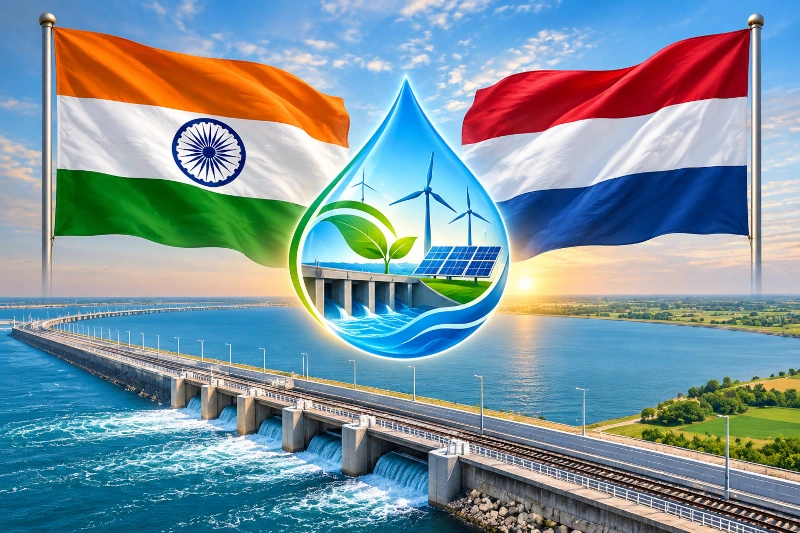
Gujarat’s Kalpasar Project represents an ambitious approach to addressing water scarcity through the integration of coastal engineering, freshwater conservation, renewable energy and transportation infrastructure. Conceived around the construction of a major barrier across the Gulf of Khambhat, the project seeks to establish an extensive coastal freshwater reservoir capable of supporting the long-term water requirements of the Saurashtra region. The initiative has gained further technical support through India’s partnership with the Netherlands, drawing upon Dutch expertise in hydraulic engineering and coastal water management.
Transforming the Gulf of Khambhat into a Freshwater Resource
The Gulf of Khambhat, situated between the Saurashtra peninsula and mainland Gujarat, receives water from several major rivers before it flows into the Arabian Sea. The Kalpasar Project proposes to capture a portion of these freshwater resources through the construction of a coastal barrier. The reservoir would receive river runoff from the Sabarmati, Mahi and Dhadhar, supplemented by water transferred from the Narmada River.
The proposed reservoir would provide an additional source of freshwater for a region that experiences considerable variation in rainfall and water availability. By developing storage capacity within a coastal environment, Gujarat seeks to improve the utilisation of its river systems while addressing the long-term requirements of agriculture and other sectors. The project represents an effort to integrate river basin management with large-scale coastal infrastructure.
Addressing Water Scarcity in Saurashtra
The Saurashtra peninsula has historically faced water management challenges arising from seasonal rainfall, recurring drought conditions and uneven freshwater availability. Agricultural activities in several parts of the region depend upon groundwater extraction, surface water storage and supplies transferred through existing water distribution networks. Establishing an additional freshwater resource could improve the region’s ability to manage seasonal shortages and support agricultural production.
The Kalpasar Project is intended to supplement existing water management infrastructure rather than replace it. Its successful implementation could provide more dependable irrigation supplies and support the broader economic development of coastal Gujarat. The effectiveness of the proposed reservoir would depend upon sustainable water allocation, hydrological conditions and the development of efficient distribution networks.
A Highway and Railway Corridor Across the Gulf
The project also incorporates plans for a combined road and railway corridor constructed along the proposed barrier. According to information presented by the Ministry of Jal Shakti in the Rajya Sabha on 27 July 2026, the corridor could shorten the journey between Bhavnagar and Surat from approximately 356 kilometres to 177 kilometres. The resulting reduction of around 179 kilometres would significantly improve connectivity between Saurashtra and southern Gujarat.
Improved transportation links could facilitate the movement of agricultural produce, industrial goods and passengers between the two regions. The corridor could also support integration between manufacturing centres, ports and commercial establishments situated along Gujarat’s coastline. Combining transportation infrastructure with water conservation would allow the project to serve multiple regional development objectives.
Integrating 2,470 MW of Renewable Energy Capacity
The Kalpasar Project envisages approximately 2,470 megawatts of hybrid renewable energy generation on land proposed to be reclaimed from areas currently submerged during high tide. Part of the electricity generated could be used to operate pumping infrastructure required to distribute stored freshwater to agricultural areas. This integration would help address the energy requirements associated with large-scale water transfer and irrigation operations.
Combining renewable power generation with water infrastructure could improve the project’s long-term operational sustainability. Pumping and distributing water across extensive geographical areas requires considerable energy, making the availability of locally generated electricity particularly relevant. The proposed renewable energy component remains subject to detailed planning, technical evaluation and the necessary approvals.
India–Netherlands Cooperation in Coastal Engineering
The Netherlands possesses extensive experience in managing coastal environments through dams, dykes, flood protection systems and hydraulic infrastructure. Its geographical circumstances have encouraged the development of specialised engineering capabilities for regulating water movement, managing salinity and protecting low-lying regions. These capabilities are particularly relevant to the complex engineering requirements associated with the Kalpasar Project.
During Prime Minister Narendra Modi’s visit to the Netherlands in May 2026, the two countries discussed technical cooperation for the proposed Gujarat reservoir. A Letter of Intent was subsequently signed on 16 May 2026 to establish a framework for collaboration. An Indian delegation visited the Netherlands in July to study coastal protection infrastructure, hydraulic systems and environmental management practices, providing further opportunities for institutional knowledge exchange.
Learning from the Netherlands’ Afsluitdijk
The Afsluitdijk, a major Dutch coastal engineering structure, offers a relevant international reference for understanding the challenges involved in separating freshwater resources from marine environments. The barrier transformed the former Zuiderzee into the freshwater IJsselmeer while providing flood protection and supporting transportation infrastructure. Its continued operation and modernisation have generated decades of experience in managing coastal water systems.
Although the geographical and hydrological conditions of the Gulf of Khambhat differ substantially from those of the Netherlands, the Dutch experience offers useful engineering principles. These include the regulation of water levels, management of salinity, operation of sluices and pumping stations, structural protection and adaptation to changing environmental conditions. Such knowledge can inform Indian engineering assessments without requiring the direct replication of Dutch infrastructure designs.
Deltares and TU Delft Join Technical Cooperation
On 24 September 2026, India and the Netherlands signed two tripartite Memoranda of Understanding during the ninth India International Water Week at Bharat Mandapam in New Delhi. The agreements bring together India’s Central Water Commission, the Gujarat government’s Kalpasar Department and two Dutch institutions, Deltares and Delft University of Technology. The bilateral meeting was chaired by Union Minister of Jal Shakti C. R. Paatil and Dutch Vice Minister for Infrastructure and Water Management Jaap Slootmaker.
The partnership with Deltares encompasses engineering assessments, coastal hydraulics, structural design, computational modelling, climate adaptation and the transfer of technical knowledge. Cooperation involving TU Delft will contribute to institutional capacity development and the exchange of engineering expertise. Together, these arrangements are intended to strengthen India’s ability to evaluate, design and manage complex coastal water infrastructure.
Managing Environmental and Engineering Challenges
Constructing a major barrier within a coastal environment involves substantial technical and ecological considerations. Changes in tidal movement, sediment transport, marine habitats and river discharge patterns require detailed assessment before engineering designs can be finalised. Preventing seawater intrusion and maintaining suitable freshwater quality will also be important to the reservoir’s long-term functionality.
The Gulf of Khambhat’s coastal ecosystem supports fisheries, intertidal habitats and maritime economic activities that must be considered during project planning. Potential impacts on fish migration, sediment accumulation, existing ports and coastal communities will require comprehensive scientific evaluation. Incorporating environmental safeguards alongside engineering design would be essential to balancing freshwater conservation with the protection of coastal ecosystems.
Climate resilience represents another important consideration given the long operational lifespan envisaged for such infrastructure. Engineering assessments must account for changing sea levels, extreme weather conditions, variable river flows and long-term maintenance requirements. International technical cooperation can contribute to these assessments while strengthening domestic expertise in sustainable coastal infrastructure development.
Current Status of the Kalpasar Project
In its parliamentary disclosure of 27 July 2026, the Ministry of Jal Shakti stated that the Detailed Project Report was nearing completion. The Indo-Dutch partnership is intended to improve the technical foundations of the proposal and support informed decisions regarding its development. The September agreements represent a further step in this preparatory process through formal cooperation between Indian and Dutch engineering institutions.
The signing of the agreements does not establish that construction has commenced, that final statutory approvals have been obtained or that the proposed infrastructure has received a fully sanctioned construction budget. Further technical studies, environmental assessments, financial arrangements and regulatory processes will determine how the project progresses towards implementation. Its proposed infrastructure components and anticipated benefits must therefore be understood within the context of an initiative still undergoing development and evaluation.
Building an Integrated Water and Infrastructure Ecosystem
The Kalpasar Project brings together several important areas of India’s infrastructure development, including freshwater security, coastal engineering, agricultural resilience, renewable energy and regional transportation. Its multidisciplinary character highlights the opportunities available through integrating infrastructure systems rather than developing water, energy and transportation projects independently. The technical expertise required for such an undertaking could also contribute to the wider development of India’s coastal engineering capabilities.
India’s collaboration with the Netherlands provides an opportunity to combine domestic scientific and engineering resources with established international experience. Subject to comprehensive technical evaluation, environmental safeguards and successful implementation, the Kalpasar Project could become an important contributor to Gujarat’s long-term water security and regional connectivity. Its development offers a broader opportunity for India to advance sustainable infrastructure engineering while strengthening its institutional capacity to manage complex coastal environments.
References
- Ministry of Jal Shakti, Press Information Bureau — Socio-Economic Impact and Technical Progress of the Kalpasar Project, 27 July 2026. Rajya Sabha Unstarred Question No. 885. Release ID: 2289927.
- Ministry of Jal Shakti, Press Information Bureau — IIWW 2026: India and Netherlands Strengthen Strategic Partnership in Water Sector, 24 September 2026. Release ID: 2314494.
- Akashvani News — IIWW 2026: India and Netherlands Sign Two MoUs to Advance Kalpasar Water Project, 24 September 2026.
You may also like
-
India Tracks ₹38.11 Lakh Crore Infrastructure Investment Pipeline
-
Suzlon Energy Lays Foundation Stone for 1 GW AI-Enabled Wind Turbine Blade Factory in Tamil Nadu
-
Avore Electric Reports 90 Per Cent Domestic Component Sourcing for Electric Motorcycles
-
Indian Nuclear Startup SUK-M Secures Funding to Develop Indigenous Thorium Microreactor
-
Jupiter Wagons Partners South Korea’s Woojin to Manufacture Metro Trains and Propulsion Systems in India
