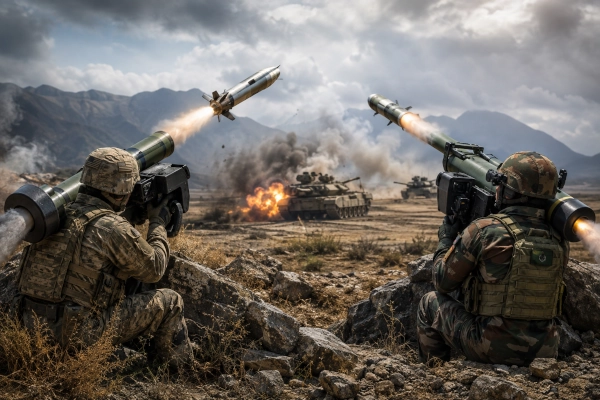
India’s decision to acquire the American FGM-148 Javelin anti-tank guided missile comes at an important point in the evolution of the Indian Army’s anti-armour capability. At the same time that India is bringing in a limited number of Javelin systems, the country is preparing to field its own Man Portable Anti-Tank Guided Missile, or MPATGM, developed by the Defence Research and Development Organisation. The two systems serve a similar battlefield role and reflect two different approaches to capability development: acquiring a mature combat-proven weapon from abroad while building a comparable system within India’s own defence-industrial ecosystem.
Both Javelin and MPATGM belong to the modern fire-and-forget class of anti-tank missiles. They use imaging infrared seekers, can operate in day and night conditions, and employ top-attack profiles against heavily armoured vehicles. Both also use tandem warheads designed to defeat tanks protected by explosive reactive armour. The principal difference today lies not in the basic concept but in maturity. Javelin has decades of operational experience and extensive combat use, while MPATGM has only recently reached an advanced stage of development and user evaluation.
The comparison became more relevant after DRDO successfully demonstrated MPATGM against a moving tank-type target in January 2026 using a top-attack engagement profile. That trial showed that the latest Indian configuration had moved beyond basic technology demonstration and was approaching the stage required for induction into the Indian Army. The result placed India much closer to possessing a domestically controlled weapon in the same broad battlefield category as Javelin.
India Moves Ahead With Javelin Acquisition
India signed a Letter of Offer and Acceptance in August 2026 for the acquisition of Javelin anti-tank missile systems from the United States through the Foreign Military Sales route. The purchase followed earlier US approval for a package that could include missiles, launch units, training equipment, spares and technical support. The final quantity covered by the signed agreement has not been fully disclosed publicly, so the acquisition is best understood as a limited procurement rather than a replacement for India’s entire inventory of older anti-tank weapons.
The significance of Javelin lies in its maturity. The missile has been in service for decades and has accumulated extensive combat experience. It has also undergone repeated improvements in launch units, warhead effectiveness, electronics and overall reliability. For the Indian Army, Javelin offers an immediately available capability that has already been tested under demanding operational conditions.
At the same time, India’s Javelin purchase does not diminish the importance of MPATGM. The scale of the requirement for modern infantry anti-tank weapons across the Indian Army is far larger than a limited foreign procurement can meet. India still operates older systems such as Milan and Konkurs, and replacing these across numerous infantry and mechanised formations will ultimately require a much larger missile inventory. That is where an indigenous system becomes strategically important.
MPATGM Is India’s Indigenous Weapon in the Same Class
DRDO developed MPATGM as a third-generation man-portable fire-and-forget anti-tank missile for the Indian Army. Although it is often described informally as India’s equivalent to Javelin, the missile is not a copy of the American system. It emerged from India’s own anti-armour development programme and incorporates indigenous seeker, guidance, warhead, propulsion and control technologies.
The weapon uses a lock-on-before-launch concept. The operator first detects and identifies the target through the sighting system. Once the missile seeker locks onto the selected target, the weapon can be fired and guide itself during flight. This allows the operator to leave the firing position or prepare another engagement rather than remaining exposed while continuously steering the missile.
That feature places MPATGM firmly in the same operational generation as Javelin. Older anti-tank missiles often require the gunner to keep tracking the target until impact. Fire-and-forget weapons remove much of that burden and reduce the time an anti-tank team remains exposed after launch.
The Latest MPATGM Configuration Represents a Major Upgrade
MPATGM has evolved considerably through successive rounds of testing. Earlier trials established its basic guidance, warhead and launch characteristics. Subsequent testing expanded the operational envelope and demonstrated performance under the conditions required by the Indian Army.
By 2024, DRDO had already validated the missile’s tandem warhead and demonstrated top-attack capability. The programme then moved into more demanding trials involving the complete weapon system, including the seeker, sighting equipment, control system and launch platform.
The most important recent development came in January 2026, when DRDO successfully engaged a moving tank-type target in top-attack mode. This was a significant step because moving targets place much greater demands on the missile seeker and guidance system than stationary targets. The missile must continuously track changes in target position and maintain an accurate terminal trajectory.
DRDO has not officially named this configuration MPATGM Mk2 or assigned another new designation to it. It is therefore more accurate to describe it as the latest upgraded or final-deliverable MPATGM configuration rather than creating an unofficial variant name.
Imaging Infrared Guidance Gives MPATGM Its Fire-and-Forget Capability
The core of MPATGM’s guidance system is its Imaging Infrared seeker. The seeker detects the thermal image of the target and tracks it after launch. This allows the missile to operate in both day and night conditions and removes the need for continuous manual guidance during flight.
The January 2026 trial demonstrated that the seeker could support a successful engagement against a moving target. This was particularly important because it confirmed the integration of multiple indigenous subsystems within a single operational missile.
DRDO laboratories contributed different elements of the weapon. These include the imaging infrared seeker, tandem warhead, propulsion system, control actuation system, launch equipment and sighting system. Bharat Dynamics Limited and Bharat Electronics Limited have also participated as development and production partners.
The indigenous seeker is especially important from a strategic perspective. Imaging infrared guidance represents one of the most complex technologies in a modern anti-tank missile, and domestic control over this subsystem reduces dependence on foreign suppliers for future upgrades.
Javelin Uses the Same Broad Guidance Philosophy
Javelin relies on a similar lock-on-before-launch concept. Its gunner uses the Command Launch Unit to locate and identify a target before transferring that information to the missile seeker. After the seeker achieves a lock, the missile can be launched and guide itself to the target.
The American system can conduct both top-attack and direct-attack engagements. Top attack is intended mainly for armoured vehicles, while direct attack can be useful against targets such as fortifications or vehicles where a diving trajectory is less suitable.
MPATGM also supports top-attack and direct-attack profiles. This gives Indian infantry greater flexibility because the missile is not restricted to one terminal trajectory.
The similarity in operational concept demonstrates how far India’s indigenous anti-tank programme has progressed. MPATGM now incorporates many of the core characteristics that define advanced third-generation infantry anti-tank weapons.
Top Attack Targets the Tank’s More Vulnerable Upper Surfaces
Modern main battle tanks devote much of their armour protection to the frontal arc because this is where they are most likely to receive direct fire. Heavy composite armour and explosive reactive armour can make frontal engagement difficult for anti-tank weapons.
The upper surfaces of the tank generally carry less protection because adding the same level of armour to the roof would increase vehicle weight substantially. Top-attack missiles exploit this difference by approaching the vehicle from above and striking areas that are usually less heavily protected.
Javelin became particularly well known for this engagement method. MPATGM now gives India the same basic tactical option.
The January 2026 moving-target trial was therefore more than a simple accuracy test. It demonstrated the ability of the indigenous missile to execute one of the most demanding attack profiles required for defeating modern armoured vehicles.
Tandem Warheads Are Designed to Defeat Reactive Armour
Both Javelin and MPATGM use tandem warheads because many modern tanks carry Explosive Reactive Armour, or ERA. These armour modules react when struck by a shaped-charge warhead and disrupt the penetrating jet before it reaches the vehicle’s main armour.
A tandem warhead counters this protection by using two charges. The first charge activates or disrupts the reactive armour. The second, larger charge then attacks the main armour beneath it.
DRDO has stated that MPATGM’s tandem warhead can defeat modern armour protected by ERA. Dedicated warhead trials were completed before the programme moved towards final user evaluation.
This gives the Indian missile the core anti-armour capability required for use against contemporary tanks and other protected vehicles.
Javelin Retains an Advantage in Published Range
One important difference remains the published engagement range.
Modern Javelin variants can engage targets at distances of around 4 kilometres under suitable operating conditions, depending on the launcher and missile configuration. This gives the American system a longer maximum engagement envelope than the current official specification for MPATGM.
DRDO has publicly listed MPATGM’s missile range at approximately 200 metres to 2.5 kilometres. The system’s sight may detect targets at greater distances, but detection range should not be confused with actual missile engagement range.
This gives Javelin an advantage where terrain allows long-range observation and engagement. Open plains and desert environments can provide such opportunities.
However, anti-tank combat rarely depends on maximum range alone. Terrain, concealment, target visibility, atmospheric conditions, launcher weight and infantry mobility can all be equally important. In mountainous or broken terrain, actual engagement distances may be far shorter than the theoretical maximum.
Javelin vs India’s MPATGM — Capability Comparison
| Capability | FGM-148 Javelin | India’s MPATGM |
|---|---|---|
| Origin | United States | India |
| Developer | Raytheon / Lockheed Martin Javelin JV | DRDO with Indian industry |
| Generation | Third-generation ATGM | Third-generation ATGM |
| Primary Role | Man-portable anti-tank / precision attack | Man-portable anti-tank / precision attack |
| Guidance | Imaging Infrared, fire-and-forget | Indigenous Imaging Infrared, fire-and-forget |
| Lock-on Method | Lock-on before launch | Lock-on before launch |
| Attack Modes | Top attack and direct attack | Top attack and direct attack |
| Moving Target Engagement | Combat-proven | Successfully demonstrated against a moving tank-type target in January 2026 |
| Day/Night Capability | Yes | Yes |
| Published Maximum Range | Around 4 km with modern configurations | Around 2.5 km currently published |
| Minimum Published Range | Roughly 65 m depending on attack mode/configuration | Around 200 m |
| Warhead | Tandem shaped-charge | Tandem shaped-charge |
| ERA Defeat Capability | Yes | Yes |
| Published MPATGM Penetration | Exact comparison varies by Javelin variant | DRDO lists over 600 mm beyond ERA |
| Soft Launch | Yes | Yes |
| Infantry Portable | Yes | Yes |
| Vehicle Launch Potential | Multiple vehicle integrations exist internationally | DRDO confirms tripod and vehicle-launch capability |
| Operational Maturity | Very high; decades in service | Approaching Indian Army induction |
| Combat Experience | Extensive combat use | No publicly confirmed combat use |
| Indigenous Content for India | Imported system; future industrial cooperation possible | Indian-developed system with domestic production partners |
| Production Partners in India | Future cooperation remains possible | BDL and BEL are development-cum-production partners |
| Upgrade Freedom for India | Dependent partly on US/OEM arrangements | High, because India controls the development ecosystem |
| Wartime Replenishment Potential | Depends on foreign supply and procurement arrangements | Can potentially scale through domestic production |
| Export Potential From India | Not an Indian-controlled export product | Potential future Make in India, Make for the World system |
| Main Present Advantage | Range, maturity and combat experience | Indigenous control, domestic production and upgrade potential |
| Main Present Limitation | Foreign dependence and higher import exposure | Shorter published range and lack of combat experience |
Capability Assessment
Javelin currently holds the advantage in operational maturity, combat experience and published engagement range. Decades of deployment have given the American system a level of battlefield validation that a newly developed missile cannot immediately reproduce.
MPATGM’s advantage lies in strategic ownership. India controls the seeker, guidance architecture, warhead development and wider production ecosystem. Its successful top-attack engagement of a moving target in January 2026 also shows that the indigenous missile has crossed an important technological threshold.
The comparison therefore should not be presented simply as “which missile is better?” Javelin is presently the more mature battlefield weapon, while MPATGM offers India the more important long-term advantage: the ability to manufacture, modify, upgrade and potentially export its own Javelin-class anti-tank missile without depending entirely on a foreign supplier.
MPATGM Was Designed Around Indian Army Requirements
One of MPATGM’s strongest advantages is that DRDO designed it specifically for Indian operational conditions.
The Indian Army must operate across a wide range of environments, including deserts, plains, mountains and high-altitude regions. An infantry anti-tank missile must therefore remain portable and reliable across significant variations in temperature, terrain and altitude.
DRDO conducted MPATGM trials across the operational envelope defined by the Army. The programme tested the missile under multiple environmental and battlefield conditions before moving towards induction.
This domestic development process gives Indian engineers greater freedom to modify the system in response to user feedback. If the Army identifies a need for changes to the seeker, sighting system, launcher or warhead, the development ecosystem exists within the country.
That level of control is much harder to achieve with a fully imported weapon.
Weight Remains an Important Infantry Consideration
Portability is critical for any man-portable anti-tank missile.
An infantry team may need to carry the missile, launcher, sighting equipment and other combat loads over long distances. Even a reduction of a few kilograms can make a meaningful difference in mountainous terrain.
DRDO has previously explored ways to reduce MPATGM weight. A lighter configuration could improve mobility and reduce the physical burden placed on the missile crew.
However, available public information does not confirm that the January 2026 test used the lighter version. It would therefore be premature to describe the latest tested weapon as a lightweight MPATGM.
The most important confirmed development is the successful demonstration of moving-target engagement with top-attack capability in the latest configuration.
Soft Launch Improves Infantry Usability
MPATGM also incorporates a soft-launch mechanism, another characteristic shared with Javelin.
During a soft launch, the missile leaves the launch tube before the main propulsion system fully engages. This reduces the immediate blast around the firing position.
For infantry, this provides several advantages. It reduces exposure to rocket exhaust and can expand the range of positions from which the weapon can be fired.
The feature also helps conceal the crew compared with systems that generate a large launch signature immediately at the firing point.
Soft launch therefore complements the fire-and-forget guidance concept by reducing both exposure time and launch signature.
Javelin’s Biggest Advantage Is Combat Experience
The greatest current advantage enjoyed by Javelin is not simply a specification such as range or warhead performance. It is operational maturity.
Javelin has been used extensively in combat and has undergone thousands of operational firings. Engineers and military users have gathered decades of information about reliability, maintenance, operator behaviour and performance under real battlefield conditions.
That experience has allowed the system to evolve through repeated upgrades.
MPATGM cannot yet match this record because it is only approaching induction.
This difference matters. A weapon that performs well during trials must still prove that it can be manufactured consistently, stored for long periods, maintained by operational units and used reliably under wartime conditions.
These are lessons that only widespread service use can fully provide.
MPATGM’s Greatest Advantage Is Indigenous Control
Where MPATGM has a clear strategic advantage is domestic ownership of the technology.
India controls the missile’s development ecosystem. DRDO has created the core technology, while BDL and BEL participate in production and system integration.
This gives India greater control over manufacturing volumes, upgrades and modifications.
During a prolonged conflict, anti-tank missiles can be consumed rapidly. The ability to manufacture additional rounds domestically can therefore become as important as the performance of each individual missile.
An imported weapon may offer excellent capability, but resupply can remain subject to production schedules, export permissions and foreign supply chains.
An indigenous missile reduces these vulnerabilities.
MPATGM Could Eventually Expand Beyond Infantry Launchers
DRDO also appears to see MPATGM as a technology base that could support additional launch platforms.
The organisation has identified future integration possibilities involving light tanks, future armoured vehicles and other platforms. The missile has already demonstrated compatibility with both tripod and vehicle-based launch arrangements.
This creates the possibility that MPATGM could evolve from a single infantry weapon into a broader lightweight anti-armour missile family.
Such an approach would have industrial advantages because the same basic seeker, warhead and propulsion technologies could support several battlefield applications.
It could also simplify logistics if different platforms eventually use related missile technology.
Why India Can Use Both Javelin and MPATGM
The Javelin purchase does not necessarily indicate dissatisfaction with MPATGM.
The two systems can serve different short-term and long-term purposes.
Javelin gives the Indian Army immediate access to a mature and combat-proven weapon. MPATGM gives India a domestic system that can eventually support much larger-scale deployment.
A limited number of Javelin launchers and missiles can equip selected units or satisfy urgent requirements. They cannot by themselves replace the Army’s entire stock of older anti-tank missiles.
MPATGM has the potential to fill that larger requirement if production scales successfully after induction.
This makes the indigenous programme strategically more important over the long term.
Javelin Can Serve as an Operational Benchmark
Operating Javelin alongside MPATGM could also create valuable learning opportunities.
The Indian Army would be able to compare the two systems under similar terrain and climatic conditions. Soldiers could assess target acquisition, launch preparation, thermal imagery, portability and engagement procedures.
The Army could then feed lessons from these comparisons into future MPATGM upgrades.
This would not require direct transfer of Javelin technology. Operational comparison alone can provide useful information about what soldiers value most in a modern anti-tank system.
Such feedback could help DRDO and Indian industry improve later versions of MPATGM.
India Is Moving From Buyer to Designer
The broader importance of this comparison lies in the transformation of India’s defence industry.
For decades, the Indian Army depended heavily on foreign anti-tank missile designs. Even where some systems were manufactured domestically, key technologies often remained under foreign control.
MPATGM changes that equation.
India now possesses domestic capability in imaging infrared seekers, tandem warheads, guidance electronics, propulsion and launch systems for a modern fire-and-forget anti-tank missile.
That capability has value beyond one specific weapon programme because many of the underlying technologies can support future missile development.
India is therefore no longer approaching Javelin-class weapons only as a customer. It is increasingly able to develop the same broad category of battlefield technology itself.
From Make in India to Make for the World
MPATGM also fits naturally into India’s wider “Make in India, Make for the World” defence vision. By developing key technologies such as the imaging infrared seeker, tandem warhead, propulsion system and fire-control architecture within the country, India is creating more than a weapon for its own Army. It is building a technology base that can support future variants, larger production runs and potential exports to friendly countries seeking modern fire-and-forget anti-tank capability. Once MPATGM enters sustained production and proves itself in service, it could strengthen India’s position as an exporter of complete precision-guided weapon systems rather than only components or licensed products. In that sense, the programme represents the next stage of defence indigenisation: designing in India, producing at scale in India, equipping Indian forces first, and eventually offering an Indian-developed battlefield system to the global market.
Javelin Remains the Benchmark, but MPATGM Is Closing the Gap
Javelin remains the more mature system today. It has longer published range, decades of operational experience and a highly developed global support structure.
MPATGM, however, has made substantial progress. The latest configuration has demonstrated top attack against a moving target, day-and-night operation, imaging infrared guidance, tandem warhead performance and soft launch.
The Indian weapon also offers something Javelin cannot provide to India in the same way: complete domestic control over future production and development.
This distinction matters greatly in defence planning.
A foreign missile can provide immediate capability. An indigenous missile can provide capability, industrial knowledge, production security and the freedom to adapt the weapon over time.
India’s Long-Term Advantage Lies in Owning the Technology
The Javelin acquisition and MPATGM programme should therefore not be viewed simply as competing choices.
In the short term, Javelin strengthens the Indian Army with a proven system that has extensive battlefield experience.
In the long term, MPATGM provides India with a foundation for large-scale indigenous anti-tank missile production.
The January 2026 test showed that India has reached an important technological threshold. Its own fire-and-forget missile can now conduct top-attack engagements against moving armoured targets using an indigenous imaging infrared seeker.
That does not make MPATGM identical to Javelin in every respect, and the American weapon still holds important advantages in maturity and range.
However, the strategic significance of MPATGM lies in the fact that India no longer needs to depend entirely on foreign suppliers for this class of weapon.
The real comparison is therefore larger than Javelin versus MPATGM. It is the difference between purchasing an advanced anti-tank missile and possessing the ability to design, manufacture, upgrade and replenish one at home.
For the Indian Army, both systems can add firepower. For India’s defence-industrial future, however, the indigenous MPATGM represents the more consequential capability.
You may also like
-
Project Seabird Expands at Karwar as Indian Navy Inaugurates New Infrastructure with Over 90% Indigenous Content
-
DRDO Seeks Semi-Autonomous Guided Installation Vehicle and Specialised Pod Storage System
-
JISA Softech Unveils Indigenous QuLens-CryptoBind Quantum-Safe Cybersecurity Platform at Pragati Q-Foundry 2026
-
Sensorise Launches Made-in-India Wega M1 4G Module for EVs, Smart Meters and Industrial IoT
-
Nayan Technologies Selected by JSW MG Motor to Advance AI-Based Road Monitoring and Smart Mobility
