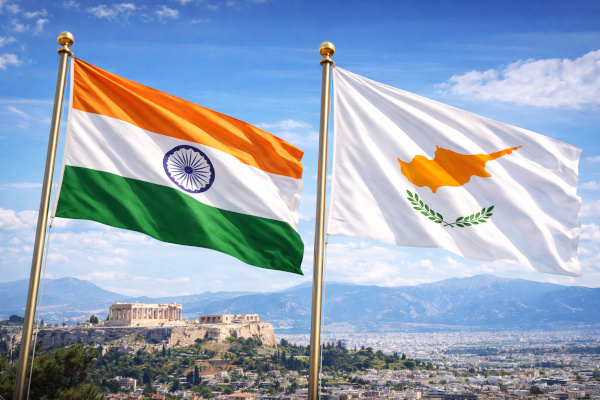
External Affairs Minister Dr. S. Jaishankar’s meeting with Cyprus President Nikos Christodoulides in Cyprus adds another important layer to India’s widening diplomatic engagement with the Mediterranean, West Asia and Europe. The discussion focused on the evolving situation in West Asia, India’s interests in the Mediterranean, and broader regional developments, placing Cyprus firmly within India’s larger strategic map.
The meeting comes at a time when the eastern Mediterranean has become more important for India’s energy security, shipping routes, trade connectivity and diplomatic outreach. For India, Cyprus is more than a friendly European partner. It sits at a sensitive maritime crossroads linking Europe, West Asia and North Africa. This geography gives the island nation a natural role in conversations on sea lanes, regional stability, logistics, energy flows and India-Europe connectivity.
India-Cyprus ties have also gained momentum after the state visit of President Christodoulides to India from 20 to 23 May 2026. During that visit, both sides elevated their Comprehensive Partnership to a Strategic Partnership, marking a shift from traditional goodwill to a more structured, results-oriented relationship.
The strategic importance of the relationship is visible in several areas. India and Cyprus have already discussed cooperation in counter-terrorism, cybersecurity, defence industry, search and rescue, maritime security, innovation, higher education, research and cultural cooperation. The two countries also agreed on a roadmap for bilateral defence cooperation for 2026-2031, giving the partnership a stronger security dimension.
The West Asia angle makes the meeting especially timely. Developments in the region affect shipping, energy markets, diaspora safety, trade corridors and the wider stability of the Indian Ocean-Mediterranean route. India has major economic and strategic stakes in safe maritime passage from the Arabian Sea through West Asia toward Europe. Cyprus, located in the eastern Mediterranean, naturally becomes a useful partner in understanding regional shifts and strengthening diplomatic coordination.
The Mediterranean interest also connects with India’s long-term connectivity vision. India and Cyprus have recognised the transformational potential of the India-Middle East-Europe Economic Corridor, which aims to create stronger trade and connectivity links between India, the wider Middle East and Europe. Both sides have also emphasised stability in the eastern Mediterranean and the importance of deeper interconnection from India through West Asia to Europe.
For New Delhi, this is a practical diplomatic move. India is strengthening ties with countries that can act as bridges into Europe, partners in maritime security and supporters in multilateral platforms. Cyprus has supported India’s permanent membership in a reformed United Nations Security Council, while India has reiterated its support for the sovereignty, territorial integrity and unity of Cyprus. This gives the relationship a political foundation beyond trade and investment.
Economic cooperation also gives the partnership depth. Cyprus has emerged as an important source of investment into India, and both sides are looking at opportunities in financial services, maritime services, logistics, clean energy, technology, space, innovation and research. The two countries have also discussed Cyprus as a European maritime gateway and operational base for Indian shipping interests.
Jaishankar’s meeting with President Christodoulides therefore reflects a larger Indian diplomatic pattern. India is engaging the Mediterranean with sharper intent, linking regional diplomacy with maritime security, trade corridors, defence cooperation and India-EU relations. Cyprus offers India a friendly European partner in a sensitive region, while India offers Cyprus a major Asian power with expanding economic, technological and strategic influence.
The meeting stands as another signal that India’s foreign policy is moving with a wider geographic imagination. The Mediterranean, West Asia and Indo-Pacific are increasingly connected in India’s strategic thinking. Cyprus now sits inside that larger arc — as a partner in diplomacy, maritime security, connectivity and regional stability.
Reference: News on Air
You may also like
-
Exercise Tarang Shakti 2026 Concludes in Jodhpur, Showcasing India’s Air Power, Indigenous Defence Technology
-
US Double Standards in Foreign Policy: 16 Recent Cases Involving India, Russia, China and Global Trade
-
Indian Navy Vice Chief Inspects Japan’s Mogami-Class Stealth Frigate as India-Japan Shipbuilding Cooperation Expands
-
INS Trishul Arrives in UK for Exercise KONKAN 2026 as India and Royal Navy Expand Maritime Cooperation
-
INS Sahyadri Arrives in Russia for Exercise INDRA 2026 to Strengthen India-Russia Naval Cooperation
