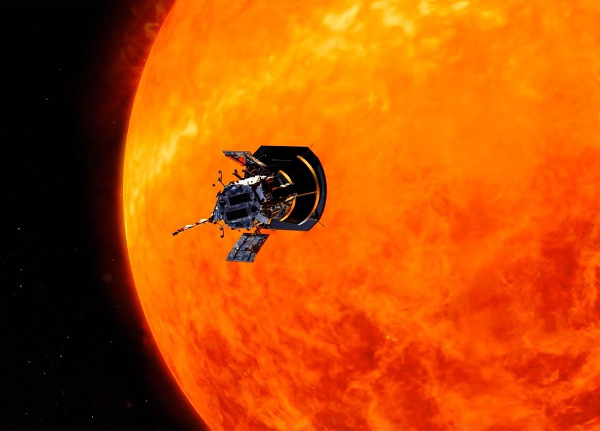
The Indian Space Research Organisation (ISRO) has announced two significant developments involving India’s Aditya-L1 solar observatory, expanding opportunities for international scientific research while advancing understanding of powerful solar eruptions and their behaviour near the Sun.
On October 16, 2026, ISRO released its fourth Announcement of Opportunity (AO), inviting Indian and international scientists to submit proposals for observations using Aditya-L1. The initiative will allow researchers to investigate solar activity, atmospheric conditions and space weather using India’s first dedicated solar observatory.
The announcement follows a scientific achievement reported on October 15, when ISRO confirmed that researchers had successfully combined observations from Aditya-L1 and the European Space Agency’s Proba-3 mission to study coronal mass ejections (CMEs) close to the Sun. Scientists from the Indian Institute of Astrophysics (IIA), Bengaluru, collaborated with international researchers to investigate the physical characteristics and energy distribution of solar eruptions.
The findings, published in the international scientific journal Astronomy & Astrophysics, demonstrate the growing scientific value of Aditya-L1 and the importance of combining observations from complementary space missions.
ISRO Opens Fourth Aditya-L1 Observation Programme to International Scientists
ISRO’s fourth Announcement of Opportunity invites researchers from India and other countries to propose scientific observations using the instruments aboard Aditya-L1. The programme aims to expand the scientific utilisation of the spacecraft while encouraging international collaboration in solar physics and heliospheric research.
Aditya-L1 operates in a halo orbit around the Sun–Earth Lagrange Point 1 (L1), approximately 1.5 million kilometres from Earth towards the Sun. This location allows the spacecraft to observe solar activity continuously without the frequent interruptions experienced by satellites operating in low Earth orbit.
The mission carries seven scientific payloads designed to investigate the solar corona, photosphere, chromosphere, magnetic fields, energetic particles and the surrounding space environment. These instruments provide complementary measurements that help scientists understand the physical processes governing solar activity.
Through the new observation programme, researchers can propose investigations involving solar atmospheric structures, magnetic activity, plasma behaviour and other phenomena associated with the Sun. The initiative allows the international scientific community to make greater use of India’s specialised space-based observation capabilities.
More Than 37 Terabytes of Aditya-L1 Scientific Data Available Worldwide
ISRO has confirmed that more than 37 terabytes of scientific data collected by Aditya-L1 are already publicly available, providing researchers worldwide with an extensive resource for studying solar activity and the space environment.
The datasets contain observations obtained through the spacecraft’s scientific instruments, supporting investigations into the solar atmosphere, plasma dynamics, energetic particles and processes associated with space weather. Researchers can use these measurements to examine solar phenomena, compare observations from different instruments and develop improved scientific models.
Making such information publicly accessible strengthens international research collaboration and enables universities, scientific institutions and space agencies to undertake independent investigations using Indian space mission data.
Several scientific studies based on Aditya-L1 observations have already appeared in internationally peer-reviewed journals. The fourth Announcement of Opportunity builds upon this progress by encouraging additional observation campaigns and expanding the scientific return from the mission.
Aditya-L1 and Proba-3 Combine Observations of Solar Eruptions
In a separate announcement on October 15, ISRO highlighted a scientific study that combined observations from India’s Aditya-L1 spacecraft and the European Space Agency’s Proba-3 mission to investigate solar eruptions near their point of origin.
Researchers at the Indian Institute of Astrophysics used data from Aditya-L1’s Visible Emission Line Coronagraph (VELC) and Proba-3’s ASPIICS coronagraph to examine coronal mass ejections. These powerful eruptions release enormous quantities of magnetised plasma from the Sun’s outer atmosphere into interplanetary space.
Studying CMEs close to the Sun is particularly challenging because the surrounding solar corona is much fainter than the intensely bright solar surface. Specialised coronagraph instruments overcome this difficulty by blocking direct sunlight and allowing scientists to observe the corona.
By combining observations from two spacecraft equipped with complementary instruments, researchers examined the movement, expansion, mass, density and energy distribution of solar eruptions during their early development. The coordinated observations provided additional information about the physical processes governing CME evolution in the inner solar corona.
Understanding Coronal Mass Ejections and Their Impact on Earth
Coronal mass ejections are large eruptions of plasma and magnetic fields originating from the Sun’s corona. These events can release enormous amounts of energy and propel solar material into interplanetary space at speeds ranging from hundreds to several thousand kilometres per second.
When a CME travels towards Earth, its magnetic field can interact with the planet’s magnetosphere and produce geomagnetic disturbances. Powerful events can interfere with satellite communications, navigation systems, radio transmissions and electrical infrastructure, making CME research important for understanding space weather.
Scientists seek to understand how these eruptions form, accelerate and evolve as they travel away from the Sun. Their movement depends on complex interactions involving magnetic forces, plasma pressure, gravity and the surrounding solar environment.
Observations close to the solar surface provide valuable information about the early stages of CME development, when much of their acceleration and energy transformation occurs. The coordinated Aditya-L1 and Proba-3 study contributes new measurements that can improve scientific understanding of these processes.
Aditya-L1’s VELC Observes the Inner Solar Corona
The Visible Emission Line Coronagraph aboard Aditya-L1 was developed by the Indian Institute of Astrophysics in collaboration with ISRO. The instrument is designed to observe the solar corona by suppressing the intense light emitted by the Sun’s visible surface.
VELC conducts imaging and spectroscopic observations of the inner corona, allowing researchers to examine the structure and physical conditions of solar plasma. Its spectroscopic capabilities provide information about the behaviour of highly heated material and the processes associated with solar activity.
During the joint observations with Proba-3, VELC supplied spectroscopic measurements that helped researchers estimate plasma density and thermal energy within the observed coronal mass ejections.
The instrument’s ability to investigate the inner solar atmosphere makes it particularly valuable for studying eruptions near their origin. Such observations complement measurements from other solar observatories that examine the corona at greater distances from the Sun.
Europe’s Proba-3 Creates Artificial Solar Eclipses in Space
The European Space Agency’s Proba-3 mission uses an innovative formation-flying arrangement involving two spacecraft operating approximately 150 metres apart. One spacecraft blocks direct sunlight, creating an artificial eclipse that allows the other spacecraft to observe the faint solar corona.
This arrangement enables the ASPIICS coronagraph to capture detailed images of solar atmospheric structures that would otherwise be obscured by the brightness of the solar surface.
Proba-3 was launched aboard India’s PSLV-XL rocket from the Satish Dhawan Space Centre, Sriharikota, on December 5, 2024. The mission represents an important example of cooperation between ISRO and the European Space Agency in advanced space technologies and scientific exploration.
During the coordinated research, ASPIICS provided imagery of the expanding solar eruptions, allowing scientists to examine their shape, movement and changes in mass distribution.
Combining these measurements with VELC’s spectroscopic observations enabled researchers to investigate the same solar events through different scientific techniques, improving their understanding of the eruptions’ physical characteristics.
Scientists Examine Two Solar Eruptions with Different Characteristics
The international research team analysed two coronal mass ejections observed on September 14 and September 16, 2025. These events provided an opportunity to compare solar eruptions displaying considerably different speeds and expansion characteristics.
According to the study, the September 14 eruption travelled at approximately 645 kilometres per second, while the September 16 event moved more slowly at around 145 kilometres per second.
The observations revealed differences in how the two eruptions expanded and how their physical conditions changed with increasing distance from the Sun. Researchers found that the density of the September 16 event decreased more rapidly with height, indicating stronger expansion during its early evolution.
These findings demonstrate that coronal mass ejections can follow different developmental paths depending on their magnetic structure, initial conditions and surrounding solar environment.
The coordinated observations also allowed researchers to compare measurements obtained independently by the two instruments, providing a stronger basis for evaluating the physical characteristics of the eruptions.
Joint Research Reveals How Solar Eruptions Distribute Energy
One of the important findings of the Aditya-L1 and Proba-3 study concerned the distribution of energy within coronal mass ejections.
Solar eruptions contain different forms of energy, including kinetic energy associated with plasma movement, thermal energy associated with temperature and magnetic energy stored within their magnetic structures. Understanding how these components interact is essential for investigating the processes that drive solar eruptions.
For the September 14 event, researchers estimated that thermal energy represented approximately 1% of the total energy, indicating that other energy components dominated the eruption.
The September 16 CME displayed different characteristics, with thermal energy increasing until it became comparable to the kinetic energy of the moving plasma. The researchers also estimated that magnetic energy was comparable to or greater than kinetic energy in the events examined.
These results provide valuable insights into the conversion and distribution of energy during the early stages of CME evolution.
Importantly, the mass and thermal energy estimates obtained from the two coronagraphs showed good agreement despite their different observation methods. This consistency strengthens confidence in the scientific measurements and demonstrates the value of combining complementary space-based instruments.
India-Europe Scientific Collaboration Advances Solar Physics
The research involved scientists from the Indian Institute of Astrophysics working with international collaborators, bringing together expertise in solar spectroscopy, coronagraph imaging and plasma physics.
The complementary capabilities of Aditya-L1 and Proba-3 allowed researchers to investigate the same solar events using different measurement techniques. While ASPIICS provided detailed images of the evolving corona, VELC contributed spectroscopic information about the physical conditions within the eruptions.
This combination helped scientists evaluate the mass, density and energy of coronal mass ejections with greater confidence.
The study illustrates how coordinated observations from different spacecraft can address scientific questions that individual missions may find difficult to investigate independently.
It also demonstrates the growing international relevance of Indian scientific instruments and the contribution of India’s space programme to collaborative research in fundamental space science.
Aditya-L1 Strengthens India’s Position in Global Solar Research
ISRO launched Aditya-L1 aboard PSLV-C57 on September 2, 2023, marking India’s first dedicated mission to study the Sun. The spacecraft successfully entered its designated halo orbit around the Sun–Earth L1 point on January 6, 2024.
Since beginning scientific operations, Aditya-L1 has contributed observations concerning solar atmospheric activity, magnetic fields, energetic particles and the Sun’s influence on the surrounding space environment.
The availability of more than 37 terabytes of scientific data demonstrates the substantial information being generated by the spacecraft. These observations are supporting research within India and internationally, strengthening scientific collaboration and expanding the mission’s contribution to solar physics.
The fourth Announcement of Opportunity provides another avenue for researchers to use Aditya-L1’s scientific capabilities, while the successful collaboration with Proba-3 highlights the benefits of combining Indian observations with those from international solar missions.
Together, these developments establish Aditya-L1 as an increasingly important platform for studying solar activity and investigating the physical processes governing the Sun.
Solar Research Supports Better Understanding of Space Weather
Scientific investigations into coronal mass ejections have practical importance because modern infrastructure increasingly depends on technologies vulnerable to disturbances in the space environment.
Satellites support telecommunications, navigation, weather forecasting, Earth observation and numerous economic activities. Powerful geomagnetic storms associated with solar eruptions can affect spacecraft electronics, communication systems and other technological infrastructure.
Improving knowledge of CME formation, acceleration and energy distribution can help researchers develop more accurate scientific models of solar activity.
The measurements obtained through Aditya-L1 and Proba-3 provide additional information about the early evolution of solar eruptions, contributing to research that supports future improvements in space weather modelling and prediction.
India’s continued investment in solar observation technologies therefore advances both fundamental scientific understanding and the knowledge required to protect increasingly important space-based infrastructure.
Aditya-L1 Opens New Frontiers in International Solar Research
ISRO’s announcements of October 15 and 16, 2026, demonstrate the growing scientific contribution of India’s Aditya-L1 solar observatory.
The coordinated observations with Europe’s Proba-3 have provided new insights into the behaviour, expansion and energy distribution of coronal mass ejections close to the Sun. Meanwhile, the fourth Announcement of Opportunity expands access to Aditya-L1’s scientific capabilities for researchers in India and around the world.
The combination of advanced Indian scientific instruments, publicly accessible datasets and international research partnerships is strengthening India’s position in global solar physics.
As Aditya-L1 continues observing the Sun from its halo orbit around the L1 point, the mission will generate valuable scientific information and support further investigations into the processes shaping solar activity and the space environment.
These developments reinforce India’s expanding contribution to international space science while advancing humanity’s understanding of the Sun and its influence on Earth.
References
- Indian Space Research Organisation (ISRO), October 16, 2026: Aditya-L1 Mission: Fourth Announcement of Opportunity Inviting Scientific Observation Proposals
- Indian Space Research Organisation (ISRO), October 15, 2026: First Joint View by Coronagraphs on India’s Aditya-L1 and Europe’s Proba-3 Decodes Solar Eruptions Near Their Birthplace
- Astronomy & Astrophysics, 2026: Agarwal, A., Mishra, W., Ramesh, R., et al. Coordinated Coronagraphic Observations from Proba-3 and Aditya-L1: Investigating Coronal Mass Ejection Energetics in the Inner Corona. Research Paper
- ISRO — Aditya-L1 Mission: Official Mission Information
- European Space Agency (ESA): Proba-3 Mission — Precision Formation Flying and Solar Corona Research
You may also like
-
ISRO Successfully Completes Critical Gaganyaan Crew Module Separation Tests at VSSC
-
ISRO Advances Indigenous 1,100 kN Methane Rocket Engine for Next-Generation Launch Vehicle
-
Indian Scientists Identify A Few Martian Analogue Sites
-
Climate History Finds Monsoon Fluctuation Footprints From Sediment Transport to Farming Adaptations
-
IIT Guwahati and IIT Kharagpur Develop Brain-Inspired Vision Device That Uses 500 Times Less Energy
