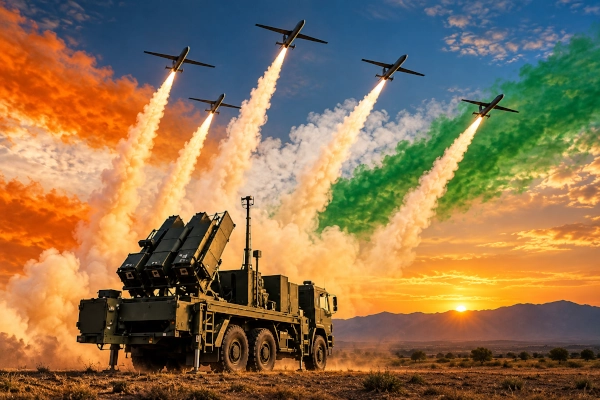
Indian defence technology company IndoWings has unveiled STRIKE, a new loitering munition concept designed for launch from Multi-Barrel Rocket Launcher systems, marking another step in India’s effort to combine conventional artillery firepower with unmanned precision-strike capabilities.
The concept was disclosed on September 26, 2026 and is currently at the technology-development stage. IndoWings has presented STRIKE as a canisterised loitering munition that would use a rocket-assisted or booster-assisted launch before transitioning into controlled powered flight.
The concept is significant because it seeks to convert an artillery rocket launcher into a platform capable of deploying persistent precision weapons. Instead of travelling directly towards a fixed target like a conventional rocket, a loitering munition can remain airborne over an operational area, search for a target and attack once the target has been identified.
STRIKE Designed for Multi-Barrel Rocket Launchers
The core idea behind IndoWings STRIKE is compatibility with an MBRL-style launcher architecture.
The munition is intended to be carried inside a launcher canister and accelerated into the air through a booster stage. After clearing the launcher, the vehicle would transition to its own propulsion and flight-control system and operate as a conventional loitering munition.
This approach could allow artillery units to launch intelligent aerial weapons using existing rocket-artillery infrastructure rather than relying exclusively on separate drone-launching vehicles.
Such a capability could give artillery formations greater flexibility against mobile or time-sensitive targets, including enemy artillery positions, radar installations, air-defence systems, command posts, logistics nodes and armoured formations.
From Rocket Artillery to Persistent Precision Strike
Conventional MBRLs are designed primarily to deliver large volumes of fire over considerable distances. Guided rockets have improved their accuracy, but their mission still generally involves travelling directly towards predetermined coordinates.
A loitering munition operates differently because it can remain airborne over the battlefield before committing to an attack.
Combining this capability with a multi-barrel launcher could allow several loitering munitions to be launched in rapid succession and dispersed across a wider operational area. Once airborne, the weapons could search for designated targets and engage them when suitable conditions emerge.
This would give artillery units a persistent strike capability that conventional rockets cannot provide on their own.
STRIKE Remains a Developmental System
STRIKE should not yet be described as an operational weapon.
IndoWings has not publicly disclosed several key specifications, including the system’s final range, endurance, warhead weight, cruising speed, launch velocity or detailed guidance architecture.
There is also no public confirmation that STRIKE has completed operational integration with Indian Army systems such as Pinaka, Smerch or GRAD.
The system is therefore best understood as an emerging indigenous concept whose military value will depend on future testing, launcher integration and validation.
Development Closely Matches an Official Indian Army Requirement
The STRIKE concept closely resembles an official requirement issued under the Ministry of Defence’s Innovations for Defence Excellence programme.
Under the ADITI initiative, the Indian Army has called for a Multi Barrel Loiter Munition System capable of operating from existing artillery rocket launchers, including GRAD, Pinaka and Smerch.
The requirement envisages the ability to launch multiple loitering munitions in salvo mode while reducing the need for separate launch infrastructure and additional manpower.
The official challenge also calls for a complete system incorporating the airframe, propulsion, warhead, fuze, secure communications, ground-control equipment, electro-optical or infrared seekers and navigation systems capable of operating in electronically contested environments.
The similarity between this requirement and IndoWings’ STRIKE concept demonstrates the growing military interest in combining artillery systems with unmanned precision weapons.
Salvo Launch Could Expand Battlefield Options
One of the most important advantages of an MBRL-launched loitering munition is the ability to deploy several weapons within a short period.
A conventional drone launcher generally releases aircraft individually or in relatively small numbers. A multi-barrel artillery launcher is already designed for rapid salvo firing.
If adapted successfully, this architecture could allow multiple loitering munitions to enter the battlespace almost simultaneously.
Once airborne, the munitions could search different sectors, remain available over the battlefield and attack targets that appear after launch.
This could prove particularly valuable against mobile artillery batteries and air-defence systems, which often change positions shortly after operating.
Existing Launchers Could Reduce Additional Logistics
Using existing MBRL platforms could also reduce the need for separate launch vehicles.
The Indian Army’s official requirement specifically highlights the possibility of operating loitering munitions from existing GRAD, Pinaka and Smerch launcher systems.
In principle, common launcher infrastructure could simplify deployment and reduce the number of specialised vehicles required within an artillery formation.
The actual level of commonality would depend on technical factors including canister dimensions, launcher interfaces, fire-control software and the physical stresses generated during launch.
These integration challenges will be important in determining whether the concept can move efficiently from development to operational deployment.
Rocket-Assisted Launch Creates Engineering Challenges
Launching a drone-like weapon from an artillery rocket system places significantly higher physical demands on the airframe and electronics than conventional UAV launch methods.
The munition must withstand rapid acceleration, vibration and thermal stresses during the booster phase.
After launch, it must separate safely, stabilise, transition into controlled flight and establish navigation and communications without losing orientation.
The propulsion system, sensors, flight computer and control surfaces must all continue functioning reliably after the high-energy launch sequence.
This transition from rocket flight to controlled loitering is one of the most technically demanding aspects of the STRIKE concept.
Anti-Jam Navigation Will Be Essential
Electronic warfare has become one of the most important challenges facing modern drones and precision-guided weapons.
Satellite-navigation signals can be jammed or spoofed, making weapons that depend entirely on GPS increasingly vulnerable in contested environments.
The Indian Army’s Multi Barrel Loiter Munition requirement therefore places emphasis on anti-jam navigation combined with electro-optical or infrared sensing and vision-based guidance.
A future operational system would likely need to combine several navigation methods so that it could continue towards its target even when satellite signals become unreliable.
This could include inertial navigation, onboard image recognition, electro-optical tracking and secure communications with the ground-control station.
One Ground Station Could Manage Multiple Munitions
The official Army requirement also calls for a ground-control system capable of managing several loitering munitions simultaneously.
This is important because launching large numbers of weapons would be impractical if each one required continuous manual control by a separate operator.
A more advanced architecture would allow individual munitions to handle routine navigation autonomously while operators supervise their missions, designate targets and authorise attacks.
Such systems begin to move towards coordinated drone operations in which multiple weapons can be managed as a group rather than as isolated aircraft.
This capability could become increasingly important as battlefield drone operations scale from individual systems to larger coordinated formations.
Potential to Complicate Enemy Air Defence
Mass deployment of loitering munitions can also create a difficult problem for enemy air-defence systems.
A defender may be able to intercept an individual drone, but a simultaneous attack involving several small aerial targets forces radar and air-defence operators to track and engage multiple threats at once.
This can place pressure on interceptor stocks and command-and-control systems.
An MBRL capable of launching multiple loitering munitions could therefore be used not only for direct attack but also to complicate enemy air-defence planning and create opportunities for other strike systems.
The effectiveness of such tactics would ultimately depend on the survivability, cost and electronic-warfare resistance of the individual munitions.
IndoWings Expanding Its Military Drone Portfolio
STRIKE is part of IndoWings’ broader expansion into military unmanned systems and precision-strike technologies.
The company has previously worked on fixed-wing UAVs, strike drones, counter-drone technologies and loitering ammunition concepts for Indian defence requirements.
Earlier reporting also linked IndoWings with an LM-250 loitering munition associated with the Pinaka rocket-launcher ecosystem.
At present, however, IndoWings has not publicly confirmed that STRIKE and LM-250 are the same system or that one directly evolved from the other.
Until such confirmation is available, they should be treated as separate designations.
Pinaka Could Gain a New Mission Role
The possibility of integrating loitering munitions with Pinaka is particularly significant for India.
Pinaka was originally developed as an indigenous Multi-Barrel Rocket Launcher for delivering large volumes of artillery fire. Over time, the system has evolved to include longer-range and guided rockets.
Loitering munitions could extend that evolution further.
An artillery formation equipped with suitable ammunition could potentially use the same launcher family for conventional area fire, guided precision strikes and persistent unmanned attack missions.
This would significantly broaden the tactical value of the Pinaka ecosystem.
STRIKE Reflects Convergence of Artillery and Drone Warfare
Modern warfare is increasingly blurring the traditional boundaries between rockets, missiles and unmanned aircraft.
A system such as STRIKE illustrates this convergence clearly.
It begins its mission with a rocket-assisted launch, transitions into an unmanned aerial vehicle and ultimately operates as a precision-guided munition.
This combination could allow artillery formations to maintain traditional long-range firepower while gaining the ability to search for and attack moving targets over extended periods.
The concept also aligns with the broader shift towards networked warfare, where sensors, drones, artillery and command systems increasingly operate as parts of the same battlefield architecture.
Indigenous Development Supports India’s Defence Innovation Push
The emergence of STRIKE also highlights the growing role of Indian private companies and startups in advanced defence research.
Initiatives such as iDEX and ADITI have allowed the Armed Forces to publish operational challenges and invite companies to develop solutions in areas including drones, artificial intelligence, autonomous systems, electronic warfare and precision weapons.
This model is expanding the pool of companies involved in defence innovation beyond traditional public-sector laboratories and established manufacturers.
For companies such as IndoWings, programmes involving loitering munitions offer an opportunity to move from conventional UAV development into more complex military systems requiring secure communications, advanced guidance and battlefield integration.
Considerable Development Still Lies Ahead
STRIKE remains an early-stage concept, and significant development will be required before it can become an operational weapon.
Future progress will depend on successful booster-launch trials, guidance-system validation, electronic-warfare testing, warhead development and integration with operational artillery launchers.
Range, endurance, survivability and production cost will also determine whether the system can provide a practical battlefield advantage.
Even at this developmental stage, however, the concept is important because it demonstrates how India’s artillery and drone ecosystems are beginning to converge.
If successfully developed, MBRL-launched loitering munitions could give Indian artillery units a new combination of rapid mass launch, persistent surveillance and precision strike using platforms already present within the force structure.
The IndoWings STRIKE loitering munition concept therefore represents an emerging direction in Indian battlefield technology, where indigenous drones, precision weapons and rocket artillery are increasingly being developed as interconnected elements of a wider long-range strike network.
References
iDEX, Ministry of Defence — ADITI Challenge: Multi Barrel Loiter Munition System.
https://idex.gov.in/challenges-cpt/315
iDEX, Ministry of Defence — Official Multi Barrel Loiter Munition System problem statement.
https://idex.gov.in/uploads/challenges/1728280263_9dd4bc594c700ddd4d5c.pdf
IndoWings — Company material covering military UAV, counter-UAV and loitering-munition development.
https://www.indowings.com/
IDRW — IndoWings unveils rocket-assisted loitering ammunition concept, September 26, 2026.
https://idrw.org/indowings-unveils-rato-assisted-loitering-ammunition-concept/
You may also like
-
NTPC Explores Russian Nuclear Technology Cooperation as India Targets 30 GW Capacity by 2047
-
Uranium Corporation of India Marks Six Decades of Indigenous Nuclear Fuel Development
-
DRDO Advances Indigenous Compact Data Link Development for Small UAVs and Loitering Munitions
-
DRDO Invites Indian Industry to Develop Advanced UV Optics for Defence Applications
-
Zen Technologies to Acquire 51.98% Stake in Cogknit Semantics for ₹135 Crore, Expanding AI Defence Capabilities
