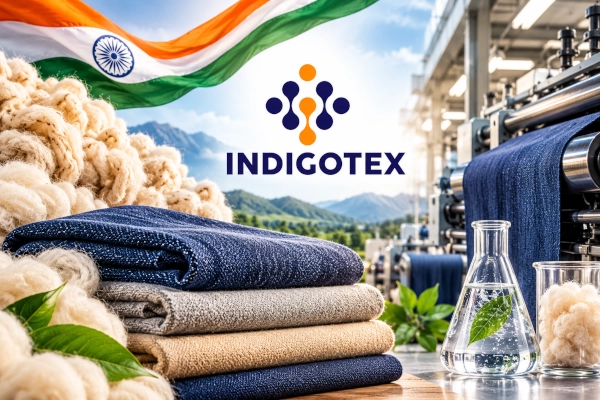
Indian deep-tech textile startup IndigoTex has raised ₹5 crore in fresh funding to expand manufacturing, commercialise advanced wool technologies and take its products into international markets.
The round was led by IAN Angel Fund, with participation from SIDBI, the Foundation for Innovation and Technology Transfer at IIT Delhi, and IIT Delhi Angels. IndigoTex plans to use the capital to establish manufacturing capacity, strengthen sales and operations, complete certifications, continue research and development, and scale products including IndiWoo Denim and washable wool and poly-wool fabrics.
The company is positioning itself at the intersection of textile engineering, advanced materials and sustainable processing, with particular emphasis on reducing the environmental and practical limitations associated with conventional wool finishing.
From IIT Delhi Research to Commercial Textile Manufacturing
Founded in 2024 by Satendra Singh, Prof. B.S. Butola and Dilip Singh, IndigoTex develops wool products, technical textiles and waterless textile-processing technologies. Its research operations are linked to IIT Delhi’s Research and Innovation Park, while manufacturing and finishing capacity is being established at the Rai Industrial Area in Sonipat, Haryana.
The IIT Delhi connection is significant because the institute’s Department of Textile and Fibre Engineering conducts research across fibres, yarns, fabrics, nonwovens and chemical processing. Its facilities include laboratories for textile chemical processing, fibre science, physical testing, smart textiles and advanced textile materials.
This gives IndigoTex access to an academic environment where textile innovation extends well beyond conventional apparel into areas such as functional fibres, protective materials, surface treatment, sustainability and advanced manufacturing.
ECOTEX Wool Targets a Long-Standing Problem in Wool Care
One of IndigoTex’s key technologies is ECOTEX Wool, which is being developed to make wool and poly-wool fabrics washable while reducing their dependence on conventional dry cleaning.
Wool is valued for insulation, comfort and natural performance, but its structure creates processing challenges. Moisture, heat, mechanical agitation and repeated washing can lead to felting, shrinkage and changes in fabric properties unless the material is treated appropriately.
That has historically pushed many wool products towards specialised finishing and dry-cleaning cycles. A technology that improves washability while maintaining fabric performance could therefore simplify garment care and broaden the practical use of wool in everyday clothing.
The commercial significance lies not only in convenience. Reducing dependence on conventional cleaning and finishing routes can also support lower-resource textile systems, provided the new processes perform reliably at industrial scale.
Waterless Processing Could Reduce Textile Resource Use
IndigoTex is also developing waterless textile-processing technologies, placing the company within a wider global effort to reduce water and chemical consumption across textile manufacturing.
Wet processing is one of the most resource-intensive stages of textile production. Dyeing, washing, finishing and chemical treatment can require large quantities of water and generate significant wastewater-management requirements.
IIT Delhi itself has a long research track in environmentally conscious textile processing, including work on natural fibres, eco-friendly finishing, surface modification and alternative treatment methods. The institute describes textile processing as an area where sustainable technologies can reduce reliance on aggressive chemical processes and improve material functionality.
Commercialising genuinely lower-water or waterless processes could therefore address both manufacturing efficiency and environmental performance, particularly as textile producers face tighter requirements on water use, effluent treatment and export-market sustainability standards.
IndiWoo Denim Broadens the Company’s Product Strategy
The new funding will also support commercialisation of IndiWoo Denim, one of IndigoTex’s emerging product lines.
The concept places wool-related textile innovation inside a product category normally dominated by cotton and cotton blends. This could allow IndigoTex to differentiate through thermal comfort, material performance or specialised finishing rather than competing solely on conventional denim manufacturing.
The company has not yet disclosed extensive public technical specifications for IndiWoo Denim, so its final commercial performance and market positioning will depend on the properties achieved at production scale.
Even so, developing differentiated textile products around indigenous process technology can give Indian manufacturers a stronger position than competing only through lower-cost production.
Sonipat Facility Will Move the Technology Towards Scale
IndigoTex is establishing a manufacturing and finishing facility in Rai Industrial Area, Sonipat, while retaining its research and development activities at IIT Delhi’s Research and Innovation Park.
This separation between research and industrial production reflects an important stage in deep-tech commercialisation. Laboratory success does not automatically translate into viable manufacturing because processes must be repeatable, quality must remain consistent and equipment must operate economically at higher volumes.
The Sonipat facility will therefore be central to proving whether IndigoTex can move from experimental textile chemistry and material engineering into commercially dependable products.
The funding will also support certifications required for domestic and international markets, an important step for a company seeking to sell into regions with demanding textile-quality and sustainability standards.
International Expansion Is Already Part of the Roadmap
IndigoTex has identified Europe, North America, Australia and other cold-climate markets as potential destinations for its wool technologies. The company is already holding discussions in countries including France, Russia and Denmark.
These markets have established demand for wool garments and technical wool products, making them logical targets for technologies that improve washability, durability or ease of maintenance.
International expansion will nevertheless require more than product innovation. IndigoTex will have to establish manufacturing consistency, regulatory and chemical compliance, certification, distribution relationships and clear performance advantages over established textile treatments.
The ₹5 crore round gives the startup early capital to begin building that commercial foundation.
Advanced Textiles Are Becoming a Deep-Tech Sector
Textile innovation is increasingly moving beyond traditional spinning, weaving and garment production into advanced materials, functional surfaces and specialised engineering.
IIT Delhi’s textile research portfolio reflects that transition. Current work spans smart and innovative textile materials, medical textiles, polymer composites, nanofibres, conductive fabrics, technical textiles and environmentally responsible processing.
The department is also involved in DRDO-supported programmes covering aerostat materials, high-altitude airship fabrics, extreme-heat and extreme-cold protective clothing and soft body armour.
This broader research environment demonstrates why advanced textiles increasingly belong within the same deep-tech ecosystem as materials science, defence manufacturing and sustainable industrial technology.
Building Indian Intellectual Property into Textile Products
India is already one of the world’s largest textile manufacturing bases, but much of the sector’s competitive strength has traditionally come from scale, labour availability and established supply chains.
Deep-tech textile companies offer a different path by building value around intellectual property, material science and proprietary production processes.
IndigoTex’s strategy combines these elements: research anchored in Indian textile engineering, product development in specialised wool and technical fabrics, and manufacturing planned within India.
Its next challenge will be to convert those technologies into products that can compete on performance as well as price.
The ₹5 crore funding round is modest compared with capital raises in sectors such as AI or fintech, but its significance lies in the kind of capability being built. If IndigoTex succeeds in industrialising washable wool, waterless processing and differentiated textile products, it could add another layer of technology-driven value to India’s enormous textile manufacturing ecosystem.
References
- ET Entrepreneur, October 7, 2026 — IndigoTex Raises ₹5 Crore Funding Led by IAN Angel Fund.
https://entrepreneur.economictimes.indiatimes.com/news/funding/indigotex-raises-5-crore-funding-led-by-ian-angel-fund/134757977 - Indian Institute of Technology Delhi, Department of Textile and Fibre Engineering — Research Facilities.
https://textile.iitd.ac.in/research-facilities - Indian Institute of Technology Delhi, Department of Textile and Fibre Engineering — Department overview and research areas.
https://textile.iitd.ac.in/about - Indian Institute of Technology Delhi — Research on sustainable and eco-friendly textile processing.
https://textile.iitd.ac.in/ - IIT Delhi, Department of Textile and Fibre Engineering — DRDO-sponsored research in smart textiles, protective clothing and advanced ballistics.
https://textile.iitd.ac.in/ongoing-research/3
You may also like
-
Sunfox Technologies Raises $7 Million to Take India-Built Spandan ECG Platform Global
-
DRDO Opens Actuators, Infrared Seeker, Lightweight Torpedo and Armour Technologies to Indian Industry
-
Airtel Extends Free International Roaming Across Its New Postpaid Plans
-
Indian Army to Add 225 Indigenous FPV Drones; Aerodrone Says Systems Were Tested Up to 17,500 Feet
-
Kasturi Cotton Bharat Expands India’s Traceable Cotton Ecosystem as Certification Scales Up
