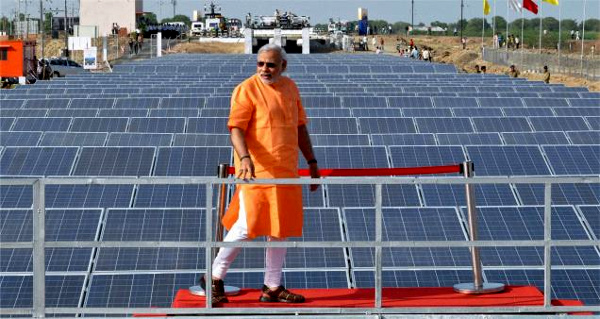
India’s solar energy sector has undergone a dramatic transformation, expanding from approximately 3 GW of installed capacity in 2014 to 162.15 GW by June 30, 2026.
Solar power has now become the largest component of India’s renewable energy portfolio, reflecting the impact of sustained policy support, large-scale infrastructure development, rooftop installations, agricultural solarisation and rapid expansion of domestic manufacturing.
The growth has positioned India among the world’s fastest-expanding solar markets and made the technology a central pillar of the country’s transition towards a cleaner and more diversified electricity system.
Solar Capacity Records Rapid Expansion
India’s solar capacity has increased more than fiftyfold since 2014.
The country added approximately 37 GW of solar power during the 2025 calendar year. Capacity additions accelerated further during the 2025–26 financial year, when a record 44.61 GW was reportedly commissioned.
This expansion raised India’s total non-fossil fuel power capacity to 283.46 GW. Renewable energy sources accounted for 274.68 GW of this total.
Solar power’s growing share has been supported by utility-scale projects, rooftop systems, solar parks, agricultural installations and emerging technologies such as floating photovoltaic plants.
The expansion also reflects growing demand for electricity from households, industries, transport systems, data centres and developing urban areas.
Floating Solar Gets a Major Policy Push
The next phase of India’s solar growth is expected to receive support from the Pradhan Mantri Surya Sarovar Yojana.
The Union Cabinet-approved programme aims to establish 5,000 MW of floating solar photovoltaic capacity accompanied by energy-storage systems.
The scheme carries an outlay of ₹5,070 crore and is planned for implementation between the 2026–27 and 2030–31 financial years.
Floating solar plants are installed on reservoirs, lakes and other suitable water bodies. They can generate electricity without requiring large stretches of additional land, making them particularly useful in regions facing competition between energy, agriculture, housing and conservation requirements.
Panels installed above water may also benefit from the cooler surrounding environment, which can improve their operating efficiency under certain conditions.
Energy Storage to Support Grid Stability
The Surya Sarovar programme includes a minimum energy-storage capacity of 10,000 MWh.
Energy storage is becoming increasingly important as the share of solar and wind power in India’s electricity system rises.
Solar generation is highest during daylight hours, while electricity demand may remain elevated after sunset. Storage systems can capture surplus power generated during the day and release it when production falls or demand increases.
Co-locating batteries or other storage technologies with floating solar plants can help reduce fluctuations, improve grid reliability and manage peak demand more efficiently.
Storage can also reduce the need to curtail renewable generation during periods when electricity production exceeds immediate demand.
India Holds Significant Floating Solar Potential
The National Institute of Solar Energy has estimated India’s floating solar potential at approximately 102.18 GW.
India possesses thousands of reservoirs associated with hydropower plants, irrigation projects, drinking-water systems and industrial facilities. Even the selective use of these water bodies could create substantial additional clean-energy capacity.
The Pradhan Mantri Surya Sarovar Yojana is expected to raise India’s total floating solar capacity to nearly 5,700 MW.
According to the projections cited for the programme, the planned installations could prevent close to 10 million tonnes of carbon dioxide emissions annually.
The initiative is also expected to generate between 16,000 and 17,000 full-time-equivalent employment opportunities across construction, engineering, installation, maintenance, logistics and related services.
Domestic Module Manufacturing Expands Rapidly
India’s solar growth is increasingly being supported by domestic manufacturing.
Solar module production capacity has risen from approximately 2.3 GW in 2014 to around 172 GW as of March 31, 2026.
This expansion has been encouraged by measures such as the Production Linked Incentive Scheme and the Approved List of Models and Manufacturers.
The Production Linked Incentive programme seeks to promote large-scale domestic manufacturing across the solar value chain. The objective is to reduce import dependence, improve supply security and establish India as a major global production centre.
The Approved List of Models and Manufacturers supports the use of approved domestically manufactured modules in designated projects and government-backed programmes.
Together, these measures have encouraged investments in module assembly, solar cells, wafers, ingots and associated materials.
Moving Towards an Integrated Solar Supply Chain
Module manufacturing represents only one part of the solar value chain.
A complete domestic ecosystem also requires polysilicon, wafers, cells, glass, encapsulants, junction boxes, inverters, mounting structures, cables, transformers and energy-storage equipment.
India’s next industrial challenge will be to deepen local production across these areas while maintaining internationally competitive quality and prices.
An integrated manufacturing base can reduce exposure to disruptions in overseas supply chains and provide greater control over the pace of renewable-energy deployment.
It can also create employment in engineering, advanced materials, electronics, project construction and research.
Rooftop Solar Reaches Millions of Households
The PM Surya Ghar: Muft Bijli Yojana has become an important driver of household-level solar adoption.
More than 43 lakh households had installed rooftop solar systems under the programme by June 2026.
Central financial assistance amounting to ₹14,771.82 crore had been disbursed by December 2025.
Rooftop solar enables households to generate a portion of their electricity close to the point of consumption. This can reduce monthly power bills and lower pressure on transmission and distribution networks during daytime hours.
Surplus electricity may also be supplied to the grid under applicable net-metering or settlement mechanisms.
Large-scale adoption of household solar systems can gradually transform electricity consumers into distributed energy producers.
Rooftop Expansion Requires Strong Local Infrastructure
The continued success of rooftop solar will depend on factors beyond financial subsidies.
Consumers require reliable installers, high-quality equipment, transparent pricing and timely approvals from distribution companies.
Effective metering arrangements and clear billing procedures are also essential for ensuring that households receive the expected financial benefits.
Maintenance and after-sales services will become increasingly important as millions of rooftop systems remain in operation for extended periods.
A strong domestic network of trained technicians, electricians and service providers can improve system performance and consumer confidence.
Solar Irrigation Benefits More Than 21 Lakh Farmers
The PM-KUSUM scheme has extended solar energy into India’s agricultural sector.
More than 21.77 lakh farmers have benefited from solar-powered irrigation initiatives under the programme.
Solar pumps can reduce dependence on diesel and provide farmers with a cleaner source of energy for irrigation.
Where properly integrated with agricultural planning, solar power can lower recurring fuel expenses and improve access to irrigation in areas with limited or unreliable electricity supplies.
The programme can also support the installation of decentralised solar plants and the solarisation of existing agricultural feeders.
Managing Water Use Remains Important
Solar pumps can make irrigation energy more affordable, but they must be accompanied by responsible water-management practices.
When pumping costs fall sharply, uncontrolled extraction may increase pressure on groundwater resources.
The long-term success of agricultural solarisation therefore depends on combining energy access with efficient irrigation methods, crop planning and groundwater monitoring.
Technologies such as drip irrigation, soil-moisture sensors and automated pump controls can help farmers use both electricity and water more efficiently.
Solar Parks Support Utility-Scale Development
India has sanctioned 54 solar parks across the country.
Solar parks provide large areas with shared infrastructure such as transmission lines, substations, roads and land-development facilities.
This model can reduce the time and complexity involved in establishing utility-scale projects because developers do not need to create every supporting facility independently.
The parks can also attract large investments and support the rapid addition of generation capacity.
However, future projects will need to maintain careful attention to land acquisition, ecological conditions and the interests of local communities.
Floating solar, rooftop systems and decentralised generation can complement solar parks by reducing exclusive dependence on land-intensive projects.
Solar Energy Strengthens India’s Energy Security
Expanding solar power can reduce India’s exposure to imported fossil fuels and international fuel-price volatility.
Once a solar plant is commissioned, it generates electricity without requiring continuous imports of coal, oil or gas.
A diversified energy system containing solar, wind, hydropower, nuclear power, storage and conventional generation can improve resilience against supply disruptions.
Solar power can also support electricity access in remote locations where extending conventional transmission infrastructure may be difficult or expensive.
Distributed systems, mini-grids and battery-backed installations can provide power to households, farms, health centres, schools and small enterprises.
International Solar Leadership
India has promoted international cooperation through initiatives such as the International Solar Alliance and One Sun One World One Grid.
The International Solar Alliance brings together countries seeking to expand solar deployment, mobilise finance and share technology and knowledge.
The One Sun One World One Grid vision promotes greater cross-border electricity connectivity, allowing renewable power to be transferred across regions with different time zones and generation patterns.
These initiatives reflect India’s effort to combine domestic energy expansion with a broader role in global climate and clean-energy cooperation.
Challenges Behind the Growth Story
India’s expansion from 3 GW to more than 162 GW represents a major achievement, but the next stage will require improvements across the wider electricity system.
Transmission networks must expand to carry electricity from solar-rich regions to major centres of demand.
Energy storage must become more affordable and available at a much larger scale.
Distribution companies will need stronger financial and technical capacity to manage increasing quantities of decentralised and variable generation.
India must also prepare for the eventual recycling and disposal of ageing solar panels, batteries and electrical equipment.
Domestic manufacturing needs to move further upstream, while research institutions and companies must continue improving efficiency, durability and energy-storage technologies.
From Capacity Expansion to System Integration
The first phase of India’s solar transition focused primarily on adding generation capacity.
The emerging phase will require deeper integration of renewable electricity into the national grid.
This means coordinating solar power with storage, flexible generation, transmission networks and demand-management systems.
Digital forecasting can help grid operators predict solar generation more accurately. Smart meters and time-based tariffs can encourage consumers to use electricity when renewable supply is abundant.
Electric vehicles, green hydrogen production and industrial electrification may also create new sources of demand capable of absorbing large volumes of solar electricity.
A New Stage in India’s Clean-Energy Transition
India’s rise from approximately 3 GW of solar capacity in 2014 to 162.15 GW by June 2026 demonstrates the scale at which public policy, private investment and technological change can reshape the energy sector.
Utility-scale projects created the initial momentum, while rooftop solar, agricultural pumps and domestic manufacturing broadened the industry’s economic reach.
The Pradhan Mantri Surya Sarovar Yojana adds a new dimension by combining floating solar plants with large-scale energy storage.
India’s future success will depend not only on installing additional panels but also on building a reliable, flexible and domestically supported clean-energy system.
With manufacturing capacity expanding, millions of households adopting rooftop systems and farmers benefiting from solar irrigation, solar power is increasingly becoming part of India’s industrial, agricultural and household infrastructure.
The sector’s transformation from 3 GW to more than 162 GW is therefore more than a story of capacity growth. It represents the emergence of solar energy as a strategic foundation for India’s energy security, manufacturing ambitions and long-term economic development.
You may also like
-
India’s Economic Warfare Challenge: Strategic Autonomy, Energy Security and the Rise of a Global Power
-
India-US Trade Deal Stalemate: Why Washington’s Tariff Pressure Has Failed to Secure an Agreement
-
US Double Standards in Foreign Policy: 16 Recent Cases Involving India, Russia, China and Global Trade
-
India’s Arctic Energy Ambitions: Russian Oil, LNG and a New Sea Route to Indian Ports
-
India and Russia Explore Joint Icebreaker Construction as Maritime Industrial Cooperation Expands
