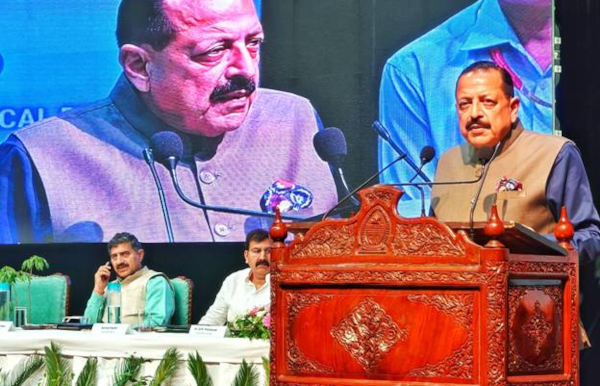
India has strengthened its mountain-weather and disaster-warning network with the launch of the country’s seventh Regional Meteorological Centre in Jammu. Inaugurated on 5 June 2026 by Union Minister Dr. Jitendra Singh, the new centre will serve Jammu & Kashmir, Ladakh and Himachal Pradesh, three regions where weather can shift rapidly across plains, valleys, passes, glaciers and high-altitude settlements.
The Jammu centre represents more than an administrative expansion of the India Meteorological Department. It is a strategic weather hub for one of India’s most sensitive and geographically demanding zones. The Himalayan belt faces cloudbursts, flash floods, avalanches, heavy snowfall, thunderstorms, landslides and sudden temperature changes. These events affect pilgrims, farmers, transport networks, hydropower projects, security forces, tourists and disaster-response agencies. A dedicated regional centre in Jammu gives the area a closer, sharper and more specialised forecasting system.
The new centre will provide district-level forecasts, mountain-weather forecasts, tourist advisories, city-specific weather services and early warnings for extreme events. This localised approach is important because mountain weather varies sharply over short distances. A valley may experience rainfall while a nearby pass receives snowfall. A pilgrimage route may remain clear in the morning and face storm activity by afternoon. A hydropower project, road convoy or security post needs accurate alerts that are specific to its terrain. The Jammu centre is designed to bring that precision into daily forecasting.
The launch also marks a restructuring of regional meteorological operations. Earlier, the Regional Meteorological Centre in Delhi coordinated services for a wide northern belt that included Jammu & Kashmir, Ladakh, Himachal Pradesh, Uttarakhand, Punjab, Haryana, Uttar Pradesh and Rajasthan. With the new Jammu centre, weather services for Jammu & Kashmir, Ladakh and Himachal Pradesh will be handled closer to the region. A similar centre is also planned in Lucknow, which will serve Uttar Pradesh and Uttarakhand.
The transformation of weather infrastructure in Jammu & Kashmir and Ladakh has been significant over the past decade. In 2014, the region had no Doppler Weather Radar. Today, four Doppler Weather Radars are operational at Jammu, Srinagar, Leh and Banihal Top. Under Mission Mausam, five additional radars have been proposed for Anantnag, Rajouri, Baramulla, Kishtwar and Doda. These radars are vital for tracking storm systems, rainfall intensity, cloud movement and severe-weather development over complex terrain.
The ground observation network has also expanded. The region now has 56 observatories, including 15 manual observatories, 25 Automatic Weather Stations and 16 Automatic Rain Gauges. In 2014, the region had 13 Automatic Weather Stations and 14 Automatic Rain Gauges. New Automatic Weather Stations have recently been installed at Kargil, Ukhral in Ramban district and Mata Vaishno Devi Bhawan. Nearly eight more Automatic Weather Stations and five Automatic Rain Gauges are expected to be added during the current financial year.
Rainfall monitoring has seen another major improvement. Stations under the Daily Rainfall Monitoring Scheme have increased from 30 in 2014 to 85 at present. This wider network helps forecasters detect rainfall patterns in real time and issue more effective warnings for flash floods and landslides. In mountain regions, rainfall data can become the difference between routine movement and timely evacuation.
The new Jammu centre will also support religious tourism and pilgrimage management. The Amarnath Yatra and Vaishno Devi Yatra pass through terrain where weather alerts are essential for public safety. Real-time forecasts, route-specific advisories and early warnings can help authorities regulate movement, manage crowd safety and prepare emergency teams before dangerous conditions develop.
For agriculture, the centre can provide climate and weather information that helps farmers plan sowing, irrigation, harvesting and crop protection. For transport operators, it can support safer movement across highways and mountain roads. For hydropower projects, it can assist reservoir operations and risk planning. For security forces deployed in high-altitude areas, it can improve operational awareness in snowbound, avalanche-prone and storm-affected zones.
The initiative also connects weather science with research and institutional capacity. The Meteorological Centre in Srinagar has collaborations with SKUAST-Jammu, SKUAST-Kashmir and the Islamic University of Science and Technology. The High-Altitude Cloud Physics Laboratory at Patnitop, developed with Swiss scientific collaboration, supports cloud and aerosol studies in the Himalayan region. These efforts can help India build deeper scientific understanding of mountain weather systems.
Earthquake monitoring has also been strengthened. Seismic stations in Jammu and Kashmir have been upgraded to digital systems, an additional observatory has been established at Udhampur, and a new seismological observatory has been proposed in Kishtwar. At present, five seismic stations across Jammu & Kashmir and Ladakh transmit near real-time data to the National Centre for Seismology.
The Regional Meteorological Centre in Jammu is therefore a major step in India’s move toward localised, technology-driven and disaster-ready weather governance. It brings forecasting closer to the mountains, closer to the people and closer to the agencies that act during emergencies. In a region where terrain, climate, security and livelihoods are deeply connected, the centre will serve as a scientific shield for the northern Himalayas.
You may also like
-
India’s Economic Warfare Challenge: Strategic Autonomy, Energy Security and the Rise of a Global Power
-
India-US Trade Deal Stalemate: Why Washington’s Tariff Pressure Has Failed to Secure an Agreement
-
US Double Standards in Foreign Policy: 16 Recent Cases Involving India, Russia, China and Global Trade
-
India’s Arctic Energy Ambitions: Russian Oil, LNG and a New Sea Route to Indian Ports
-
India and Russia Explore Joint Icebreaker Construction as Maritime Industrial Cooperation Expands
