India’s expanding private space industry is beginning to move beyond launch vehicles, satellites and Earth observation into an entirely different frontier: manufacturing pharmaceuticals in space.
Bhubaneswar-based startup Serendipity Space is developing reusable satellites designed to carry pharmaceutical compounds into Low Earth Orbit, process them under microgravity conditions and return the resulting material safely to Earth. At the centre of the programme is Alchemy, an autonomous pharmaceutical-processing module intended to function as a miniature factory in space.
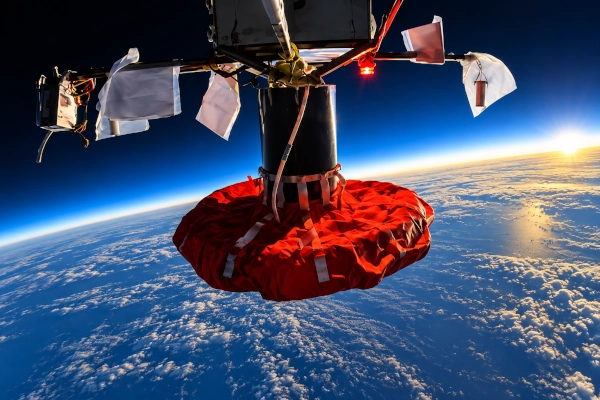
The company took an important step towards that goal in 2026 when it flight-tested an orbital-class satellite prototype carrying Alchemy during a stratospheric balloon mission conducted with the Tata Institute of Fundamental Research’s Balloon Facility in Hyderabad. The flight took place in March and was publicly disclosed in August. During the mission, the company tested its avionics, thermal-protection technologies and pharmaceutical-processing hardware while also recovering the vehicle and its payload after flight.
Serendipity said Alchemy carried out drug-crystallisation processes during the mission and that the samples included monoclonal-antibody therapeutics, small-molecule pharmaceutical compounds and proteins used in drug discovery. The company also tested whether the processed samples could remain intact through descent, landing and recovery — an essential requirement for any future commercial system intended to manufacture valuable pharmaceutical material in orbit and return it to laboratories on Earth.
The experiment should, however, be understood as a near-space technology demonstration rather than actual orbital pharmaceutical manufacturing. A stratospheric balloon does not provide the sustained microgravity environment available aboard an orbiting spacecraft. The March mission therefore validated important elements of the hardware, operations and recovery architecture, but Serendipity’s critical next step will be to demonstrate Alchemy during a genuine orbital mission.
That distinction makes the programme no less significant. Instead, it highlights how the company is progressively testing the technologies required to build an autonomous pharmaceutical factory that can eventually operate hundreds of kilometres above Earth.
Why Manufacture Medicines in Microgravity?
The scientific argument behind space-based pharmaceutical manufacturing begins with crystallisation.
Many medicines — particularly proteins and complex biological drugs — depend heavily on the way their molecules form crystals. Crystal structure can influence characteristics such as purity, stability, solubility, formulation and how effectively a drug can ultimately be delivered.
On Earth, gravity affects this process. Dense particles can settle while buoyancy-driven convection produces movement within the liquid surrounding a growing crystal. These effects can influence crystal growth and contribute to irregularities.
Microgravity greatly reduces these gravity-driven processes.
The result, depending on the compound and experimental conditions, can be larger, more uniform or better ordered crystals than researchers can readily obtain on Earth. Scientists have consequently conducted protein-crystallisation and pharmaceutical experiments aboard orbital laboratories for decades.
Serendipity Space wants to transform that research model into an automated commercial manufacturing service.
The Department of Biotechnology has officially highlighted the company as a startup incubated at the DBT-Institute of Life Sciences Bioincubator. DBT says Serendipity is developing reusable satellite platforms and autonomous microgravity crystallisation technology to process pharmaceutical and protein crystals in Low Earth Orbit. The department has specifically identified potential applications in areas including subcutaneous biologics and improving the properties of small-molecule drugs.
Serendipity describes its broader goal simply: process pharmaceutical compounds in space and bring them back to Earth. Its proposed spacecraft are being designed with re-entry capability so that pharmaceutical payloads can be recovered rather than remaining in orbit.
Alchemy: An Autonomous Pharmaceutical Factory
The autonomy of Alchemy is particularly important.
Traditional pharmaceutical experiments aboard crewed space stations can be operated or supervised by astronauts. Serendipity’s commercial concept is different. Its satellites would fly without a crew, meaning the pharmaceutical-processing system must be capable of initiating experiments, controlling environmental parameters, completing crystallisation and preserving the samples largely by itself.
The spacecraft must then accomplish another difficult task: bring those materials back through the atmosphere.
That requires far more than pharmaceutical expertise. A commercially useful returnable spacecraft needs guidance and avionics, thermal protection, re-entry capability, recovery systems and a payload environment capable of protecting sensitive material throughout the journey.
This explains why the recent balloon mission tested both Alchemy and spacecraft technologies such as the company’s avionics and heat-shield systems. The eventual commercial platform has to function simultaneously as a laboratory, spacecraft and recoverable capsule.
Serendipity’s long-term concept is therefore closer to a reusable orbital factory than to a conventional research satellite.
Indian Researchers Join the Programme
The startup is also building an Indian research network around microgravity pharmaceuticals.
In March 2026, Siksha ‘O’ Anusandhan University and Serendipity Space signed an MoU for joint research in microgravity drug development. The collaboration covers pharmaceutical crystallisation under conventional laboratory conditions, simulated microgravity and eventually spaceflight.
According to SOA, the research will investigate small-molecule crystallisation and the potential for microgravity environments to produce larger, purer or more highly ordered molecular structures. Such work could eventually contribute to pharmaceutical formulation, drug delivery and structure-based drug discovery.
This staged approach is important because not every medicine automatically becomes better simply because it is processed in space. Individual compounds need controlled experimentation comparing Earth-grown and microgravity-grown materials before any advantage can be scientifically established.
Serendipity will therefore need not only successful spacecraft missions but also detailed pharmaceutical analysis demonstrating that its orbital products offer properties valuable enough to justify the cost of launching and returning them.
From Space Startup to National Recognition
The company has also begun receiving attention at the national level.
During Prime Minister Narendra Modi’s interaction with the founders and CEOs of 20 Indian space startups on August 21, 2026, Serendipity Space was among the companies represented. The Prime Minister’s Office subsequently published the interaction in which co-founder Antariksh Parichha described the company as India’s first space-pharma startup and explained that it was developing satellites capable of travelling to space, manufacturing pharmaceuticals there and bringing them back.
The company is emerging within an Indian private-space ecosystem that has expanded rapidly since the sector was opened to greater private participation. According to the government, India had around 440 registered space startups by August 2026, compared with only one in 2014. Private investment in the sector had crossed $618 million by March 2026, while the government expects India’s space economy to expand substantially over the coming decade.
Serendipity represents an interesting new stage in that evolution.
The first wave of Indian private-space companies concentrated heavily on launch vehicles, propulsion, satellite manufacturing and geospatial services. Companies are now moving into activities that depend upon actually using the space environment as an industrial resource.
In-space manufacturing is one such field.
Space Could Become a New Pharmaceutical Laboratory
The larger idea behind Serendipity Space is that Low Earth Orbit should not merely be a destination for satellites. Microgravity itself can potentially become a manufacturing environment.
Pharmaceuticals are particularly attractive because some medicines are extremely valuable relative to their mass. Returning tonnes of ordinary manufactured material from orbit would be economically difficult. Returning a few kilograms — or even much smaller quantities — of high-value pharmaceutical compounds could present an entirely different business case.
The economics would improve further if spacecraft can be recovered and reused.
This is why Serendipity’s emphasis on reusable re-entry satellites is central to its model. Instead of building a disposable experiment for every mission, the company ultimately wants a spacecraft architecture capable of repeatedly carrying pharmaceutical payloads into orbit and bringing finished material home.
But considerable work remains before that vision becomes commercial reality.
Serendipity has not yet demonstrated sustained pharmaceutical processing in orbit. An orbital Alchemy mission will need to validate the system under genuine microgravity, followed by successful re-entry and recovery. The recovered samples would then have to undergo detailed laboratory analysis to demonstrate whether their properties are significantly better than comparable material produced on Earth.
After that would come perhaps the most important validation of all: pharmaceutical customers willing to pay for orbital production.
The Next Step Is Orbit
The recent balloon flight should therefore be seen for what it is — an important engineering milestone on a much longer road.
Serendipity has demonstrated an integrated prototype carrying its autonomous pharmaceutical module, operated pharmaceutical-processing hardware during a near-space flight and recovered the system. What it has not yet demonstrated is a complete launch-to-orbit, microgravity-manufacturing, re-entry-and-recovery cycle.
That is now the crucial objective.
If the company succeeds, India would gain capabilities extending far beyond conventional satellite manufacturing. It would create expertise in returnable spacecraft, autonomous space laboratories, pharmaceutical processing and potentially commercial in-space manufacturing.
For an Indian space sector that was once dominated almost entirely by government missions, the significance is striking.
The question is gradually changing from “Can India send something into space?” to “What can Indian companies build and manufacture once they get there?”
Serendipity Space’s answer is pharmaceuticals.
And Alchemy could become one of India’s earliest attempts to turn Low Earth Orbit from a place used primarily for satellites into an industrial laboratory capable of producing high-value materials and bringing them back home.
References
Department of Biotechnology, Government of India
DBT highlighted Serendipity Space as an Institute of Life Sciences-incubated startup developing reusable satellite platforms and its Alchemy microgravity crystallisation technology for pharmaceutical and protein processing in Low Earth Orbit.
Prime Minister’s Office / Press Information Bureau — August 23, 2026
Official transcript of PM Narendra Modi’s interaction with Indian space-startup founders. Serendipity Space co-founder Antariksh Parichha describes the company’s plan to manufacture pharmaceuticals in space and return them to Earth.
Siksha ‘O’ Anusandhan — March 31, 2026
Official announcement of the university’s collaboration with Serendipity Space on laboratory, simulated-microgravity and spaceflight pharmaceutical crystallisation experiments.
Serendipity Space — Company Website
The company describes its objective as processing pharmaceutical compounds in space using reusable satellites with re-entry capability.
You may also like
-
Indian Navy Initiates Communication Systems Upgrade for Kamorta-Class Anti-Submarine Warfare Corvettes
-
TDB Backs Panacea Medical Technologies to Develop Indigenous 32-Slice CT Scanner in Karnataka
-
India Reportedly Offers Mine-Protected Vehicles to Kenya to Strengthen Defence Cooperation
-
Sigma Advanced Systems and Munitions India Sign MoU for Indigenous 155mm Course-Correction Fuzes
-
Koraput Kalajeera Rice: Odisha’s Fragrant ‘Prince of Rice’ Preserved by Generations of Tribal Farmers
