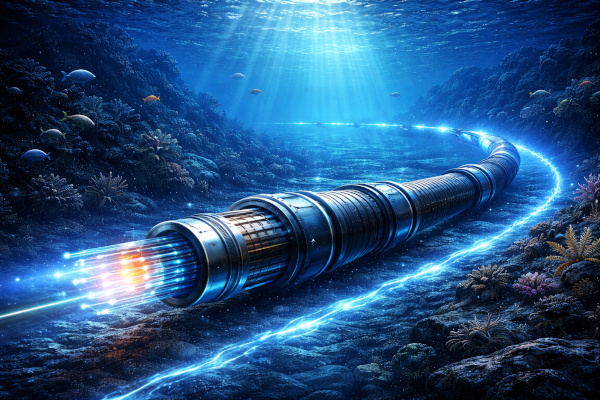
India’s international digital backbone is entering a new expansion cycle as a fresh wave of subsea cable projects converges with the country’s rapidly growing data centre and AI ecosystem. The immediate trigger is rising demand for cloud, AI inference, data mirroring and hyperscale traffic, all of which require far greater international bandwidth and route diversity than earlier generations of internet infrastructure. ETTelecom reported that India’s current international subsea capacity is estimated at about 180 Tbps and could quadruple once the new systems are fully lit.
The scale of the demand shift is becoming clearer in the numbers. According to ETTelecom, global international bandwidth is expected to grow at a 26% CAGR from 2024 to 2031, effectively doubling in roughly three years. In India, the data-centre buildout is moving in parallel: the government said domestic data-centre capacity has already grown from 375 MW in 2020 to more than 1,500 MW by 2025, while the Economic Survey projection cited by TRAI Chairman Anil Kumar Lahoti puts India’s data-centre capacity at about 8 GW by 2030, up from 1.4 GW in Q2 2025. Lahoti also said subsea cables carry up to 99% of global intercontinental traffic, underlining why cable landing infrastructure is now central to digital resilience.
India’s present upgrade cycle is being led by both telecom operators and hyperscalers. The government told Parliament in March 2026 that four submarine cable systems are currently under commissioning at Indian cable landing stations: India Europe Xpress (IEX) in Mumbai, SEA-ME-WE-6 in Mumbai and Chennai, 2Africa in Mumbai, and Raman Cable in Mumbai. Three more systems are under planning with applications submitted to the Department of Telecommunications: Tata Communications’ Wyasa Cable System in Chennai, Reliance Jio’s Indian Ocean Cable in Raigad, and Sify’s WABAN Cable System in Mumbai.
Among the systems already advancing, Airtel’s SEA-ME-WE-6 is one of the biggest near-term additions. Airtel said the 21,700 route-kilometre cable connects India to Singapore and Marseille via Egypt, and will bring 220 Tbps of global capacity to India. The company had already landed the cable in Mumbai in December 2024 and landed it in Chennai in February 2025, while also integrating the system with Nxtra data-centre facilities in both cities. Airtel’s 2Africa Pearls landing adds another major layer: the company said it brings over 100 Tbps of international capacity to India and forms part of the 45,000-km 2Africa system, which is expected to become the world’s longest subsea cable system when complete.
Reliance Jio’s subsea play is also significant. In its 2022 announcement, Reliance said its IAX and IEX systems together would provide more than 200 Tb/s of capacity over more than 16,000 km, linking India with Europe and Southeast Asia. That legacy buildout is now being joined by a hyperscaler-led phase. In February 2026, Google announced its America-India Connect initiative, which will create a new international subsea gateway in Visakhapatnam along with three new subsea paths connecting India to Singapore, South Africa and Australia. Google said the project is designed to add resilience and capacity beyond the traditional Mumbai and Chennai concentration, positioning Vizag as a major new gateway on India’s east coast.
Meta is pursuing a similarly ambitious route strategy. The company said in February 2025 that Project Waterworth will span more than 50,000 km, connect five major continents, and become the world’s longest subsea cable project using the highest-capacity technology available. Meta said the system will support links involving the United States, India, Brazil and South Africa, and described it as a multi-billion-dollar, multi-year investment aimed at strengthening the infrastructure needed for AI-era workloads.
The strategic implication is that India is moving from being a large bandwidth consumer to becoming a more distributed global connectivity hub. Until now, Mumbai and Chennai have dominated India’s cable landing geography, but the next phase is beginning to add eastern and alternate western routes, reducing concentration risk and supporting new data-centre clusters. With more cable systems under commissioning, more routes under planning, and hyperscaler-backed gateways coming into play, India’s subsea network is being rebuilt for an economy where AI, cloud and digital services demand far more than legacy internet capacity ever did.
Reference:
https://telecom.economictimes.indiatimes.com/news/telecom-equipment/indias-next-gen-subsea-cables-revolutionize-global-connectivity/130081669
https://www.pib.gov.in/PressReleasePage.aspx?PRID=2241783&lang=1®=6
https://economictimes.indiatimes.com/industry/telecom/resilient-subsea-networks-critical-to-indias-ai-digital-ambitions-trai-chairman-lahoti/articleshow/128748132.cms
https://cloud.google.com/blog/products/infrastructure/america-india-connect-infrastructure-connects-four-continents
https://engineering.fb.com/2025/02/14/connectivity/project-waterworth-ai-subsea-infrastructure/
https://www.airtel.in/press-release/02-2025/airtel-lands-the-sea-me-we-6-cable-in-chennai/
https://www.airtel.in/press-release/03-2025/airtel-lands-the-2africa-pearls-cable-in-india/
https://www.ril.com/sites/default/files/2023-01/media-release-21-february-2022.pdf
https://www.pib.gov.in/PressReleseDetailm.aspx?PRID=2219981&lang=2®=3
You may also like
-
India’s Economic Warfare Challenge: Strategic Autonomy, Energy Security and the Rise of a Global Power
-
India-US Trade Deal Stalemate: Why Washington’s Tariff Pressure Has Failed to Secure an Agreement
-
US Double Standards in Foreign Policy: 16 Recent Cases Involving India, Russia, China and Global Trade
-
India’s Arctic Energy Ambitions: Russian Oil, LNG and a New Sea Route to Indian Ports
-
India and Russia Explore Joint Icebreaker Construction as Maritime Industrial Cooperation Expands
