
Indian scientists have reported an important advance in precision cancer nanomedicine, developing a biodegradable nanocarrier system that can silence key genes involved in breast cancer survival and therapy resistance. The research comes from the Nanobioscience Group at the Agharkar Research Institute, Pune, an autonomous institute under the Department of Science and Technology. The study was recently published in Advanced Healthcare Materials and highlights a new pathway for RNA interference-based cancer therapy.
The central idea behind the research is simple but powerful: instead of attacking cancer cells only through conventional chemical toxicity, the therapy tries to switch off specific genes that help tumour cells survive. The platform uses small interfering RNA, or siRNA, a molecule capable of reducing the activity of selected genes inside the cell. In this case, the researchers focused on two anti-apoptotic genes, MCL-1 and Survivin, both associated with tumour survival and resistance to treatment.
The delivery vehicle is built using biodegradable mesoporous silica nanoparticles. These nanoparticles are valuable in drug delivery research because they have high loading capacity and tunable surface chemistry, allowing therapeutic molecules to be packed and guided toward specific targets. The ARI team engineered the system further by adding a protamine biopolymer and an MUC1-specific aptamer, creating a targeted platform designed to recognise breast cancer cells that overexpress MUC1 receptors.
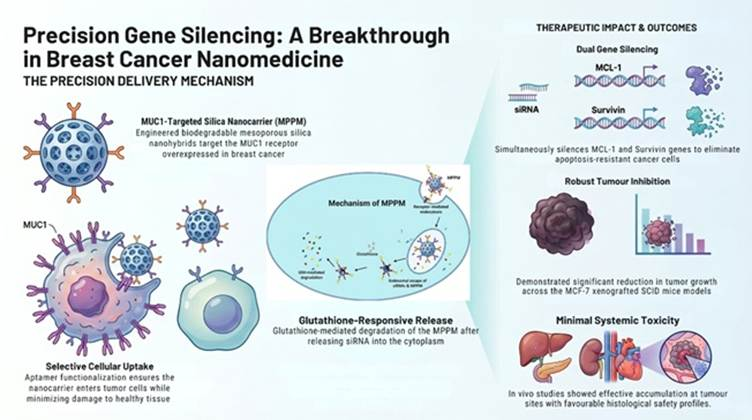
This targeting approach is important because cancer therapy often faces the challenge of precision. A powerful therapeutic molecule becomes more useful when it reaches the diseased cells efficiently and limits unwanted exposure to healthy tissues. By using the MUC1-specific aptamer as a guiding element, the nanocarrier improves cellular uptake in breast cancer cells and reduces off-target effects, making the platform more selective in its action.
Another major feature of the platform is its glutathione-responsive design. Once the nanocarrier enters the tumour microenvironment, the internal conditions help trigger controlled release of the therapeutic siRNA payload. This means the system is built not only to carry the gene-silencing molecules, but also to release them in a biologically meaningful setting where they can act inside tumour cells.
The study showed promising results in biological evaluations using MCF-7 breast cancer models. The researchers observed strong gene knockdown, increased apoptosis and significant tumour growth inhibition. In simple terms, the targeted siRNA delivery reduced the activity of survival-linked cancer genes and pushed tumour cells toward programmed cell death.
The findings were also tested in Severe Combined Immunodeficiency mice, a model often used in cancer research. In these in vivo studies, the nanocarrier accumulated effectively at tumour sites and showed minimal systemic toxicity, supported by favourable histological outcomes. This is a key point because many cancer therapies face limitations due to toxicity beyond the tumour area.
The research team included Niladri Haldar, Rajkumar Samanta, Surajit Patra, Devyani Sengar, Sachin Jadhav and Virendra Gajbhiye. Their work brings together three important elements of next-generation cancer treatment: targeted delivery, stimuli-responsive release and combinatorial gene silencing. By combining these features in a biodegradable platform, the study offers a framework for safer and more effective nanomedicine-based approaches in precision oncology.
This development is still part of the research pathway, yet it shows the direction in which cancer medicine is moving. The future of oncology is increasingly focused on therapies that understand the molecular machinery of cancer cells and intervene with accuracy. India’s work in nanobiotechnology, RNA interference and targeted delivery platforms is steadily adding strength to this global scientific shift. For breast cancer research, the ARI platform represents a promising step toward treatments that can strike at the survival signals of tumours with greater precision.
Publication Link: https://advanced.onlinelibrary.wiley.com/doi/abs/10.1002/adhm.202505296?af=R
You may also like
-
Ayurveda on Cold Foods and Iced Drinks: Why Food Temperature Matters for Digestion
-
Serum Institute of India-Manufactured Ebola Vaccine Enters Clinical Trial in Uganda
-
Ayurveda and Hydration: How Much Water Should We Really Drink?
-
Warm Water in Ayurveda: When and Why It Is Recommended
-
Women Make Up 43% of India’s Ayush Workforce as Sector Supports 17.6 Lakh Livelihoods
