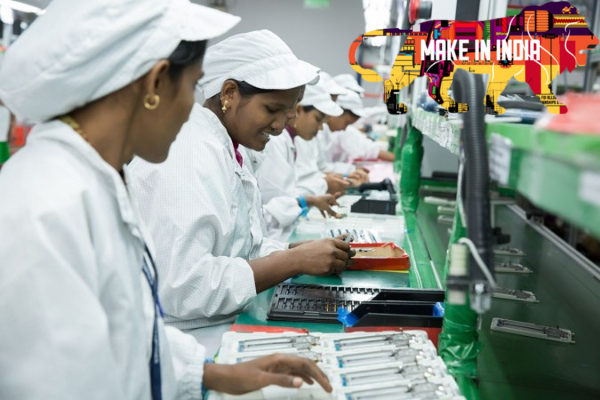
India’s electronics manufacturing journey is entering a more serious and strategic phase. After becoming one of the world’s largest mobile phone manufacturing hubs, the country is now trying to move deeper into the value chain by building domestic capability in components, chipsets, microprocessors and indigenous digital platforms.
Union Minister for Electronics and Information Technology Ashwini Vaishnaw has said that India is on its way to becoming self-reliant in mobile manufacturing, with complete domestic production of mobile phone components expected within two years. His statement reflects a broader shift in India’s electronics strategy: the focus is now moving from assembling finished devices to manufacturing the critical parts that give real depth to the industry.
This is an important transition. Mobile phone assembly brought India scale, jobs, exports and global manufacturing visibility. But deeper self-reliance depends on domestic production of printed circuit boards, camera modules, display assemblies, batteries, chargers, sensors, mechanical parts, enclosures, glass, connectors and eventually semiconductor components. A country that only assembles imported parts captures limited value. A country that manufactures the parts builds industrial depth.
India’s progress in electronics manufacturing has already been substantial. Government material notes that total electronics production rose from ₹1.9 lakh crore in 2014-15 to ₹11.3 lakh crore in 2024-25, with mobiles becoming the leading success story in this expansion. Mobile phone production has also expanded sharply, with official parliamentary material placing production at about ₹5.5 lakh crore in FY 2024-25, while mobile phone exports rose to nearly ₹2 lakh crore.
The Production Linked Incentive scheme played a central role in this growth. The scheme was designed to attract large investments in mobile phones, specified electronic components and semiconductor packaging, offering incentives on incremental sales of eligible goods manufactured in India. This helped India become a major location for large-scale electronics manufacturing and positioned mobile phones as one of the country’s most visible export-led manufacturing stories.
The next challenge is value addition. India has achieved scale in device production, but the strategic target is to increase the domestic share of components and technology. Recent reports indicate that the government is preparing a stronger second phase of the mobile manufacturing push, linked with the Electronics Component Manufacturing Scheme, to raise domestic value addition and reduce dependence on imported parts.
The semiconductor angle makes this even more important. Vaishnaw said chipsets for multiple applications, including CCTV, are being developed in the country, and that the government will invest more than ₹200 crore to develop energy-efficient microprocessors for high-performance computing, including servers. This matters because semiconductors are the core of modern electronics. They power surveillance systems, telecom networks, servers, vehicles, medical equipment, industrial automation, defence systems and consumer devices.
India has already started building indigenous processor capability. In October 2025, PIB highlighted an initiative around an indigenous 7 nanometre processor, describing it as a major step in India’s semiconductor design journey and next-generation technology innovation. Earlier, India also showcased the indigenous Vikram 32-bit processor at Semicon India 2025, signalling progress in home-grown chip design and semiconductor capability.
Energy-efficient microprocessors are especially important for high-performance computing. As artificial intelligence, cloud platforms, data centres, scientific modelling, weather forecasting, defence computing and enterprise servers expand, India will need reliable domestic compute architecture. Indigenous processor development can reduce dependence on foreign technology in sensitive sectors and support local design talent, deep-tech start-ups and electronics manufacturing clusters.
The mention of CCTV chipsets also carries strategic significance. Surveillance systems are used in cities, airports, railways, factories, defence establishments, border areas and critical infrastructure. Domestic chipsets for such applications can improve supply-chain security, reduce exposure to imported technology risks and support trusted hardware ecosystems. In the age of connected devices, self-reliance in electronics is also a cybersecurity issue.
Another interesting part of the announcement is the shift towards indigenous software platforms. Vaishnaw said more than 12 lakh central government employees had been onboarded on Zoho’s indigenous digital suite. This indicates a wider push for Indian alternatives in productivity software, cloud tools and enterprise collaboration. Hardware self-reliance and software self-reliance are now being treated as linked goals.
The development of a chatbot for fact-checking videos and online content also reflects the government’s concern over misinformation, deepfakes and manipulated media. As artificial intelligence makes fake content more convincing, public institutions will need faster verification tools. A domestic fact-checking chatbot can support media literacy, platform accountability and public trust if built with transparency, accuracy and safeguards.
India’s electronics strategy is therefore becoming multi-layered. At one level, it is about manufacturing more mobile phones. At another level, it is about producing the components inside those phones. At a deeper level, it is about designing chips, microprocessors, secure digital platforms and trusted technology systems. This layered approach is what separates a true electronics ecosystem from a simple assembly base.
The economic benefits can be large. Component manufacturing creates demand for precision engineering, materials, chemicals, testing labs, clean rooms, tooling, logistics, packaging, machine maintenance and skilled technicians. Semiconductor design creates demand for engineers, research labs, electronic design automation tools and deep-tech start-ups. Indigenous software adoption creates demand for Indian cloud companies, cybersecurity firms, SaaS platforms and data infrastructure providers.
This transition also supports job creation beyond low-end assembly. India needs technicians, process engineers, chip designers, embedded systems experts, firmware developers, materials scientists, hardware testers and clean-room operators. If the ecosystem matures, electronics manufacturing can become a major source of skilled industrial employment.
The export opportunity is equally important. Mobile phones have already become a major export category for India. If the country increases domestic value addition, export earnings will have a stronger local multiplier effect. Instead of importing high-value parts and exporting assembled phones, India can retain more value inside the domestic economy through component production, design ownership and supply-chain localisation.
There are still challenges. Deep component manufacturing requires stable policy, skilled manpower, reliable power, high-quality logistics, precision equipment, supplier ecosystems, technology partnerships and long investment cycles. Semiconductor fabrication and advanced packaging require huge capital, global expertise and disciplined execution. India’s success will depend on whether it can move from announcements to steady production at global quality standards.
The direction, however, is clear. India’s electronics story is moving from “Make in India” as assembly to “Design and Make in India” as technology ownership. The target of domestic mobile component production within two years, the investment in microprocessors, the development of chipsets and the adoption of indigenous digital suites all point to the same national ambition: India wants to control more of the technology stack.
For India’s economy, this is a crucial shift. Electronics is one of the largest global manufacturing sectors, and countries that dominate electronics value chains gain export strength, industrial capability and strategic leverage. If India can combine scale, component depth, semiconductor design, trusted software and skilled manpower, it can become a serious global electronics power.
The larger message is simple: India has already proved that it can build mobile phones at scale. The next test is whether it can build the ecosystem behind the phone. Components, chips, processors and indigenous digital platforms will decide how deep the country’s technology self-reliance becomes. That is where the real transformation now begins.
You may also like
-
India to Track Challenges Faced by Women Entrepreneurs in New National Business Survey
-
India Updates Vehicle Rules to Strengthen E85 and E100 Flex-Fuel Technology
-
Adani Green Energy Expands Battery Storage to 6.63 GWh at Khavda, Strengthening India’s Renewable Power Infrastructure
-
Manastu Space Secures ₹116 Crore Government Support to Develop Indigenous Green Propulsion Systems
-
GeM’s AABHAR Collection Showcases 294 Indigenous Products, Strengthens Market Access for Indian Artisans
