BENGALURU: In a significant step towards large scale hydrogen production, Indian Institute of Science (IISc) researchers have developed a low-cost catalyst that can speed up splitting of water to produce hydrogen gas, a press release issued here said.
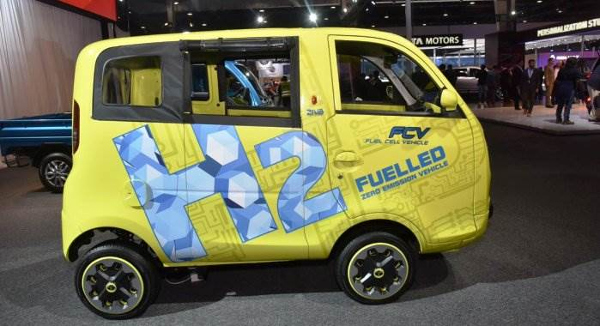
Splitting water using electricity is a widely explored method to generate hydrogen, a sought-after clean power source for fuel cells, batteries and zero emission vehicles.
Scientists say one of the two major reactions involved in this process—the Oxygen Evolution Reaction—is notoriously slow, restricting overall efficiency. Therefore, researchers focused on developing better catalysts — materials that can speed up the reaction while remaining neutral. The most efficient catalysts today are made from precious metals such as ruthenium and platinum, which are expensive and rare.
“An IISc team developed a low-cost catalyst by combining cobalt oxide with phosphate salts of sodium. The material cost is over two hundred times less expensive than the current state-of-the-art ruthenium dioxide catalyst, and the reaction rate is also faster,” claimed Ritambhara Gond, PhD student at the Materials Research Centre (MRC), IISc. He is the first author of the paper published in Angewandte Chemie.
This material, researchers say, can be useful for largescale applications in devices such as metal-air batteries and fuel cells. The study was led by Prabeer Barpanda, assistant professor at MRC, and carried out in collaboration with researchers at Jawaharlal Nehru Centre for Advanced Scientific Research.
Source: ToI
Image Courtesy: AutocarProfessional
You may also like
-
How Indigenous Indian Technologies Are Helping Aircraft and Trains Navigate Safely Through Dense Fog
-
ISRO Successfully Completes Critical Gaganyaan Crew Module Separation Tests at VSSC
-
ISRO’s Aditya-L1 Expands Global Solar Research as Joint Observations with Europe’s Proba-3 Reveal New Insights
-
ISRO Advances Indigenous 1,100 kN Methane Rocket Engine for Next-Generation Launch Vehicle
-
Indian Scientists Identify A Few Martian Analogue Sites
