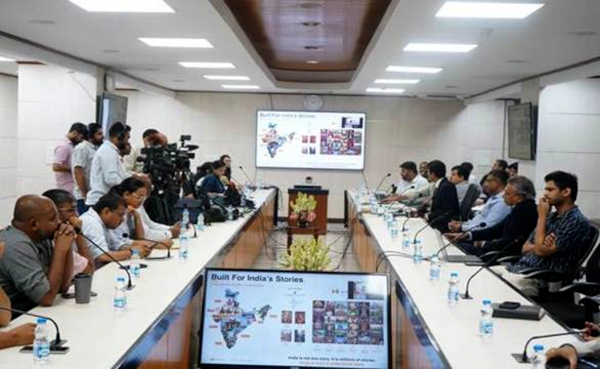
India’s artificial intelligence ecosystem has taken another step toward indigenous capability with the launch of Varya, a video story-generating AI model developed by Avataar with support from the IndiaAI Mission. The model was launched in New Delhi in the presence of S. Krishnan, Secretary, Ministry of Electronics and Information Technology, along with Avataar’s leadership team.
Varya has been positioned as a made-for-India video generation model that can convert a simple idea or prompt into a moving visual story. Its purpose reaches beyond entertainment. The model is designed for use in education, e-commerce, public communication, advertising, training, and digital storytelling. A teacher could create a visual lesson, a small business could prepare a product video, and a citizen-facing service could explain information in video form.
The most important feature of Varya is efficiency. According to the PIB release, the model uses a distillation technique that reduces video generation from around 50 steps to 4 steps, while maintaining comparable output quality. Avataar’s internal benchmarks claim that Varya can generate video at around ₹0.48 per second, making it up to ten times more cost-efficient than several leading global video models.
This efficiency matters for India because AI adoption at population scale depends on affordability. High-cost models may serve large enterprises, but India needs AI systems that can be used by students, teachers, small businesses, creators, local governments and ordinary citizens. Varya’s “Idea → Video → Story” approach allows users to type an idea, upload an image, generate a video and continue the story through additional clips.
The model has also been designed to reflect Indian cultural contexts. It aims to generate visuals connected to India’s regions, festivals, communities, food, clothing, public spaces and everyday life. This is important because a generic global AI model may miss local details, while an India-focused model can better support content creation in Indian settings and languages.
Varya also shows how public digital infrastructure can support private innovation. Avataar was among the companies selected under the IndiaAI Mission to build indigenous foundation AI capabilities. Access to subsidised national AI compute infrastructure supported the research behind the model, showing how government-backed compute access can reduce the entry barrier for Indian deep-tech companies.
Speaking at the launch, MeitY Secretary S. Krishnan described Varya as a milestone in India’s AI journey and linked it to the country’s larger goal of building indigenous AI capabilities. Avataar has also said that it will publish a technical report covering Varya’s model architecture, distillation method and benchmarks.
Varya’s launch strengthens India’s ambition to build AI systems that are not only powerful, but also affordable, efficient and locally relevant. As video becomes a major medium for learning, commerce and communication, such tools can help India’s creators, educators and businesses participate more actively in the AI economy.
You may also like
-
Indian Scientists Discover How Rapidly Spinning Black Holes Produce High-Frequency X-Ray Oscillations
-
ISRO Completes Historic SPADEX Mission as Both Satellites Re-enter Earth’s Atmosphere After Successful Space Docking Experiments
-
Indian Scientists Discover Rare Accretion Disk Around Neutron Star 24,000 Light-Years Away
-
BARC Scientists Develop Indigenous Technology to Recover 90% of Lithium from Seawater
-
How Indigenous Indian Technologies Are Helping Aircraft and Trains Navigate Safely Through Dense Fog
