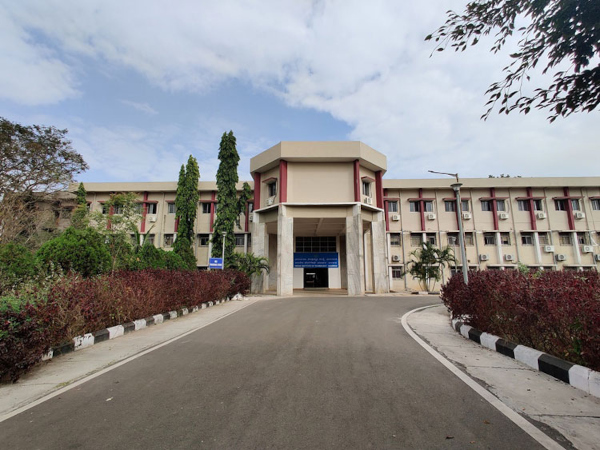
India’s semiconductor ambitions have received a strong academic boost with students of the Indian Institute of Information Technology, Dharwad designing an indigenous silicon chip named Siddharoodha-1. The chip, developed by third- and fourth-year students, marks an important milestone for Indian technical education because it shows that advanced chip design capability is now emerging from university campuses, not only from large industrial laboratories.
Siddharoodha-1 is named after Siddharoodha Swami, the respected philosopher and social reformer associated with Karnataka. The name gives the project a local cultural identity while its technology connects directly with India’s national goal of semiconductor self-reliance. It reflects a powerful combination: Indian knowledge tradition in name, modern silicon engineering in function.
The chip is a GPIO expander, or General Purpose Input/Output expander. Its role is to increase the number of devices that a microcontroller or single-board computer can connect with. In simple terms, it allows an electronic system to handle more sensors, actuators and peripheral devices at the same time. This makes the chip useful for embedded systems, industrial automation, smart devices, robotics and Internet of Things applications.
The significance of the project lies in its complete chip design journey. Designing a chip requires architecture planning, circuit design, validation, debugging, interface optimisation, performance checks and preparation for tape-out. Tape-out is a crucial stage where the final design is sent for fabrication. For students to take a chip to this stage is a major achievement in the Indian academic environment.
IIIT Dharwad was among only a small group of Indian institutions selected for a global semiconductor initiative involving 55 institutions worldwide. The institute worked with Synopsys, a leading chip design software company, and GlobalFoundries, a major semiconductor fabrication company. Siddharoodha-1 was taped out at GlobalFoundries’ facility in Germany, giving students direct exposure to the international semiconductor design and fabrication ecosystem.
The chip is based on the open-source RISC-V processor architecture. RISC-V has become important globally because it allows researchers, start-ups and institutions to build custom processors and systems with greater design flexibility. For India, RISC-V is especially valuable because it supports indigenous innovation and reduces dependence on closed technology ecosystems.
One of the key strengths of Siddharoodha-1 is scalability. Multiple chips can be interconnected to increase input and output capacity. This gives designers flexibility when building larger systems that need to connect many devices together. Such a feature is valuable in industrial control systems, robotics platforms, laboratory automation, smart agriculture devices and connected electronics.
The project was carried out between May and September 2025 as a special tape-out initiative. The student team was led by final-year BTech electronics student Shivashankar B. The students worked on design validation, debugging, interface optimisation and performance enhancement under the guidance of faculty and industry experts. This kind of hands-on experience is exactly what India needs to build a strong semiconductor workforce.
The achievement also highlights the growing importance of campus-based semiconductor ecosystems. India’s chip mission cannot depend only on fabrication plants and foreign investment. It also needs trained engineers who understand design, verification, architecture, embedded systems and physical implementation. Universities and IIITs can become the talent engines of this national semiconductor push.
For IIIT Dharwad, Siddharoodha-1 strengthens its identity as a young institute contributing to advanced technology. The project shows how motivated students, faculty guidance and industry collaboration can produce real outcomes in a complex field. It also gives future students a path to move from classroom learning to actual silicon design.
For India, this development fits into the larger goals of the India Semiconductor Mission, Atmanirbhar Bharat and Viksit Bharat. Semiconductor self-reliance is not only about producing chips. It is about building the full chain of knowledge, from design to fabrication, testing, packaging and product integration. Siddharoodha-1 represents one important piece of that chain.
The project also carries an important message for Indian engineering education. Students learn best when they build real systems. A chip that reaches tape-out gives them industry-level exposure and confidence. It prepares them for roles in VLSI design, embedded systems, electronic hardware, IoT platforms, robotics and semiconductor product development.
Siddharoodha-1 may be a student-designed chip, but its meaning is larger than its size. It shows that India’s semiconductor future will be shaped not only by factories and policies, but also by classrooms, student teams, open-source architectures and bold academic experiments. The chip stands as a small piece of silicon with a big national message: India’s next generation is ready to
You may also like
-
Indian Scientists Discover How Rapidly Spinning Black Holes Produce High-Frequency X-Ray Oscillations
-
ISRO Completes Historic SPADEX Mission as Both Satellites Re-enter Earth’s Atmosphere After Successful Space Docking Experiments
-
Indian Scientists Discover Rare Accretion Disk Around Neutron Star 24,000 Light-Years Away
-
BARC Scientists Develop Indigenous Technology to Recover 90% of Lithium from Seawater
-
How Indigenous Indian Technologies Are Helping Aircraft and Trains Navigate Safely Through Dense Fog
