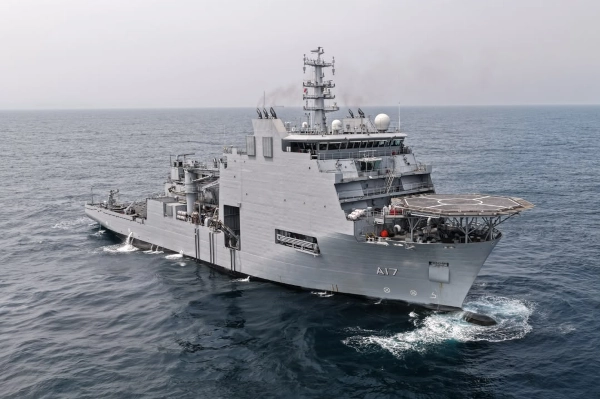
The Indian Navy has commissioned INS Nipun, its second indigenously designed and constructed Nistar-class Diving Support Vessel, significantly strengthening India’s ability to conduct deep-sea diving, underwater intervention and submarine rescue operations.
The specialised vessel was commissioned at the Naval Dockyard in Mumbai on 31 August 2026, with Chief of the Naval Staff Admiral Krishna Swaminathan presiding over the ceremony. Its induction gives the Navy another large, purpose-built platform capable of supporting some of the most demanding underwater operations undertaken by a modern naval force.
INS Nipun is the second vessel of the class after INS Nistar, which entered naval service in July 2025. Together, the two ships substantially expand India’s deep-ocean intervention capability and, crucially, provide specialised support for rescuing sailors from submarines disabled beneath the surface.
Built in India by Hindustan Shipyard
INS Nipun has been indigenously designed and constructed by Hindustan Shipyard Limited at Visakhapatnam. The vessel was formally delivered to the Indian Navy on 30 July 2026 after completion of outfitting, harbour trials and sea trials before being commissioned a month later. It has been designed and constructed in accordance with the classification requirements of the Indian Register of Shipping.
The ship’s name derives from the Sanskrit word “Nipun”, denoting someone who is skilled, adept, capable or highly proficient in a particular discipline. The name is particularly appropriate for a vessel designed around highly specialised diving, rescue and underwater engineering operations.
The ship incorporates nearly 75% indigenous content, according to the Ministry of Defence’s official announcement at the time of its delivery. The wider Diving Support Vessel programme has involved a substantial Indian industrial supply chain, with more than 120 MSME vendors having participated in the construction of Nistar and Nipun by supplying equipment, materials and services.
This industrial participation is significant because a Diving Support Vessel is considerably more specialised than a conventional support ship. It requires the integration of diving complexes, pressure chambers, remotely operated underwater vehicles, medical facilities, precision station-keeping equipment and systems required to support submarine rescue operations.
A Ship Designed for Operations Beneath the Surface
The central mission of INS Nipun is to provide a stable offshore platform from which Indian Navy divers and specialised underwater equipment can conduct prolonged operations at considerable depths.
The Nistar-class ships are capable of conducting diving and salvage operations at depths of up to 300 metres. This capability allows naval diving teams to undertake underwater inspection, repair, recovery and salvage missions far beyond the limits associated with ordinary surface-supplied diving operations.
INS Nipun is equipped for deep-sea saturation diving, a specialised technique used when divers must work at significant depth for extended periods. Rather than repeatedly undergoing lengthy decompression after every dive, saturation divers remain in a pressurised environment corresponding to their working depth and undergo decompression only at the end of their operational cycle.
This permits teams to perform sustained underwater work that would otherwise be extremely difficult or inefficient. Such capabilities are particularly useful for naval salvage, inspection of submerged structures, recovery of equipment and assistance to submarines or ships experiencing underwater emergencies.
A side diving stage is also incorporated into Nipun to facilitate diving operations. The ship’s dedicated diving infrastructure allows it to function as a self-contained offshore base for teams working below the surface rather than merely transporting divers to an operating area.
Remotely Operated Vehicles for Deep-Water Intervention
Another important element of INS Nipun’s underwater capability is its use of Remotely Operated Vehicles, or ROVs.
ROVs allow operators aboard the ship to inspect objects and structures underwater without immediately exposing divers to potentially dangerous conditions. They can assist in locating submerged equipment, surveying wreckage, monitoring divers and supporting salvage operations.
The Ministry of Defence specifically identifies diver monitoring and salvage as important roles for Nipun’s ROV systems. Combining remotely operated vehicles with saturation divers gives the vessel considerable flexibility: an ROV can initially examine an underwater location, after which divers can be deployed when human intervention is required.
The ship also carries modern navigation, platform-management and precision station-keeping systems. The ability to maintain an extremely accurate position is particularly important during diving and ROV operations because even relatively small uncontrolled movements of a large ship could pose hazards to divers, underwater vehicles and their connecting cables.
Mother Ship for India’s Submarine Rescue System
INS Nipun’s most strategically important function is its ability to support the Indian Navy’s Deep Submergence Rescue Vessel, or DSRV.
A DSRV is a specialised submersible designed to descend to a submarine that has become disabled underwater, establish a connection with its escape or rescue hatch and evacuate trapped crew members to the surface.
INS Nipun can operate as the mother ship for a DSRV, providing the surface platform, personnel and supporting infrastructure necessary for submarine rescue operations.
This substantially expands the operational flexibility of India’s submarine rescue organisation. In a submarine accident, response time can be critical. The disabled vessel may be resting hundreds of metres below the surface, potentially with diminishing electrical power and life-support reserves. Rescue equipment must therefore be transported, deployed and operated as rapidly as possible.
A purpose-built Diving Support Vessel provides far greater capability for sustained operations at the accident site than relying entirely on a vessel that was not designed specifically for underwater rescue.
The importance of such capability has grown alongside expansion of the Indian Navy’s submarine force and India’s wider responsibilities across the Indian Ocean.
Nistar and Nipun Give India a Powerful Two-Ship Capability
INS Nipun joins INS Nistar, the first vessel of the class, which was commissioned at Visakhapatnam on 18 July 2025.
INS Nistar represented a major step forward when it entered service because it was India’s first indigenously designed and constructed vessel specifically built for this complex deep-sea diving and submarine-rescue mission. The Ministry of Defence described these capabilities as being possessed by only a select group of navies.
Nistar carries equipment including remotely operated vehicles, diving compression chambers and a Self-Propelled Hyperbaric Lifeboat, while also functioning as a DSRV mother ship. Its commissioning established the operational foundation that Nipun now reinforces.
With two ships available, the Navy gains greater redundancy and geographical flexibility. A submarine rescue capability is only useful if it can be brought to the location of an accident quickly enough to make a difference. Maintaining more than one specialised support platform consequently reduces dependence on a single ship and strengthens India’s ability to respond across its extensive maritime operating area.
The addition is particularly relevant given the vast scale of the Indian Ocean, extending from the Arabian Sea in the west to the Bay of Bengal and approaches to Southeast Asia in the east.
More Than a Submarine Rescue Vessel
Although submarine rescue is among its most important missions, INS Nipun is not restricted to that role.
The Nistar-class ships were designed to conduct search-and-rescue operations and can support helicopter operations at sea. Their diving and underwater intervention equipment also gives them utility during maritime accidents, recovery missions, underwater inspection and salvage operations.
The vessel can consequently support humanitarian assistance and disaster-relief missions when necessary. Following a maritime disaster, a ship equipped with divers, medical facilities, underwater vehicles, heavy support equipment and aviation facilities can provide specialised assistance that ordinary naval vessels may not be able to deliver.
Its capabilities could also prove useful in recovering aircraft, helicopters, ships, sensors or other important equipment lost underwater and in examining damaged underwater infrastructure.
A Complex Indigenous Shipbuilding Achievement
The construction of Nipun also demonstrates a less visible aspect of India’s naval indigenisation programme. Indigenous shipbuilding is increasingly moving beyond frigates, destroyers and patrol ships towards highly specialised auxiliary vessels requiring complex engineering systems.
Nistar and Nipun were launched together at Hindustan Shipyard in September 2022. Even at that stage, the Ministry of Defence emphasised the involvement of more than 120 Indian MSMEs and described the Diving Support Vessel project as an important step towards self-reliance in specialised naval ship construction.
Building a Diving Support Vessel requires expertise extending beyond conventional hull construction. Pressure-controlled diving chambers, saturation-diving infrastructure, underwater vehicles, precision positioning, rescue-support equipment and specialised medical systems have to function together reliably in demanding ocean conditions.
The programme therefore provides Indian industry with experience in a niche category of naval engineering with relatively few comparable platforms operating internationally.
Strengthening India’s Role in Regional Submarine Rescue
The implications of the Nistar-class extend beyond assistance to Indian submarines.
When INS Nistar was commissioned, the Navy specifically highlighted the potential for India to provide submarine rescue assistance to regional partners. Such capability contributes to India’s wider role as a maritime security provider and first responder across the Indian Ocean.
Submarine rescue is an area in which international cooperation is particularly important. A disabled submarine may require assistance from whichever suitably equipped country can reach it fastest, irrespective of nationality. Navies therefore regularly participate in multinational submarine rescue exercises and develop procedures that allow foreign rescue vehicles to interface with submarine rescue seats and hatches.
Possessing two large indigenous Diving Support Vessels, supported by India’s DSRV capability, places the Indian Navy in a stronger position to contribute to such regional operations.
A Major Addition to India’s Underwater Fleet Support
INS Nipun is not a frontline combatant carrying missiles or guns, but its operational importance is considerable. Modern submarine fleets depend upon an entire ecosystem of rescue, diving, maintenance and underwater-support capabilities that remain largely invisible during routine deployments.
The commissioning of Nipun fills precisely this specialised role.
With saturation diving facilities, remotely operated vehicles, deep-water salvage capability, precision station keeping and the ability to operate as a mother ship for a Deep Submergence Rescue Vessel, INS Nipun gives the Indian Navy another sophisticated platform dedicated to operations beneath the ocean surface.
Together with INS Nistar, it significantly strengthens India’s ability to respond to submarine emergencies, conduct complex underwater missions and provide rescue assistance across the Indian Ocean. Its induction also represents another important achievement for Hindustan Shipyard and the Indian industrial network involved in constructing increasingly sophisticated specialised naval vessels.
You may also like
-
Indian Navy Vice Chief Inspects Japan’s Mogami-Class Stealth Frigate as India-Japan Shipbuilding Cooperation Expands
-
India and Russia Explore Joint Icebreaker Construction as Maritime Industrial Cooperation Expands
-
Philippine Marine Wargames Reportedly Show BrahMos Can Penetrate Chinese Destroyer Air Defences
-
Safran Signs 18 Agreements with Indian Aerospace Suppliers, Expanding Make in India Manufacturing Partnerships
-
Indian Army’s Vajra Corps Certifies First Batch of Drone Operators, Strengthens Battlefield Surveillance
