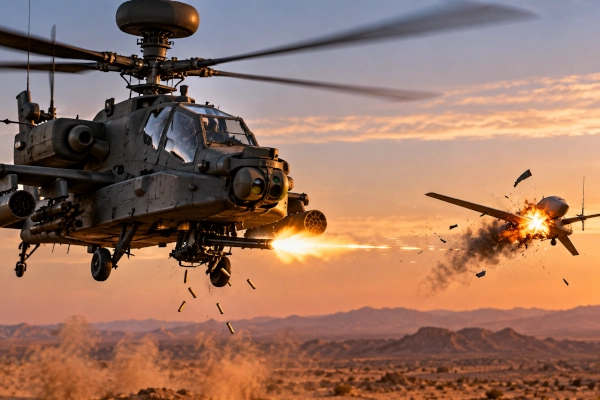
The Indian Army has reportedly tested the 30 mm M230 chain gun of its AH-64E Apache attack helicopter against an aerial target in the western sector, examining the weapon’s utility against fast-moving unmanned threats.
The reported firing is significant because it explores an additional counter-drone role for a weapon already integrated with the Apache. The exercise does not represent the induction of a new counter-UAS system, but rather the evaluation of an existing helicopter-mounted cannon against a different class of target.
Apache’s 30 mm Cannon Forms the Core of the Test
The AH-64E is equipped with the M230 30 mm chain gun, mounted beneath the forward fuselage and designed for rapid engagement of ground and low-altitude targets.
The cannon is part of the Apache’s standard armament package, which also includes air-to-surface missiles and rockets.
Using the gun against an aerial target allows crews to assess whether the helicopter can engage certain drone threats without expending more expensive missile systems.
Counter-Drone Role Addresses the Cost of Air Defence
The growing use of inexpensive drones has changed the economics of battlefield air defence.
Small unmanned aircraft can be deployed in large numbers at relatively low cost, while conventional surface-to-air missiles can be far more expensive than the targets they destroy.
A gun-based engagement offers a different cost equation. The 30 mm cannon gives the Apache a reusable, magazine-fed weapon that could be employed against suitable low-altitude targets where missile use would be unnecessary or uneconomical.
This does not make the Apache a dedicated counter-drone platform. Its effectiveness would depend on target detection, identification, engagement geometry and the speed and manoeuvrability of the incoming UAV.
Aerial Target Reportedly Used to Simulate Drone Threat
Current reports indicate that the Army used an aerial target to simulate a fast-moving unmanned threat during the firing.
The exercise was conducted in the western desert sector, where the Army Aviation Corps operates its newly inducted AH-64E fleet.
Publicly available official Ministry of Defence and Indian Army material has not yet provided a detailed technical account of the specific firing event, including the target profile, engagement range or hit sequence. The broader Apache armament configuration, however, is officially established.
Apache Gives the Army an Armed Aviation Option
The Indian Army’s Apache fleet adds a heavily armed rotary-wing platform to the Army Aviation Corps.
India received its first batch of Army-configured AH-64E helicopters for deployment with the Army Aviation Corps, giving the service a platform equipped with advanced sensors, precision weapons and high survivability.
The helicopter’s mast-mounted and nose-mounted sensor systems allow crews to detect and track targets in complex battlefield conditions.
Against drones, these sensors could support target acquisition while the 30 mm cannon provides a close-range kinetic engagement option.
Gun-Based Counter-UAS Has Operational Limits
The 30 mm cannon offers clear advantages in cost and ammunition availability, but it also has practical limitations.
Drones can present small radar and visual signatures, especially at low altitude. Fast-moving or manoeuvring UAVs may also be difficult to engage from another moving aircraft.
Helicopter crews must additionally consider the direction of fire, background terrain and the risk posed by falling fragments or missed rounds.
For these reasons, the Apache cannon is best understood as one potential layer within a broader counter-UAS network rather than a substitute for dedicated air-defence systems.
Indian Army Expands Layered Counter-Drone Capabilities
The Apache test fits into a wider Indian Army effort to build multiple responses to unmanned aerial threats.
The service has been expanding its counter-UAS architecture through electronic warfare systems, jammers, surveillance sensors, short-range air-defence weapons and kinetic interceptors.
Different systems are suited to different classes of threats. Electronic warfare may be effective against drones dependent on external control links, while autonomous or hardened UAVs may require physical destruction.
The Apache cannon adds another possible option at the armed-helicopter level.
Why the Apache Could Be Useful Against Selected Drone Targets
An attack helicopter has one advantage that fixed ground-based defences do not: mobility.
An Apache can move rapidly between threatened sectors, use onboard sensors to search for targets and reposition according to battlefield conditions.
This mobility could prove useful against drones operating over dispersed formations or in areas where permanent counter-UAS coverage is limited.
The role would remain selective. The Apache is a high-value combat platform, and its principal missions continue to include anti-armour operations, close combat support and battlefield reconnaissance.
Validation Reflects the Changing Nature of Battlefield Aviation
The reported counter-drone firing illustrates how existing military platforms are being adapted to meet new battlefield threats.
Attack helicopters were designed primarily to engage armoured vehicles, fortified positions and other ground targets. The spread of tactical drones now requires armed forces to examine whether existing weapons can be repurposed for air-defence tasks.
Testing the Apache’s 30 mm cannon against an aerial target gives the Indian Army practical data on one such option without requiring a completely new weapon system.
Apache Counter-Drone Test Adds Another Layer to Army Air Defence
The Indian Army’s reported use of the Apache’s 30 mm cannon against an aerial target reflects a broader shift towards layered and cost-conscious counter-drone warfare.
The test explores how an existing weapon can be adapted to address low-altitude unmanned threats while preserving more expensive missiles for targets that genuinely require them.
As drone warfare continues to expand, the value of such trials lies in giving commanders a wider choice of responses. The Apache’s cannon now adds another potential kinetic layer to the Indian Army’s evolving counter-UAS architecture.
References
Press Information Bureau, Ministry of Defence — Official material on AH-64E Apache induction and armament.
Ministry of Defence — Indian Army Aviation Corps and AH-64E Apache programme information.
Indian Army — Official communications on Army Aviation Corps modernisation and counter-UAS capability development.
You may also like
-
India Moves Towards Five-Year Assured Orders for Defence Startups Under New Procurement Reforms
-
Zen Technologies Introduces Indigenous Hyper-Strike Falcon AI-Guided Counter-Drone Interceptor
-
L&T and Germany’s SCHOTTEL Expand Partnership for Controllable Pitch Propeller Systems in Indian Shipbuilding
-
India to Train 60,000 Civil Defence Volunteers Across 12 States and UTs with Indian Army Support
-
Indian Army’s Northern Command Opens 75-Day Defence Technology Internship Programme for Young Innovators
