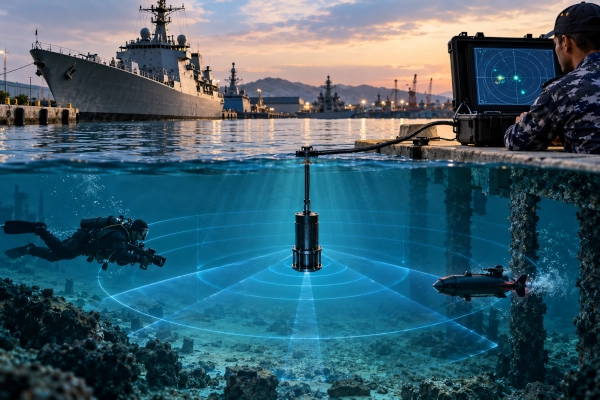
India’s indigenous Portable Diver Detection Sonar, developed by the Defence Research and Development Organisation’s Naval Physical and Oceanographic Laboratory, represents a specialised layer of underwater security designed for threats that conventional surface-surveillance systems cannot detect.
Known as PDDS in DRDO’s technology-transfer documentation and PDDS-X in its export catalogue, the system is designed to detect, track and classify divers, diver-delivery vehicles and similar low-signature underwater targets in shallow waters around naval bases, ships, harbours and critical maritime infrastructure.
The concept is not unique to India. Sonardyne’s Sentinel, Kongsberg’s DDS 9000 series and TKMS ATLAS UK’s Cerberus address the same underwater security problem. Comparing these systems shows where PDDS-X fits within the international diver-detection sonar class and where available public data still limits direct comparison.
Why Divers Present a Difficult Harbour-Security Problem
Naval bases and commercial ports are generally well protected against threats approaching above the water. Coastal radars, electro-optical systems, patrol craft and physical security networks can detect vessels or aircraft moving towards sensitive areas.
The underwater environment is far more difficult. A combat diver can approach slowly with a very small acoustic and physical signature. Closed-circuit breathing apparatus can reduce bubbles and noise, while swimmer-delivery vehicles allow personnel to travel farther and carry equipment or payloads.
Potential targets include anchored warships, submarines, piers, ammunition facilities, offshore installations and other waterside infrastructure.
High-frequency active sonar has therefore become one of the principal technologies used to create an underwater security perimeter around such facilities.
PDDS Began as a DRDO Technology Development Programme
DRDO formally took up the Portable Diver Detection Sonar as a technology-development project in 2016.
The objective was to create an indigenous system capable of detecting small underwater targets, including divers and diver-delivery vehicles, in and around harbours. A laboratory prototype was fabricated and tested at the underwater acoustic research facility at Kulamavu in January 2016.
The deployment system was subsequently installed and tested aboard INS Sagardhwani in March 2016.
The programme later progressed into a technology available for transfer to Indian industry. DRDO’s current Technology Transfer catalogue lists PDDS under NPOL and identifies multiple licences for the technology.
The export version appears in DRDO documentation under the designation PDDS-X, with Bharat Electronics Limited identified in earlier export literature as a production agency.
How DRDO’s PDDS-X Works
PDDS-X divides the system between an underwater sonar unit and processing equipment positioned on shore or aboard a vessel.
The wet-end contains the transducer arrays and associated transmitter and receiver electronics. A water-blocked cable provides the connection between the underwater unit and the surface equipment.
Processing is carried out through a ruggedised computer system that performs beamforming, automatic detection, automatic tracking and target classification.
Detected tracks can be displayed over a geographical map, allowing the operator to view movements around the protected area in a tactical format.
This means PDDS-X is more than an acoustic sensor generating raw returns. It is designed as an automated underwater surveillance system capable of maintaining tracks and supporting rapid identification of suspicious contacts.
360-Degree Surveillance Around the Protected Area
One of the important characteristics of PDDS-X is its 360-degree azimuth coverage.
DRDO also gives the system vertical coverage of approximately 20 degrees in elevation, allowing the sonar to monitor a volume of water rather than only a narrow horizontal plane.
When a target is detected, the system can provide range and bearing together with estimated speed and course. Multiple underwater contacts can therefore be followed around the protected zone.
DRDO describes the system as offering a high probability of detection with a low probability of false alarm, although public documentation does not provide operational percentages for either parameter.
High-Frequency Sonar Helps Detect Small Underwater Targets
DRDO technical literature identifies the system as a high-frequency active sonar operating around 75 kHz.
Higher acoustic frequencies can provide finer resolution than lower-frequency sonar, which is valuable when the target is a diver rather than a submarine.
The trade-off is that high-frequency sound attenuates more rapidly in water. Diver-detection systems are therefore optimised for comparatively shorter-range security missions rather than long-range anti-submarine warfare.
NPOL used piezo-composite transducers in the projector and receiver arrays. DRDO has stated that this technology helped reduce the size and weight of the acoustic arrays and supported the development of a portable system.
PDDS-X Can Protect Ships as Well as Harbours
Portability gives PDDS-X flexibility beyond permanent installations.
DRDO states that the system can be deployed beside harbour walls and piers, positioned on the seabed or lowered over the side of a vessel.
For ship protection, the sonar can be deployed while a vessel is anchored or alongside and recovered before departure.
This allows the same basic system to support naval bases, temporary anchorages, visiting ships and sensitive maritime installations.
Its modular design also allows configurations to be adapted to local geography, an important requirement because acoustic conditions vary significantly between harbours.
PDDS-X vs Sonardyne Sentinel
Britain’s Sonardyne Sentinel is one of the most established international diver-detection sonar systems.
Sentinel provides 360-degree surveillance and is marketed for the detection of divers, uncrewed underwater vehicles and other submerged threats around ports, naval bases, vessels and offshore infrastructure.
Sonardyne publishes detection ranges of up to 900 metres for divers and up to 1,200 metres for uncrewed underwater vehicles under specified conditions.
The system can simultaneously track and classify multiple targets, giving operators a continuous picture of underwater activity around the protected area.
Both Sentinel and PDDS-X therefore follow a similar operational philosophy: a high-frequency active sonar searches continuously, generates tracks and alerts operators to potential threats.
The main difference in publicly available information is that Sonardyne publishes explicit target-detection ranges, while DRDO does not publicly disclose an equivalent maximum diver-detection figure for PDDS-X.
Sentinel Uses a Similar Acoustic Approach
The technological similarities between the systems are also notable.
Sonardyne states that Sentinel operates around 70 kHz and uses a circular transducer arrangement to provide 360-degree surveillance.
DRDO documentation describes PDDS-X as operating around 75 kHz, also with 360-degree azimuth coverage and narrow-beam processing.
Both systems therefore occupy a similar acoustic regime suited to detecting and resolving small underwater targets in shallow and cluttered environments.
The details of beamforming, signal processing and target-classification algorithms remain proprietary.
PDDS-X vs Kongsberg DDS 9000
Kongsberg Maritime’s DDS 9000 provides another useful comparison.
The system uses 256 beams with approximately 1.5-degree beamwidth and has a maximum instrumented range of 1,000 metres.
Kongsberg states that diver-like targets can be detected at ranges exceeding 600 metres, while also noting that actual performance depends strongly on local water conditions.
The DDS 9000 offers 200-degree horizontal coverage, while the related DDS 9001 configuration provides full 360-degree coverage.
PDDS-X provides 360-degree azimuth coverage as part of its published configuration.
The comparison highlights the importance of interpreting range figures carefully. Detection performance can vary with salinity, water temperature, seabed composition, harbour geometry and background noise.
Kongsberg Emphasises Networked Surveillance
Kongsberg places strong emphasis on integrating diver-detection sonar into larger command-and-control architectures.
Its processing systems support automatic detection, tracking and classification and can pass target information to broader security networks.
PDDS-X also provides tactical mapping and automated tracking, but DRDO’s public literature contains less detail about integration with external command networks.
This could become increasingly important as Indian naval facilities integrate underwater sonar with coastal radar, electro-optical sensors and other surveillance systems.
PDDS-X vs TKMS ATLAS Cerberus
The Cerberus Portable Diver Detection Sonar, developed by TKMS ATLAS UK, is perhaps the closest comparison in terms of portability and deployment flexibility.
Cerberus weighs around 23 kilograms and can operate from the seabed, a ship, pier or jetty.
Its published operating-frequency range extends from approximately 70 to 130 kHz, with a maximum operating depth of 50 metres.
TKMS publishes a maximum detection range of up to 1,000 metres, with open-circuit divers detected at more than 900 metres and closed-circuit divers at more than 700 metres under specified conditions.
The distinction between open- and closed-circuit divers is important because closed-circuit systems release fewer bubbles and can be more difficult to detect acoustically.
Cerberus Highlights the Limits of Public PDDS-X Data
Cerberus provides a useful example of the difference in publicly released data.
TKMS publishes detection range, frequency range, operating depth, sonar-head weight and bearing accuracy.
DRDO publicly confirms PDDS-X’s approximate operating frequency, 360-degree coverage, elevation coverage, automatic classification and deployment options, but does not provide equivalent open-source figures for detection range, operating depth or sonar-head weight.
That absence does not indicate inferior performance. It simply prevents a precise numerical comparison from official public data.
Such limitations are common with defence equipment, where detailed performance parameters are often withheld.
How the Four Systems Compare
| Characteristic | DRDO PDDS-X | Sonardyne Sentinel | Kongsberg DDS 9000 | TKMS Cerberus |
|---|---|---|---|---|
| Primary role | Diver and diver-delivery vehicle detection | Diver and UUV detection | Diver and underwater target detection | Diver, swimmer and underwater vehicle detection |
| Azimuth coverage | 360° | 360° | 200°; DDS 9001 offers 360° | Up to 360° |
| Published diver range | Not publicly disclosed | Up to 900 m | Over 600 m for diver-like targets | 900 m+ open-circuit; 700 m+ closed-circuit |
| Maximum published range | Not publicly disclosed | UUV detection up to 1,200 m | 1,000 m | Up to 1,000 m |
| Frequency | Around 75 kHz | Around 70 kHz | 85–95 kHz | 70–130 kHz |
| Automatic detection | Yes | Yes | Yes | Yes |
| Automatic tracking | Yes | Yes | Yes | Yes |
| Automatic classification | Yes | Yes | Yes | Yes |
| Portable deployment | Yes | Yes | Yes | Yes |
| Ship deployment | Yes | Yes | Yes | Yes |
| Pier or harbour deployment | Yes | Yes | Yes | Yes |
| Seabed deployment | Yes | Available | Available | Yes |
| Published sonar-head weight | Not disclosed | Not stated in principal public specification | Under 90 kg for DDS 9000 series | 23 kg |
These figures should not be treated as a ranking. Manufacturers use different target definitions, trial conditions and environmental assumptions, while DRDO does not publish enough equivalent performance data for a direct numerical comparison.
PDDS-X’s Strategic Advantage Is Indigenous Control
The importance of PDDS-X for India extends beyond individual performance figures.
India has a long coastline, major naval bases on both seaboards, submarine facilities, shipyards, commercial ports and offshore energy infrastructure. Many of these installations require protection against underwater intrusion.
An indigenous diver-detection sonar gives India domestic control over acoustic hardware, signal processing, maintenance, production and future upgrades.
It also allows the technology to be adapted to Indian operating conditions without complete dependence on foreign suppliers.
NPOL is one of India’s principal centres for underwater acoustics and has developed a wider family of naval sonar technologies. PDDS-X therefore belongs to a broader domestic sonar ecosystem rather than standing as an isolated product.
India Has Previously Procured a Separate Foreign-Origin PDDS
PDDS-X should not be confused with a separate Indian Navy procurement announced in 2017.
The Ministry of Defence confirmed that the Navy contracted Tata Power Strategic Engineering Division for Portable Diver Detection Sonars under the Buy and Make (Indian) category.
Those systems were to be manufactured in Bengaluru using technology transferred from DSIT of Israel.
That acquisition and DRDO-NPOL’s indigenous development programme are separate projects.
The distinction matters because the generic term “Portable Diver Detection Sonar” has been used for both systems.
Underwater Drones Make Diver Detection Sonar More Relevant
The underwater threat environment has expanded beyond human divers.
Ports and naval bases must now also consider compact autonomous and remotely operated underwater vehicles.
Small UUVs can be used for reconnaissance, surveillance or other underwater missions without exposing a human operator.
Sonardyne explicitly markets Sentinel against UUVs, while TKMS includes swimmer-delivery vehicles and unmanned underwater systems among Cerberus targets.
DRDO identifies divers and diver-delivery vehicles as primary PDDS targets.
The same high-resolution sonar technology therefore has growing relevance as unmanned underwater systems become more widely available.
Detection Is Only One Layer of Harbour Defence
A diver-detection sonar does not neutralise a threat by itself.
Its primary function is to create warning time and establish a reliable underwater track.
Once a suspicious contact is detected and classified, security forces can investigate and respond through appropriate means.
Effective harbour defence therefore combines underwater sonar with surface radar, electro-optical cameras, command centres, patrol craft, physical barriers and trained personnel.
PDDS-X fills the submerged part of that surveillance picture, where conventional cameras and radar have limited effectiveness.
Environmental Conditions Decide Real-World Performance
Harbours are difficult acoustic environments.
Concrete walls, ship hulls, piers and the seabed generate reflections. Propellers, machinery, marine life and construction activity add background noise.
Temperature and salinity also influence how sound propagates through water.
A sonar capable of detecting a diver at a particular distance during one trial may achieve a different range in another harbour.
Automatic tracking and classification are therefore as important as raw detection range. A useful system must distinguish genuine intruders from fish, debris, vessels and recurring underwater clutter without overwhelming operators with false alarms.
PDDS-X Belongs to the Same Functional Class as Established Global Systems
Based on publicly released specifications, DRDO’s PDDS-X follows the architecture expected of a modern diver-detection sonar.
It combines high-frequency active sonar, 360-degree monitoring, automatic detection, tracking and classification, tactical map display and multiple deployment configurations in a portable package.
Sentinel, DDS 9000 and Cerberus provide more detailed public performance figures, particularly for range and physical characteristics.
That makes a numerical ranking inappropriate, but the comparison places PDDS-X clearly within the same specialised family of underwater-security systems.
Its development by NPOL and availability for technology transfer also show that India has created domestic capability in a field traditionally dominated by a small number of specialist underwater-acoustics companies.
Indigenous Underwater Surveillance Strengthens India’s Maritime Security Base
PDDS-X represents a less visible side of India’s naval indigenisation than warships, missiles or submarines, but it addresses a security requirement that is becoming more important as naval facilities and maritime infrastructure expand.
The system brings together indigenous transducers, high-frequency acoustics, beamforming, automated detection and tactical processing in a deployable package designed for shallow-water security.
Against established international systems such as Sentinel, DDS 9000 and Cerberus, the available evidence shows a common technological approach and mission profile, while differences in published data prevent unsupported claims of superiority.
For India, the larger achievement is possession of the underlying sonar technology itself. PDDS-X adds an indigenous underwater surveillance layer to the protection of ships, naval bases and critical maritime infrastructure while strengthening the country’s ability to design, manufacture and evolve advanced sonar systems domestically.
References
Defence Research and Development Organisation — Portable Diver Detection Sonar (PDDS) System, NPOL Technology Transfer Documentation.
https://drdo.gov.in/drdo/en/offerings/transfer-of-technologies/portable-diver-detection-sonar-pdds-system
Defence Research and Development Organisation — DRDO Products for Export: Portable Diver Detection Sonar (PDDS-X).
https://www.drdo.gov.in/drdo/sites/default/files/schemes_services/DRDO-Product-for-Export-2021_web.pdf
DRDO Technology Focus — Technologies for Underwater Surveillance Systems, March–April 2017.
https://www.drdo.gov.in/drdo/sites/default/files/technology-focus-documrnt/TF_Mar_2017_WEB.pdf
Press Information Bureau, Ministry of Defence — Year End Review 2016: Portable Diver Detection Sonar.
https://www.pib.gov.in/newsite/PrintRelease.aspx?lang=2®=48&relid=156049
Press Information Bureau, Ministry of Defence — Portable Diver Detection Sonar, November 16, 2017.
https://www.pib.gov.in/newsite/PrintRelease.aspx?lang=2®=48&relid=173539
Sonardyne — Sentinel Subsea Intruder and Threat Detection System.
https://www.sonardyne.com/product/sentinel/
Kongsberg Maritime — DDS 9000 Diver Detection Sonar.
https://www.kongsberg.com/globalassets/kongsberg-maritime/km-products/product-documents/dds9000_datasheet_hr.pdf
Kongsberg Maritime — DDS Processor: Diver Detection System Processing, Tracking and Classification.
https://www.kongsberg.com/globalassets/kongsberg-maritime/km-products/product-documents/dds-processor.pdf
TKMS ATLAS UK — Cerberus Portable Diver Detection Sonar.
https://www.tkmsgroup.com/fileadmin/website/group/ATLAS-UK/TKMS_25_021_Datasheet_Cerberus_04.pdf
You may also like
-
ICAR Scientists Develop Indigenous Protective Gloves for Cotton Farmers, Sign Commercial Manufacturing Agreement
-
India Moves Towards Five-Year Assured Orders for Defence Startups Under New Procurement Reforms
-
BHEL–Coal India Joint Venture Begins Construction of ₹25,016 Crore Indigenous Coal Gasification Project in Odisha
-
Zen Technologies Introduces Indigenous Hyper-Strike Falcon AI-Guided Counter-Drone Interceptor
-
L&T and Germany’s SCHOTTEL Expand Partnership for Controllable Pitch Propeller Systems in Indian Shipbuilding
