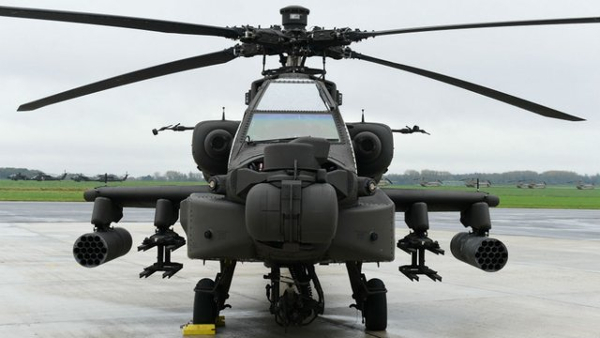
The Indian Army has carried out highway landing and take-off drills with its AH-64E Apache attack helicopters in Rajasthan, demonstrating the gunship’s ability to operate away from conventional military aviation bases.
Footage of the exercise released on August 21, 2026, showed an Army Apache descending onto a highway in a forward area of Rajasthan before operating from the road surface. DD News described the activity as an operational-readiness demonstration near the India-Pakistan border and said it showcased the Apache’s ability to function from unconventional locations.
The precise highway used for the latest exercise has not been officially identified. Therefore, reports linking the Apache operation to a particular road or Emergency Landing Facility should be treated cautiously unless the Indian Army provides further details.
Taking the Apache Beyond Permanent Bases
Although helicopters do not need conventional runways, operating a heavily armed platform such as the AH-64E from a highway has significant operational value.
In a high-intensity conflict, permanent airbases and established aviation facilities could become priority targets for enemy missiles, drones and other long-range precision weapons. Dispersing combat helicopters across temporary operating locations complicates an adversary’s targeting process and allows aviation units to continue operations even if their principal bases come under attack.
A highway can provide a firm and relatively obstruction-free surface for helicopters while also allowing support vehicles to reach the operating site. Fuel tankers, ammunition vehicles, maintenance teams and communications equipment can move rapidly along the road network to sustain helicopter operations.
The concept fits into a wider military emphasis on dispersed and flexible operations. Instead of requiring an attack helicopter to return to a permanent base after every mission, ground crews can establish temporary forward locations where aircraft can refuel, rearm and return to combat.
For an Army formation operating across Rajasthan’s vast desert sector, that flexibility can shorten turnaround times and allow attack helicopters to remain closer to the land battle.
Army’s Apache Fleet Takes Shape in Rajasthan
The highway drill comes after the Indian Army completed the acquisition of six AH-64E Apache Guardian attack helicopters for the Army Aviation Corps.
India ordered the six aircraft in 2020. The Army raised 451 Army Aviation Squadron at Nagtalao near Jodhpur in March 2024 to operate the type. The first three Army Apaches arrived at Hindon Air Force Station on July 22, 2025, before moving towards their operational base in Rajasthan.
The final three aircraft arrived in December 2025, completing the six-helicopter fleet. The deployment gives the Army its own dedicated Apache force in addition to the 22 AH-64E helicopters operated separately by the Indian Air Force.
Basing the Army squadron in Rajasthan places the helicopters close to one of India’s most important mechanised warfare sectors. The terrain along the western frontier includes large areas suitable for armoured manoeuvre, making attack helicopters particularly relevant for supporting tanks, infantry combat vehicles and other ground formations.
From Induction to Live Weapons Training
The Army has moved steadily from receiving the Apaches to integrating them into realistic combat training.
In April 2026, Army Apaches participated in the Brahmastra live-fire exercise at the Pokhran Field Firing Range. During the drill, crews demonstrated the helicopter’s weapons and practised coordination between pilots and ground-support teams. The exercise included the Apache’s 30 mm chain gun, AGM-114 Hellfire missiles and rockets.
Colonel Vikrant Sharma, Commanding Officer of 451 Squadron, said during the exercise that pilots had undergone simulator training, mission planning and continuous target-engagement practice, while technical teams prepared the helicopters and weapon systems for firing.
The highway operation adds a different element to that training cycle. Live-fire exercises demonstrate the platform’s ability to locate and engage targets. Dispersed landing drills test how effectively the helicopter can continue operating when conventional aviation infrastructure may not be available.
Together, the two capabilities are important in converting a newly acquired helicopter into a functioning battlefield weapon system.
A Powerful Anti-Armour and Battlefield Support Platform
The AH-64E represents the latest major production version of the Apache family and combines heavy firepower with advanced sensors, communications and networking capabilities.
Its nose-mounted M230 30 mm chain gun gives crews a direct-fire weapon against troops, light vehicles and other battlefield targets. The helicopter can also employ precision-guided weapons such as the Hellfire missile, along with unguided or guided rocket systems depending on mission configuration.
Equally important are its sensors. The Apache combines electro-optical and infrared targeting equipment with night-flying capability and, on appropriately equipped aircraft, the AN/APG-78 Longbow fire-control radar.
The AH-64E architecture also places considerable emphasis on battlefield connectivity. Boeing describes the platform as capable of integrating modern communications, navigation, sensor and weapon systems, allowing crews to receive and share battlefield information rather than operating as isolated helicopter teams.
Such capabilities allow Apaches to support mechanised formations, conduct armed reconnaissance, attack enemy armour and engage selected targets while remaining connected with wider surveillance and command networks.
Highway Operations Add Survivability
The significance of the Rajasthan drill goes beyond the spectacle of an attack helicopter landing on a public road.
Modern warfare has made large, fixed military facilities increasingly vulnerable. Long-range missiles, satellite surveillance, reconnaissance drones and loitering munitions can place airfields and known aviation bases under persistent observation.
Dispersal therefore becomes a form of protection.
If helicopters can shift between military bases, temporary landing zones and suitable stretches of civilian infrastructure, an adversary faces a much more complicated surveillance and targeting problem. Aircraft can relocate, ground crews can establish temporary support points, and commanders gain additional choices about where sorties originate.
For helicopters, the concept can also support the establishment of forward arming and refuelling points. Such facilities allow an attack helicopter to land closer to the battlefield, receive fuel and ammunition, and return to action without flying all the way back to its permanent home station.
The effectiveness of the concept ultimately depends on logistics. An Apache operating from a road still requires fuel, ammunition, trained technicians, communications, security and spare parts. The ability to move that entire support structure is therefore just as important as the helicopter’s ability to land there.
Rajasthan Already Has Strategic Highway Aviation Infrastructure
The Indian military has previous experience using highways as aviation infrastructure in Rajasthan.
In September 2021, India inaugurated an Emergency Landing Facility on the Satta-Gandhav section of NH-925A near Barmer. The National Highways Authority of India developed a three-kilometre stretch for aircraft operations. The facility lies around 40 kilometres from the international border and includes aircraft parking areas and other supporting infrastructure.
Three helipads were also constructed at Kundanpura, Singhania and Bakhasar as part of the project to support requirements of the armed forces.
However, there is currently no official confirmation that the Army Apache seen in the August 21 drill used the NH-925A Emergency Landing Facility. The Army and DD News have described the location only as a highway in a forward area of Rajasthan near the Pakistan border.
Building a More Flexible Army Aviation Force
The latest Apache drill reflects a broader transformation within Indian Army Aviation.
Attack helicopters increasingly serve as an integral component of the land battle rather than simply as aviation assets operating behind established bases. Their ability to move with ground formations, exploit forward operating locations and respond rapidly to developing threats can become particularly valuable during fast-moving mechanised operations.
The Indian Army now operates both the heavy AH-64E Apache and indigenous attack-helicopter platforms such as the Light Combat Helicopter Prachand and armed variants of the Advanced Light Helicopter. Each occupies a different part of the rotary-wing combat structure.
For the six Army Apaches based in Rajasthan, the immediate priority is likely to remain operational integration: training crews, refining maintenance practices, practising live weapons employment and learning how to sustain the aircraft under realistic field conditions.
Landing an Apache on a highway may appear straightforward compared with firing a Hellfire missile or conducting a complex battlefield attack. From an operational perspective, however, it addresses an equally important question — whether the helicopter can continue fighting when the infrastructure of peacetime is no longer guaranteed.
The Rajasthan exercise suggests that the Indian Army is actively preparing its new Apache force for precisely that environment.
You may also like
-
India Moves Towards Five-Year Assured Orders for Defence Startups Under New Procurement Reforms
-
Zen Technologies Introduces Indigenous Hyper-Strike Falcon AI-Guided Counter-Drone Interceptor
-
L&T and Germany’s SCHOTTEL Expand Partnership for Controllable Pitch Propeller Systems in Indian Shipbuilding
-
India to Train 60,000 Civil Defence Volunteers Across 12 States and UTs with Indian Army Support
-
Indian Army’s Northern Command Opens 75-Day Defence Technology Internship Programme for Young Innovators
