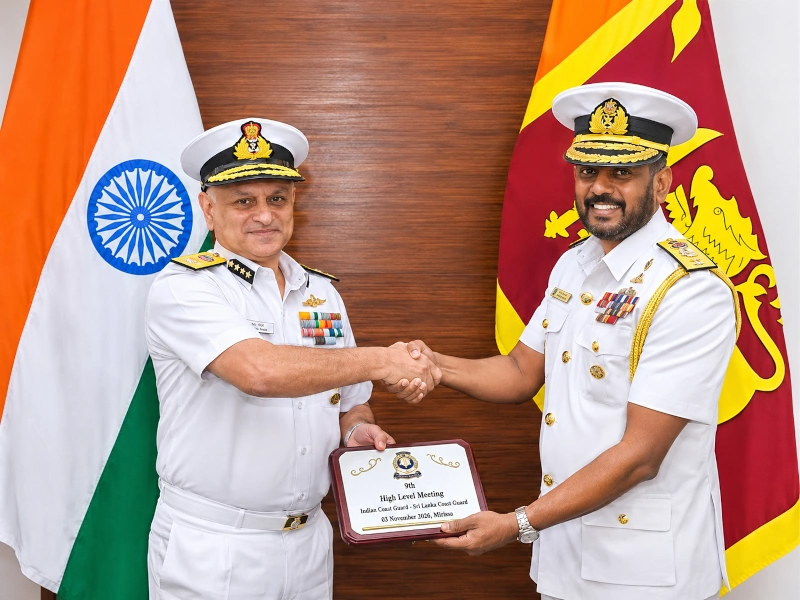
The Indian Coast Guard (ICG) and Sri Lanka Coast Guard (SLCG) held their 9th High-Level Meeting at Mirissa, Sri Lanka, on November 3, 2026, reaffirming their commitment to strengthening bilateral maritime cooperation and addressing shared security and environmental challenges in the Indian Ocean Region. The discussions focused on expanding operational coordination in maritime search and rescue, marine pollution response and maritime law enforcement, reflecting the importance of cooperation between the two neighbouring countries in maintaining safety and security across their adjoining maritime domains.
The Indian delegation was led by Director General Paramesh Sivamani, Director General of the Indian Coast Guard, while the Sri Lankan delegation was headed by Rear Admiral Ruwan Rupasena, Director General of the Sri Lanka Coast Guard. The meeting provided an institutional platform for reviewing areas of mutual interest, exploring opportunities for technical cooperation and identifying measures to strengthen the operational capabilities of both maritime security organisations.
Strengthening Maritime Search and Rescue Cooperation
Maritime search and rescue was a principal area of discussion during the meeting, with both Coast Guards examining opportunities to improve cooperation in responding to emergencies at sea. The waters surrounding India and Sri Lanka support extensive commercial shipping, fishing and other maritime activities, making timely coordination between maritime authorities essential for protecting lives and ensuring effective emergency response.
Closer cooperation in search and rescue operations can support the exchange of information, improve coordination during maritime emergencies and facilitate assistance to vessels operating in the shared maritime environment. The discussions reflected the importance of maintaining effective communication and operational understanding between the two Coast Guards, particularly when incidents require assistance across national maritime jurisdictions.
The geographical proximity of India and Sri Lanka makes coordinated emergency response particularly relevant in the waters connecting the Bay of Bengal, the Palk Strait, the Gulf of Mannar and the wider Indian Ocean. Strengthening institutional cooperation in this area can contribute to improved maritime safety while supporting the broader objective of ensuring secure sea routes for commercial and fishing activities.
Marine Pollution Response and Environmental Protection
Marine pollution response formed another major component of the bilateral discussions, highlighting the environmental risks associated with maritime transportation and other activities in the Indian Ocean Region. Oil spills, hazardous cargo incidents and other forms of marine contamination can affect coastal ecosystems, fisheries and maritime economic activities, making cooperation between neighbouring coastal states important for effective environmental protection.
The Indian and Sri Lankan delegations explored opportunities to strengthen coordination in responding to marine pollution incidents, including areas where technical assistance and capacity-building initiatives could improve operational preparedness. Cooperation in this field is particularly significant because marine pollution can spread beyond national maritime boundaries, requiring timely information exchange and coordinated action to minimise environmental damage.
Both countries possess extensive coastal ecosystems and maritime resources that support fishing communities, tourism and other economic activities. Improving the ability of their Coast Guards to respond to pollution emergencies can help protect these resources while contributing to the development of a safer and cleaner maritime environment.
Enhancing Maritime Law Enforcement and Operational Coordination
Maritime law enforcement was also identified as a priority area for cooperation, with the two Coast Guards discussing ways to strengthen their ability to address emerging challenges across the shared maritime domain. Effective maritime law enforcement requires coordination among national authorities to respond to activities that threaten maritime safety, security and the lawful use of ocean resources.
The discussions are relevant to the wider security environment of the Indian Ocean, where maritime agencies face challenges associated with illegal activities at sea, unauthorised maritime movements and the need to protect legitimate commercial and fishing operations. Cooperation between the Indian and Sri Lankan Coast Guards can improve mutual understanding of operational requirements and facilitate more effective responses to maritime incidents.
The meeting also examined opportunities for capacity building and technical assistance, reflecting the importance of strengthening institutional capabilities alongside operational cooperation. Training, professional exchanges and technical engagement can help maritime agencies improve preparedness, develop specialised skills and enhance their ability to respond to evolving maritime challenges.
Although the official announcement did not specify new agreements, joint operational deployments or additional equipment commitments, the discussions demonstrated the continuing importance of institutional engagement between the two Coast Guards.
India–Sri Lanka Maritime Cooperation in the Indian Ocean
India and Sri Lanka occupy strategically important positions along maritime routes connecting the Indian Ocean with major international shipping corridors. Their geographical proximity and shared maritime interests make cooperation between their coastal security agencies essential for maintaining maritime safety, protecting marine resources and responding to emergencies affecting the surrounding region.
The Indian Coast Guard plays an important role in maritime law enforcement, search and rescue, marine environmental protection and the safeguarding of India’s maritime interests. Engagement with neighbouring maritime agencies forms part of its wider responsibility to promote cooperation and strengthen collective responses to challenges that extend beyond individual national jurisdictions.
For Sri Lanka, cooperation with India provides an important channel for exchanging operational experience and developing closer institutional coordination with a neighbouring maritime security organisation. Such engagement supports practical cooperation in areas where maritime emergencies, environmental threats and security concerns may require communication and assistance between the two countries.
The 9th High-Level Meeting at Mirissa reinforced the value of maintaining regular dialogue between the Indian Coast Guard and Sri Lanka Coast Guard. By focusing on maritime safety, pollution response, law enforcement and technical cooperation, both organisations reaffirmed their shared commitment to improving operational coordination and strengthening maritime security in the Indian Ocean Region. Continued engagement through established institutional mechanisms can support more effective responses to maritime contingencies while contributing to a secure, safe and environmentally sustainable regional maritime environment.
Source: Press Information Bureau, Ministry of Defence, Government of India, November 3, 2026, 6:30 PM.
You may also like
-
Indian and Indonesian Special Forces Begin GARUDA SHAKTI 2026 Validation Exercise in East Java
-
Indian Navy Rescues Hijacked Fishing Vessel Azini off Somalia, Secures All 20 Crew Members
-
Balu Forge Secures Quality Approval for Jet Engine Components, Expands Aerospace Manufacturing Capabilities
-
Sunita Tools Secures Ordnance Factory Qualification and Artillery Shell Forging Orders
-
Balu Forge Secures Order from Czech Armoured Vehicle Manufacturer, Expands European Defence Industry Presence
