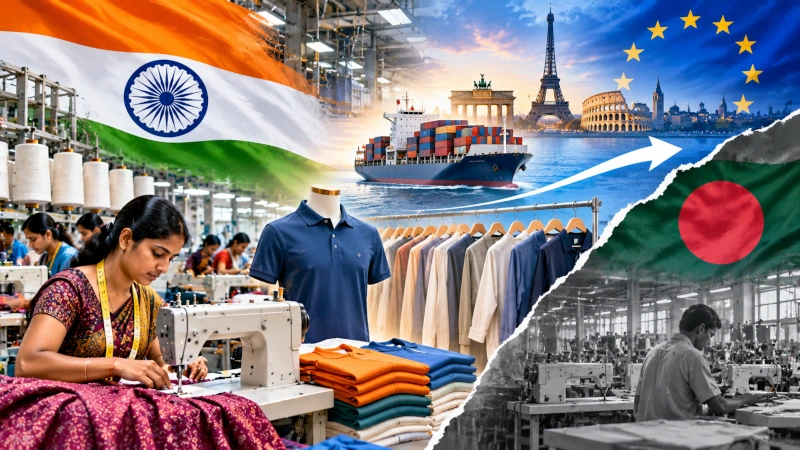
For more than two decades, Bangladesh built its economic transformation around the ready-made garment industry, becoming one of the largest apparel suppliers to European retailers. Competitive labour costs, preferential access to European markets and an extensive export-oriented manufacturing ecosystem enabled Bangladesh to establish a substantial lead over India in finished garment exports. However, changing international trade arrangements, supply-chain diversification and India’s investment in integrated textile manufacturing are beginning to reshape the competitive landscape.
India is pursuing a strategy that extends beyond competing on labour costs. By combining domestic raw material availability, integrated manufacturing, technological modernisation and preferential trade agreements, India is positioning itself to compete across the entire textile value chain. The objective is not simply to capture orders traditionally placed with Bangladeshi manufacturers, but to establish India as a comprehensive and dependable sourcing destination for European apparel companies.
Bangladesh’s Dominance in the European Apparel Market
Bangladesh’s emergence as a global apparel manufacturing centre was supported by its ability to produce large volumes of competitively priced garments for international fashion brands. European retailers established extensive sourcing relationships with Bangladeshi manufacturers, particularly for cotton T-shirts, trousers, denim, knitwear and other mass-market clothing. Preferential market access under the European Union’s Everything But Arms (EBA) arrangement further strengthened Bangladesh’s competitive position.
In 2025, Bangladesh supplied approximately €19.41 billion worth of apparel to the European Union, accounting for 21.57% of the bloc’s external garment imports. India, despite possessing a considerably more diversified textile manufacturing ecosystem, maintained a much smaller share of the European apparel import market. This disparity illustrates how Bangladesh successfully converted its manufacturing specialisation and preferential trade access into a substantial export advantage.
Bangladesh’s European Market Share Comes Under Pressure
The first nine months of 2026 witnessed a significant change in European apparel sourcing. Bangladesh’s garment exports to the European Union declined from approximately €15.30 billion during January–September 2025 to €13.48 billion during the corresponding period of 2026. Its market share declined from 21.10% to 19.06%, representing a reduction of approximately €1.82 billion in export earnings.
The decline occurred against a broader contraction in European apparel imports, which fell by 2.46% to €70.72 billion. Bangladesh’s considerably steeper decline indicates that weakening European demand alone does not fully explain its performance. Competitive pricing from alternative suppliers, changing product requirements and domestic manufacturing challenges have also been identified as contributing factors.
China increased its market share from 32.02% to 34.29%, while Vietnam also recorded gains during the period. Indian apparel shipments declined as well, although less sharply than those from Bangladesh. Consequently, the emerging opportunity for India should be understood as a contest for future sourcing allocations rather than an already completed transfer of Bangladesh’s European market share.
India’s Farm-to-Fashion Manufacturing Advantage
India’s principal structural advantage lies in the breadth of its domestic textile ecosystem. Unlike manufacturing economies that depend heavily on imported raw materials or intermediate products, India possesses substantial capabilities across cotton cultivation, spinning, weaving, knitting, synthetic fibre production, dyeing, processing and garment manufacturing. This extensive industrial foundation provides opportunities to integrate multiple stages of production within the domestic economy.
Bangladesh has developed considerable backward integration, particularly in knitwear, but remains dependent on imported cotton and certain categories of yarn, woven fabrics and synthetic materials. India is itself an important supplier of textile inputs to Bangladesh. This relationship illustrates how Indian manufacturing already participates in portions of the value chain that support Bangladesh’s finished apparel exports.
By expanding domestic garment manufacturing alongside existing textile production capabilities, India can retain a greater proportion of the economic value generated across the supply chain. Instead of primarily supplying intermediate textile products, Indian enterprises have an opportunity to increase direct exports of finished garments to European retailers. Achieving this transition will require greater manufacturing scale, competitive production costs and stronger commercial relationships with international buyers.
The India–EU Free Trade Agreement: Changing the Competitive Equation
The conclusion of negotiations for the India–European Union Free Trade Agreement on January 27, 2026, represents one of the most important developments for India’s textile industry. Indian apparel exporters have historically faced European import duties of up to 12% on relevant products, while Bangladesh has benefited from preferential duty-free access under the EBA arrangement. This tariff disparity has significantly influenced sourcing decisions in price-sensitive apparel categories.
Under the negotiated agreement, most European tariffs on Indian textiles and apparel are scheduled for elimination upon its entry into force. The agreement therefore has the potential to remove a longstanding disadvantage faced by Indian exporters and enable them to compete more effectively with preferential suppliers. The European Commission submitted proposals for the agreement’s signature and conclusion in September 2026, although its tariff benefits should not be treated as operational until the necessary procedures are completed.
For European apparel companies managing procurement costs across millions of garments, even relatively small differences in landed costs can influence sourcing allocations. Tariff elimination could allow Indian manufacturers to improve their competitiveness, negotiate more effectively with international buyers and invest additional resources in manufacturing technology and product development. The eventual commercial benefits will depend on exporters satisfying applicable rules of origin and other regulatory requirements.
India’s British Trade Agreement Provides an Earlier Opening
The United Kingdom provides India with a separate opportunity to expand its European commercial presence. The India–UK Comprehensive Economic and Trade Agreement entered into force in July 2026, improving preferential market access for Indian products, including textiles and clothing. Unlike the India–EU agreement, the British agreement has already reached the implementation stage.
According to the Government of India, the United Kingdom imports approximately USD 28.8 billion worth of textiles and clothing, while India supplies around USD 1.79 billion, representing a market share of approximately 6.1%. Improved tariff treatment creates opportunities for Indian manufacturers to strengthen relationships with British fashion retailers and expand their participation in higher-value product categories.
Although the United Kingdom is no longer part of the European Union, it remains an important component of Europe’s apparel sourcing ecosystem. Strengthening commercial engagement with British retailers could help Indian manufacturers develop production scale, regulatory expertise and supply-chain capabilities that are also relevant to continental European markets.
Bangladesh’s Extended Preferential Access
One of the most important recent developments is the postponement of Bangladesh’s graduation from the United Nations’ Least Developed Country category. Bangladesh was originally scheduled to graduate on November 24, 2026, but the United Nations General Assembly approved a three-year extension on October 29, 2026. Its revised graduation date is November 24, 2029.
This extension provides Bangladesh with additional time to address economic vulnerabilities, strengthen industrial competitiveness and prepare for changes in international trade preferences. It also means that India cannot rely on the immediate disappearance of Bangladesh’s preferential market access as a mechanism for gaining European apparel orders. Bangladesh continues to possess an established manufacturing ecosystem and valuable commercial relationships with international fashion companies.
The European Union’s preferential trade framework also provides transitional arrangements for graduating countries, subject to applicable regulations. Bangladesh’s eventual tariff treatment will depend on these arrangements and its eligibility for alternative preferential schemes. India must therefore pursue manufacturing competitiveness independently of assumptions about the withdrawal of Bangladesh’s trade privileges.
PM MITRA Parks and the Creation of Integrated Textile Manufacturing Hubs
India’s PM Mega Integrated Textile Region and Apparel (PM MITRA) Parks programme is designed to address longstanding challenges associated with fragmented manufacturing and industrial infrastructure. The government has approved seven integrated textile parks across Tamil Nadu, Telangana, Gujarat, Karnataka, Madhya Pradesh, Uttar Pradesh and Maharashtra. The scheme has an approved financial outlay of ₹4,445 crore.
By bringing textile processing, garment manufacturing and associated industrial services into integrated manufacturing environments, the programme seeks to reduce logistical inefficiencies and encourage larger production capacities. Common infrastructure and coordinated industrial services could help manufacturers improve production consistency, turnaround times and resource utilisation. These capabilities are particularly important when competing for large international apparel contracts.
In August 2026, the Ministry of Textiles reported investment interest amounting to ₹68,590 crore across the PM MITRA states. These figures represent expressions of investment interest rather than completed industrial investment or operational manufacturing capacity. The eventual success of the programme will depend on infrastructure execution and the establishment of commercially viable manufacturing facilities.
Moving Beyond Cotton Into Man-Made Fibre Apparel
While India possesses substantial cotton textile manufacturing capabilities, the global apparel industry increasingly incorporates polyester, viscose, synthetic blends and specialised performance fabrics. European demand encompasses sportswear, outdoor clothing, activewear, functional garments and products combining natural and synthetic fibres. Developing greater capabilities in these categories is essential for expanding India’s presence beyond traditional cotton apparel.
The Production Linked Incentive Scheme for Textiles, with an approved outlay of ₹10,683 crore, focuses on promoting man-made fibre fabrics, man-made fibre apparel and technical textiles. The programme seeks to encourage larger manufacturing capacities and strengthen India’s competitiveness in product categories where domestic capabilities require further expansion.
Greater diversification into synthetic and blended fabrics could allow Indian companies to address a wider spectrum of European apparel requirements. Bangladesh is also pursuing product diversification, making technological development and manufacturing investment important competitive priorities for both countries. India’s ability to combine natural fibre production with synthetic textile capabilities could become a significant advantage if translated into commercially competitive finished products.
Supply-Chain Diversification and European Sourcing Strategies
International apparel companies are increasingly evaluating the resilience of their sourcing networks alongside conventional production costs. Dependence on a limited number of manufacturing locations can expose retailers to production interruptions, shipping delays and regulatory changes. Diversified sourcing arrangements can help companies manage these risks while maintaining flexibility across different product categories.
India’s manufacturing geography provides opportunities to distribute production across multiple industrial regions. Tiruppur’s knitwear ecosystem, Ludhiana’s hosiery industry, Surat’s synthetic textiles, Bengaluru’s garment manufacturing capabilities and the textile clusters of Gujarat and Tamil Nadu collectively contribute to a diverse production base. This geographical and industrial diversity can support a broader range of procurement requirements.
European buyers are unlikely to abandon established Bangladeshi suppliers solely because alternative manufacturing locations become available. Instead, purchasing strategies may increasingly allocate additional orders across multiple countries according to product specialisation, pricing, reliability and regulatory compliance. India can benefit from this diversification by demonstrating its ability to fulfil large orders consistently and competitively.
Sustainability and Traceability as Competitive Instruments
The European apparel industry is placing greater emphasis on environmental performance, supply-chain transparency and responsible production practices. Manufacturers seeking long-term access to European markets must increasingly demonstrate compliance with evolving requirements relating to product sustainability, chemical management, traceability and environmental impact. These considerations are becoming important components of commercial competitiveness alongside traditional production costs.
India’s integrated textile ecosystem offers opportunities to establish traceability from fibre production through processing and finished garment manufacturing. Investments in renewable energy, water recycling, efficient dyeing technologies and waste management could further strengthen the environmental performance of manufacturing facilities. Digital production records could also help exporters provide European customers with more reliable information about product origins and manufacturing processes.
Bangladesh has itself established internationally recognised environmentally certified garment factories, demonstrating that sustainability is not an exclusive Indian advantage. Indian manufacturers must therefore compete through measurable environmental performance, credible certification and transparent supply-chain management. The ability to combine compliance with competitive pricing could become an important differentiator in European procurement decisions.
The Challenges India Must Overcome
Despite its structural advantages, India’s textile industry continues to face challenges relating to manufacturing fragmentation, workforce productivity, raw material costs, access to finance and consistency of delivery. Bangladesh’s extensive garment manufacturing experience and established relationships with international buyers provide it with significant competitive strengths. The scale of its export-oriented apparel factories cannot be replicated merely through tariff reductions or policy announcements.
India’s own apparel export performance during 2026 demonstrates the importance of addressing these challenges. According to the Confederation of Indian Textile Industry, textile exports increased by 9.05% during April–September 2026, while apparel exports declined by 6.19%. The divergence indicates that growth in textile inputs and related products does not automatically translate into expansion in finished garment exports.
India must consequently strengthen its garment manufacturing capabilities through industrial modernisation, workforce training, product development and greater production efficiency. Expanding access to international markets will provide opportunities, but sustained market-share gains will depend on the ability of domestic manufacturers to deliver products that meet the price, quality and volume requirements of global retailers.
From Textile Supplier to Global Apparel Manufacturing Power
India’s textile strategy can be understood as an effort to capture a greater share of the economic value generated across the international apparel supply chain. Its extensive capabilities in fibre production, textile processing and manufacturing provide a foundation for expanding exports of finished garments. Trade agreements with major international markets and investments in integrated manufacturing infrastructure can strengthen this transition.
Bangladesh’s current challenges create an opportunity for India to compete for additional European sourcing allocations, but the competition extends beyond the two South Asian countries. China, Vietnam, Türkiye and other manufacturing centres continue to possess significant advantages in particular product categories. India must establish its competitiveness against this broader international manufacturing landscape rather than depending exclusively on Bangladesh’s loss of market share.
The strategic objective should be to convert India’s existing textile capabilities into a globally competitive finished apparel industry. Successful implementation of trade agreements, integrated textile parks, manufacturing incentives and sustainable production practices could help India expand its presence in European markets while generating employment and industrial investment at home. India’s textile gambit will ultimately succeed through its ability to offer international buyers a compelling combination of manufacturing scale, product diversity, reliability and competitive value.
References
- European Commission — EU–India Free Trade Agreement, conclusion of negotiations, January 27, 2026; subsequent proposals for signature and conclusion, September 2026.
- Ministry of Commerce and Industry, Government of India — India–EU Free Trade Agreement and opportunities for the Indian textile industry, January 2026.
- Ministry of Textiles, Government of India — Promotion of Textile Exports, July 28, 2026.
- Ministry of Textiles, Government of India — PM MITRA Parks implementation and investment interest, August 11, 2026.
- Ministry of Textiles, Government of India — Production Linked Incentive Scheme for Textiles.
- United Nations — Bangladesh Graduation Status; General Assembly Resolution A/RES/81/8.
- Government of India — India–UK CETA Comes into Effect, July 2026.
- Eurostat — European apparel import data for January–September 2026, as reported by Bangladesh Apparel Voice and Bangladeshi industry publications in November 2026.
- Confederation of Indian Textile Industry — Quick Estimates, September 2026.
You may also like
-
AXISCADES Expands US Aerospace Presence With New Subsidiary
-
Lupin Secures USFDA Approval for Ferric Citrate Tablets
-
GalaxEye Awards Bellatrix Aerospace Propulsion Contract for 30 Satellites
-
Garuda Aerospace Explores Joint Drone Development With Israeli Defence Companies
-
HAL–L&T Consortium Advances India’s Industry-Led PSLV Manufacturing Programme
