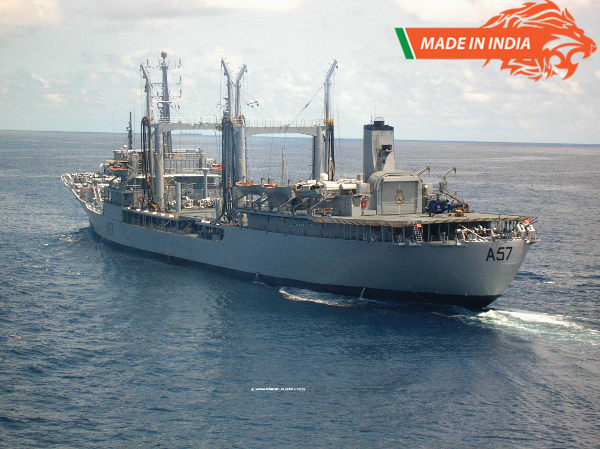
India is preparing a major expansion of its merchant shipping capacity as part of a broader effort to reduce dependence on foreign carriers, lower freight outflows and strengthen control over critical trade routes. At the inaugural Sagar Samvad of the National Shipping Board in New Delhi, the government and maritime industry outlined a roadmap that could support the addition of 100 ships to the Indian fleet over the next five years.
Union Minister for Ports, Shipping and Waterways Sarbananda Sonowal backed a five-point strategy centred on fiscal reform, assured cargo support, competitive financing, regulatory simplification and improved ease of doing business. The proposals are intended to make Indian-flagged vessels more competitive against foreign operators and accelerate the expansion of domestic tonnage.
The issue has significant economic implications. India currently pays close to $75 billion annually in freight charges to foreign shipping companies for transporting commodities and goods that include crude oil, natural gas, coal, fertilisers and other essential cargo. Expanding the Indian-controlled fleet could help retain a larger share of this expenditure within the domestic economy while improving resilience during periods of geopolitical or supply-chain disruption.
Industry representatives at the event said operating an Indian-flagged vessel remains around 16% to 20% more expensive than running a comparable ship under several foreign registries. They attributed the gap to factors such as taxation on ship imports and maintenance services, freight-related taxes, deductions affecting seafarers and the relatively high cost of capital in India.
These structural disadvantages become particularly important under the Right of First Refusal mechanism, where Indian shipowners may still be required to compete with foreign carriers on freight rates despite carrying higher operating costs. The National Shipping Board’s proposed reforms seek to narrow this gap and create conditions in which domestic shipping companies can expand more aggressively.
The government’s maritime ambitions extend well beyond the immediate 100-vessel proposal. India is working toward increasing national port capacity to around 10,000 million tonnes annually by 2047, while Maritime Amrit Kaal Vision 2047 envisages the country emerging among the world’s leading ship-owning nations.
Sonowal said the expansion of domestic shipping must proceed alongside growth in ports, shipbuilding, container manufacturing and logistics. He also highlighted the ₹10,000-crore Container Manufacturing Assistance Scheme, under which global shipping companies are increasingly sourcing containers manufactured in India. Such initiatives are aimed at creating a broader domestic maritime industrial ecosystem rather than focusing solely on vessel ownership.
The inaugural Sagar Samvad was organised by the National Shipping Board, the statutory body advising the government on shipping policy, fleet development, seafarer welfare and maritime-sector growth. The event brought together government officials, shipowners, financiers, maritime professionals and cadets to discuss the implementation of Maritime India Vision 2030 and Maritime Amrit Kaal Vision 2047.
Sonowal also launched the National Shipping Board’s first official website during the programme, while NSB Chairperson Sameer Kumar Khare submitted the board’s annual report for 2025-26 and reports prepared by its subcommittees.
A separate session focused on the future of India’s maritime workforce. Union Minister for Labour and Employment and Youth Affairs and Sports Mansukh Mandaviya said the shipping sector could become a major source of skilled employment for young Indians and strengthen India’s position as a global supplier of maritime professionals.
India already has one of the world’s largest pools of seafarers, but the next phase of expansion will require greater training capacity and new skills suited to areas such as advanced shipbuilding, cruise shipping and modern marine technologies. Mandaviya called for stronger coordination between government, industry and training institutions, while also highlighting the need to improve employment opportunities for women in the maritime sector.
The government is also looking at the maritime workforce from an international employment perspective. Rising global demand for trained seafarers could provide Indian workers with high-quality overseas opportunities while supporting the country’s own fleet and shipbuilding expansion.
Minister of State for Ports, Shipping and Waterways Shantanu Thakur, who chaired the session on augmentation of Indian tonnage, emphasised the strategic dimension of fleet ownership. A larger Indian-controlled merchant fleet would give the country greater control over the movement of critical imports and exports rather than leaving a major share of maritime transport dependent on foreign operators.
The five-pillar roadmap discussed at Sagar Samvad therefore combines economic, industrial and strategic objectives. Fiscal reforms are intended to reduce the cost disadvantage faced by Indian vessels, assured cargo mechanisms could provide shipowners with predictable demand, and access to lower-cost finance could support fleet acquisition. Regulatory simplification and broader ease-of-doing-business reforms would further improve the competitiveness of the sector.
If implemented effectively, the strategy could also generate wider benefits for Indian shipyards, marine equipment suppliers, container manufacturers, logistics companies, maritime training institutes and financial institutions.
The proposed addition of 100 ships is consequently part of a much larger ambition: to build an integrated Indian maritime economy in which domestic companies play a greater role in carrying the country’s trade, manufacturing ships and containers, training seafarers and financing maritime assets.
As India’s trade volumes and port capacity expand, strengthening domestic shipping ownership is emerging as a critical component of the country’s long-term economic and strategic planning. The Sagar Samvad roadmap signals an attempt to ensure that India’s maritime growth is accompanied by a stronger Indian merchant fleet rather than an increasing dependence on foreign shipping capacity.
You may also like
-
India’s Defence Electronics Industry Expands as BEL, Astra Microwave and Private Manufacturers Strengthen Indigenous Supply Chains
-
India’s Private Space Sector Creates New Opportunities for Young Engineers, Helps Reduce Brain Drain
-
IndigoTex Raises ₹5 Crore to Scale Indigenous Advanced Textile Technologies
-
Sunfox Technologies Raises $7 Million to Take India-Built Spandan ECG Platform Global
-
DRDO Opens Actuators, Infrared Seeker, Lightweight Torpedo and Armour Technologies to Indian Industry
